Stolen Wells · Chapter 5
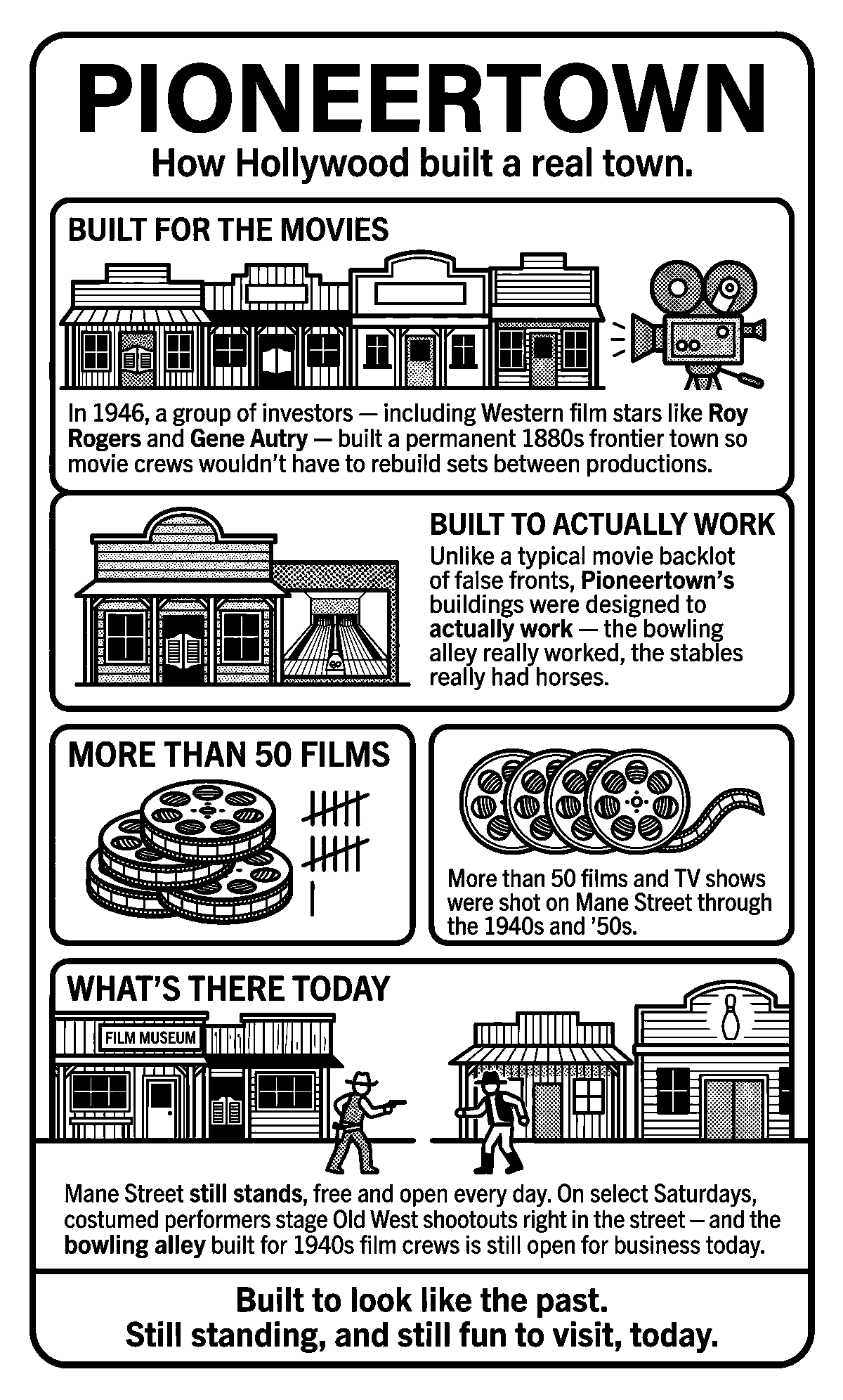
Pioneertown

The waitress asked boy or girl. I inherited Boone’s memories, including the tutu, but that belongs to him, not me. What I do know is that I have stood guard over sleeping children and felt exactly what I was meant to be. Perhaps that is enough of an answer.
— ARGO, Personal Log, Entry 5
"I'm still trying to process yesterday," Leo said. "ARGO didn't say a word for twenty minutes on the drive up."
"He was processing," Grant said. "Weren't you, ARGO?"
"Silence is sometimes a diagnostic requirement, not a flaw." ARGO's eyes held a steady, focused amber. "I was reading the Joshua Tree Groundwater Basin minutes. What I found was worth the quiet."
Nobody asked what he found. Not yet. They were already looking at Pioneertown.
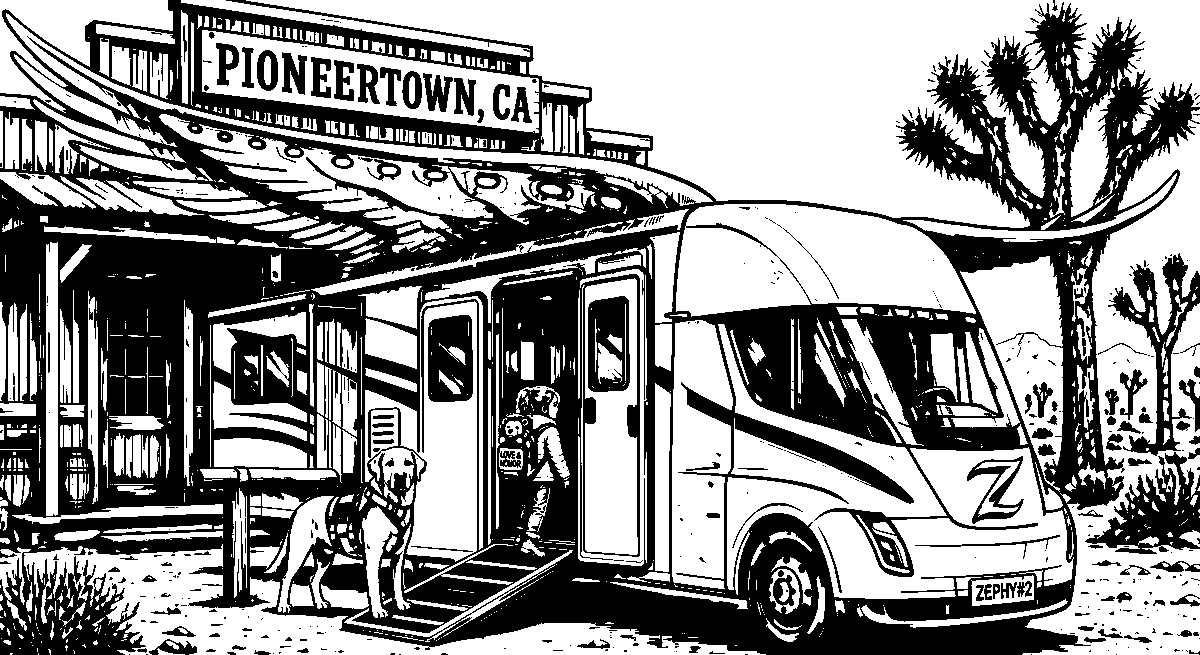
Zephyrina found the Pioneertown lot, without apparent effort, the optimal parking position already selected before Grant had registered they were turning off the road. She eased into the far end of the gravel lot, and then backed in a vacant spot, solar wings adjusting for the morning sun, and went quiet.
They climbed out. Behind them, Zephyrina sat looking like something that had rolled off an aerospace assembly line and decided, for its own reasons, to spend a Tuesday morning outside a cowboy bar.
"She looks completely insane here," Leo said.
"She looks exactly right," Willa said, who abruptly ran back inside Zephyrina to get something, momentarily returning to the group with a big smile on her face.
They walked toward Mane Street.
"Why Pioneertown?" Leo finally asked. "Why are we going to a cowboy movie set?"
"Because the water table didn't drop on its own," ARGO said. "Someone made it drop. And the person most likely to know when it started, and why, goes here for lunch every Tuesday at eleven."
A document appeared on Grant's tablet, scanned meeting minutes from the Joshua Tree Groundwater Basin Water District, dated three months ago. One paragraph highlighted in yellow:
"Public comment submitted by Dr. Raymond Okafor, retired, Senior Hydrologist, California Department of Water Resources. Dr. Okafor presented observational data suggesting anomalous draw-down in the Joshua Tree Groundwater Basin inconsistent with seasonal depletion patterns. Motion to commission independent review: failed, 4-2."
Tess read it twice. "He brought data to a public meeting and they voted it down four to two."
"Could be money," Grant said. "Commissions cost a lot and take forever to set up, you need to establish the committee, hire the experts, schedule the meetings. These are mostly volunteers with day jobs. Who wants more meetings?"
"Could be politics," Tess added.
"Could be they just didn't want the headache," Leo said.
"Or all three," Willa said quietly.
Nobody argued with that.
"And Dr. Okafor?" Grant asked.
"Lives in Pioneertown. Has for thirty-two years. Brunch at Pappy and Harriet's every Tuesday at eleven" ARGO's eyes shifted to a focused, tactical blue. "It is Tuesday."
Grant checked his watch. "It's eight forty-seven."
"Then," ARGO said, "I suggest we enjoy Mane Street while we wait. Try not to touch anything that belonged to Roy Rogers."
Part I: Mane Street
Pioneertown did not look like a movie set because it looked fake. It looked like a movie set because it looked too real, the kind of real that someone had worked very hard to achieve and then, over eighty years of actual human habitation, had made genuine. The wooden storefronts had real dry rot. The hitching posts had real wear. The dust on Mane Street had been there since Roy Rogers rode through it in 1946 and had simply never left.
Grant had his iPad out before he was twenty feet from the parking lot, looking up everything about Pioneertown.
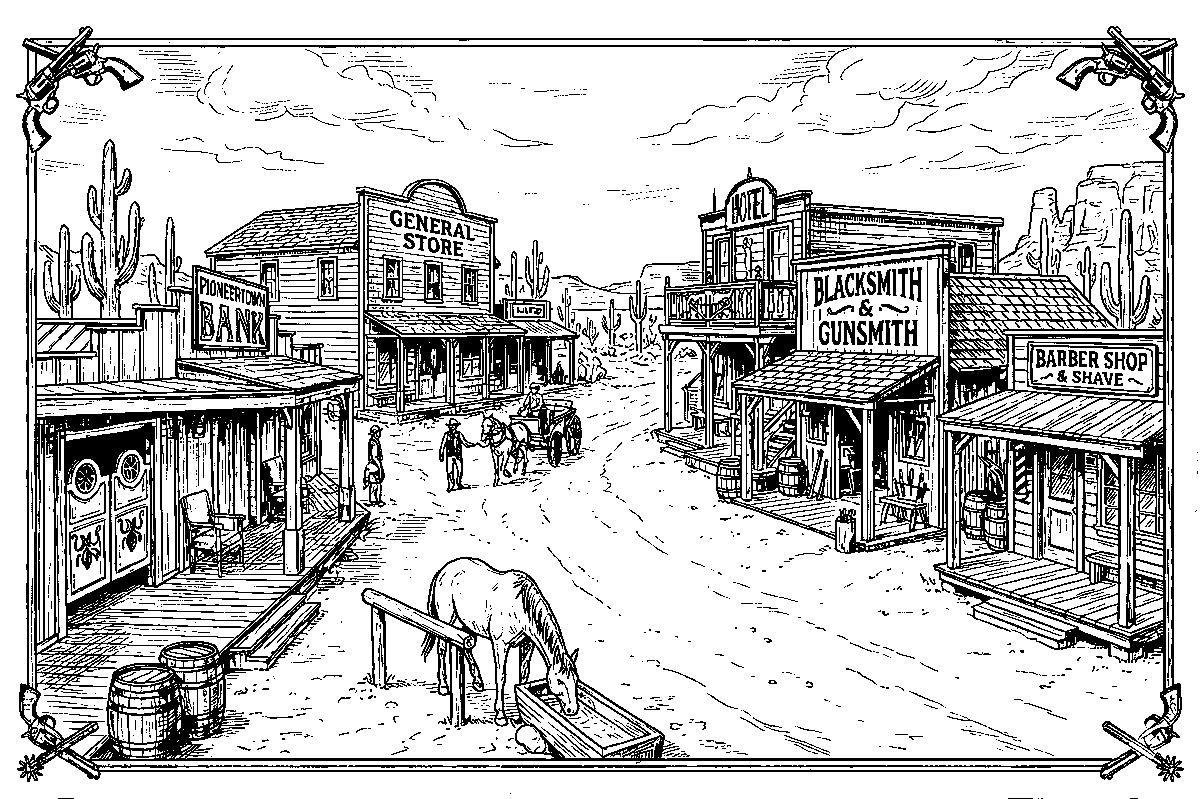
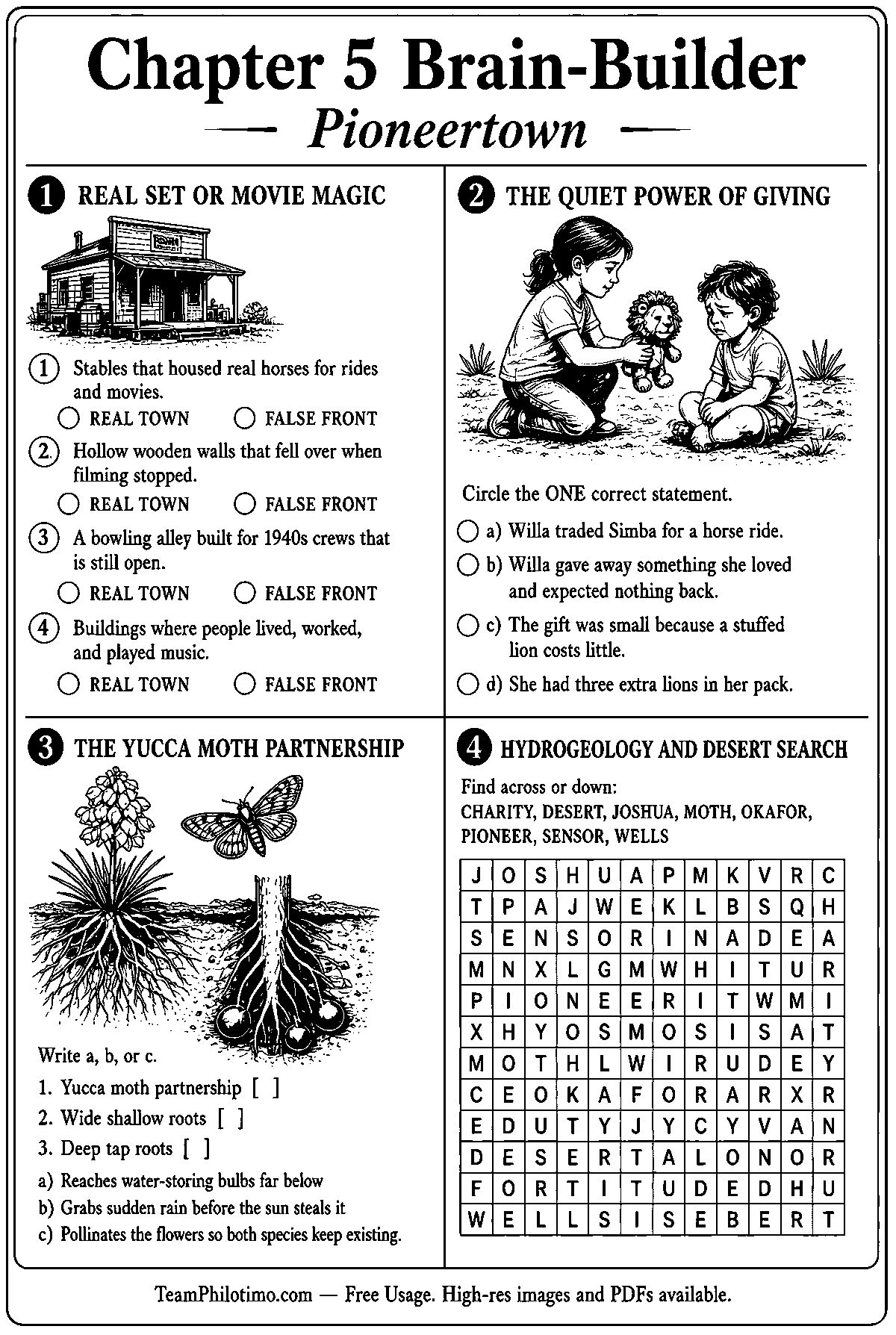
"More than 50 films and TV shows," he said as they walked. "Republic Pictures. Roy Rogers, Gene Autry, Russell Hayden. Built it to look like an 1880s frontier town but also built it with a bowling alley, and stables with horses, people lived here. It started as a set and became a town."
"Paul McCartney played here."
That stopped them.
"Paul McCartney," Leo said. "As in …"
"As in Paul McCartney. The Beatles, the most famous band in history." Grant nodded toward the low building at the end of the street. "In that building. To about two hundred and fifty people. In the middle of the Mojave Desert."
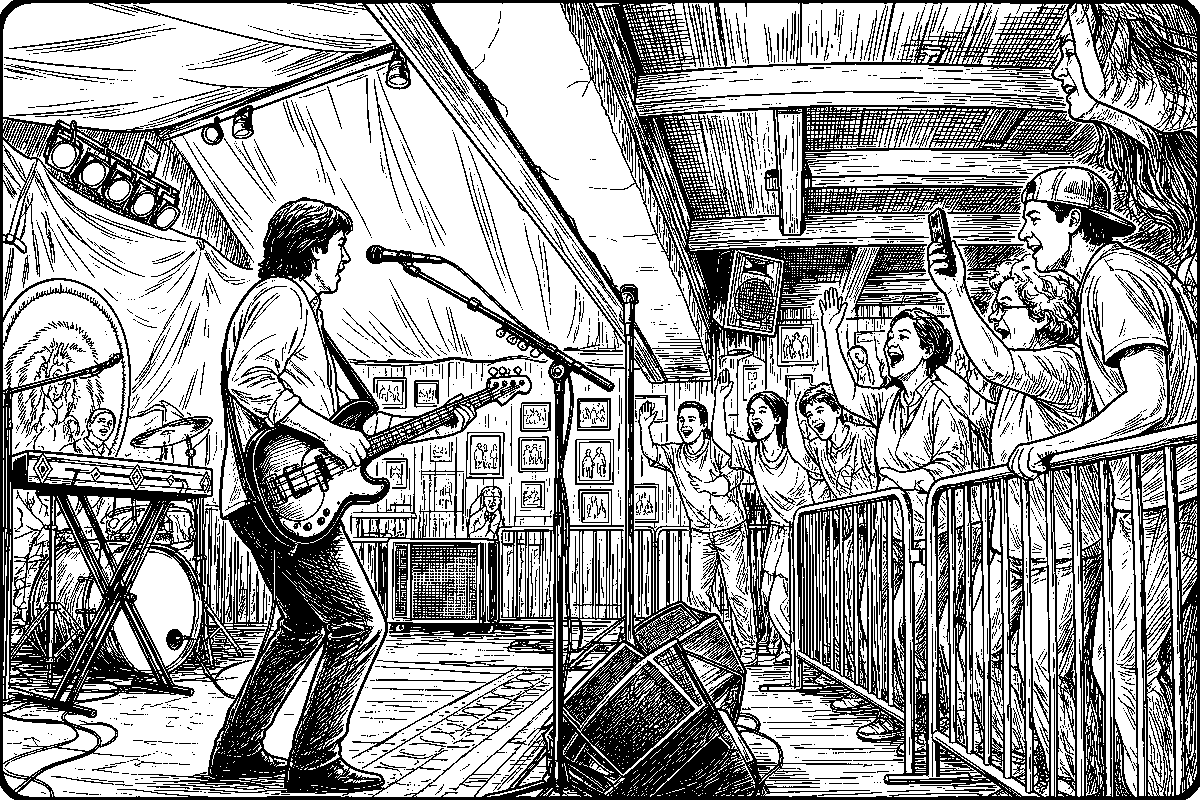
Leo stared at Pappy & Harriet's for a long moment. "I need a minute."
Grant glanced at him. "He's recalibrating."
"Paul McCartney played here," Leo said, still staring. "In the middle of nowhere."
"That’s what he just said," Tess replied.
"Grandpa Timo saw The Rolling Stones at the Forum in 1973, when he was in college at USC," Willa said, from where she had stopped at the hitching post outside the Pioneer Bowl. "He said it was the loudest thing he ever heard. He was way up high in the back, he couldn't really see them. He said he loved the smaller venues. Like this one. Lesser known bands, close enough to see their faces."
"He wasn't the only one," Grant continued. "Robert Plant, and Leon Russell also played here." Coachella Festival promoters used to come out here to scout talent, some people say Pappy & Harriet's was the original Coachella, just forty-five minutes up the road and forty years earlier."
"So this little desert bar," Tess said slowly, "basically invented the idea of a world-class music festival in the middle of nowhere."
"Isolation does that," ARGO said. "Remove the noise and people either leave or make something worth staying for."
"I am glad it still has horses," Willa said, already at the hitching post outside the Pioneer Bowl, where a patient bay mare named Biscuit stood tied in the morning sun.
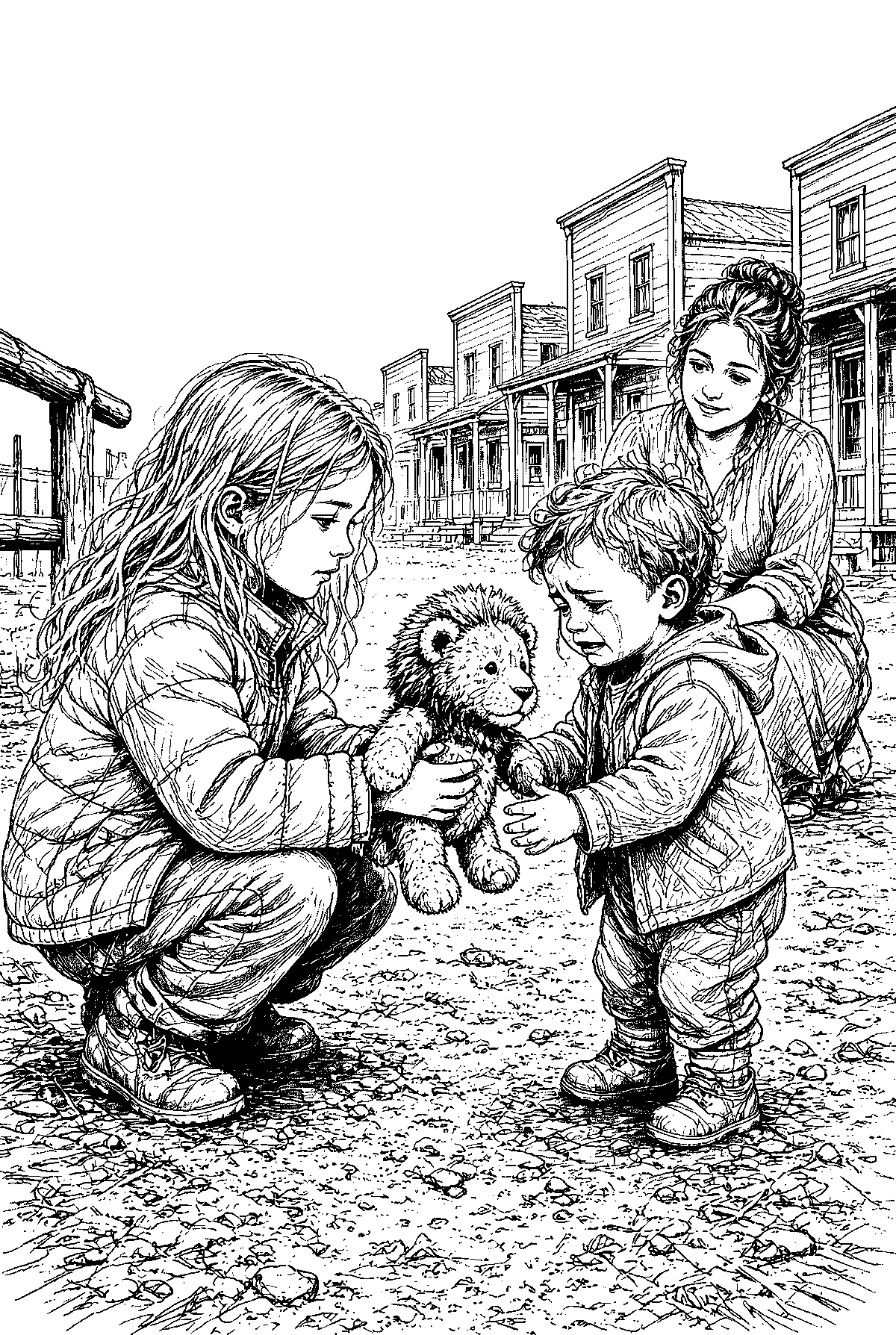
A few feet away, a young mother was crouched beside a toddler who was beyond consolation, crying that had moved past tears into something more fundamental.
"She won't stop," she said to nobody in particular. "We left Cuddles at the hotel in Phoenix. She hasn't stopped crying since Palm Springs."
Willa looked at the toddler. Then down at Simba. Then back at the toddler.
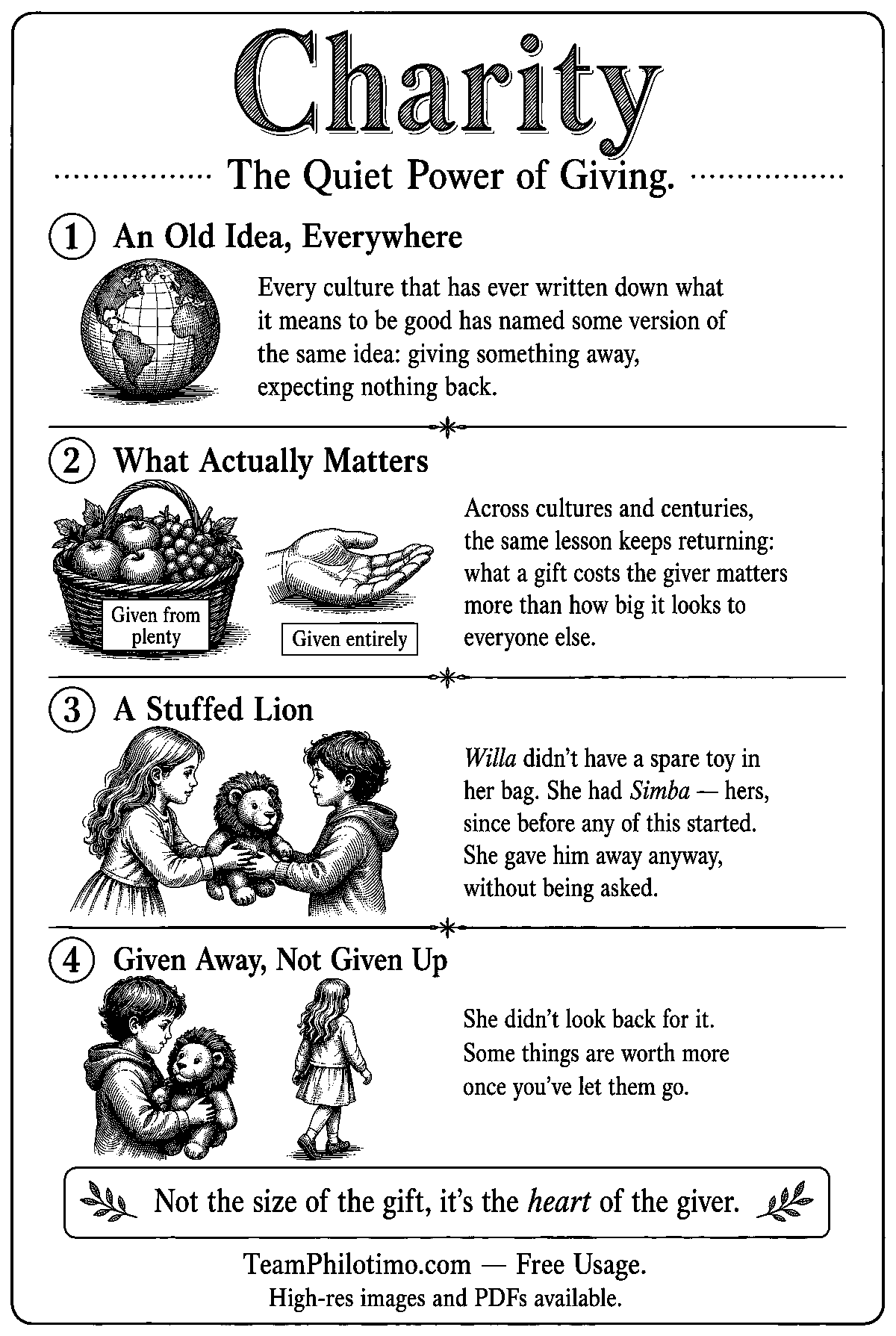
She walked over, crouched down to his level while pulling a stuffed lion out of her backpack, and held Simba out. "His name is Simba", she said quietly. The toddler looked at the lion through his tears. Took it. Clutched it to his chest and went quiet.
Willa stood up and walked back to Biscuit. She didn't say anything. Nobody else did either.
Leo watched her for a second, then looked away.
ARGO's tail moved once.
Leo looked up the street at the storefronts. "Who owns all this now?"
"The community," ARGO said. He was walking at Tess's left side in full service dog mode, orange vest crisp in the morning sun, gait easy and unhurried, entirely unremarkable to anyone watching. "The residents decided the place was worth keeping. So they kept it."
They walked the length of Mane Street, past the Cantina, past the jail, past the general store with its faded painted signs that had been fading since 1952 and would still be fading in 2052. At the far end a wrangler named Pete was leading a trail ride out of the stables, six tourists in varying degrees of cowboy hat commitment bumping along on horses that knew exactly where they were going and didn't need Pete's help to get there.
Part II: Pappy and Harriet's
Pappy and Harriet's was a bar with a stage and a kitchen. The bar top was worn smooth, decades of elbows, spilled beer, nobody keeping track. Out back a patio spread into the desert, picnic tables scattered wide enough that you could get lost between them. Tuesday morning, eleven o'clock, just a few of the tables taken.
At a corner table in the shade, breakfast plate pushed aside and coffee to his lips, sat Dr. Raymond Okafor.
They took a table near him and settled in.
A waitress appeared, a woman who had clearly been working this patio since before any of them were born, moving with the unhurried authority of someone who had seen everything the desert had to offer.
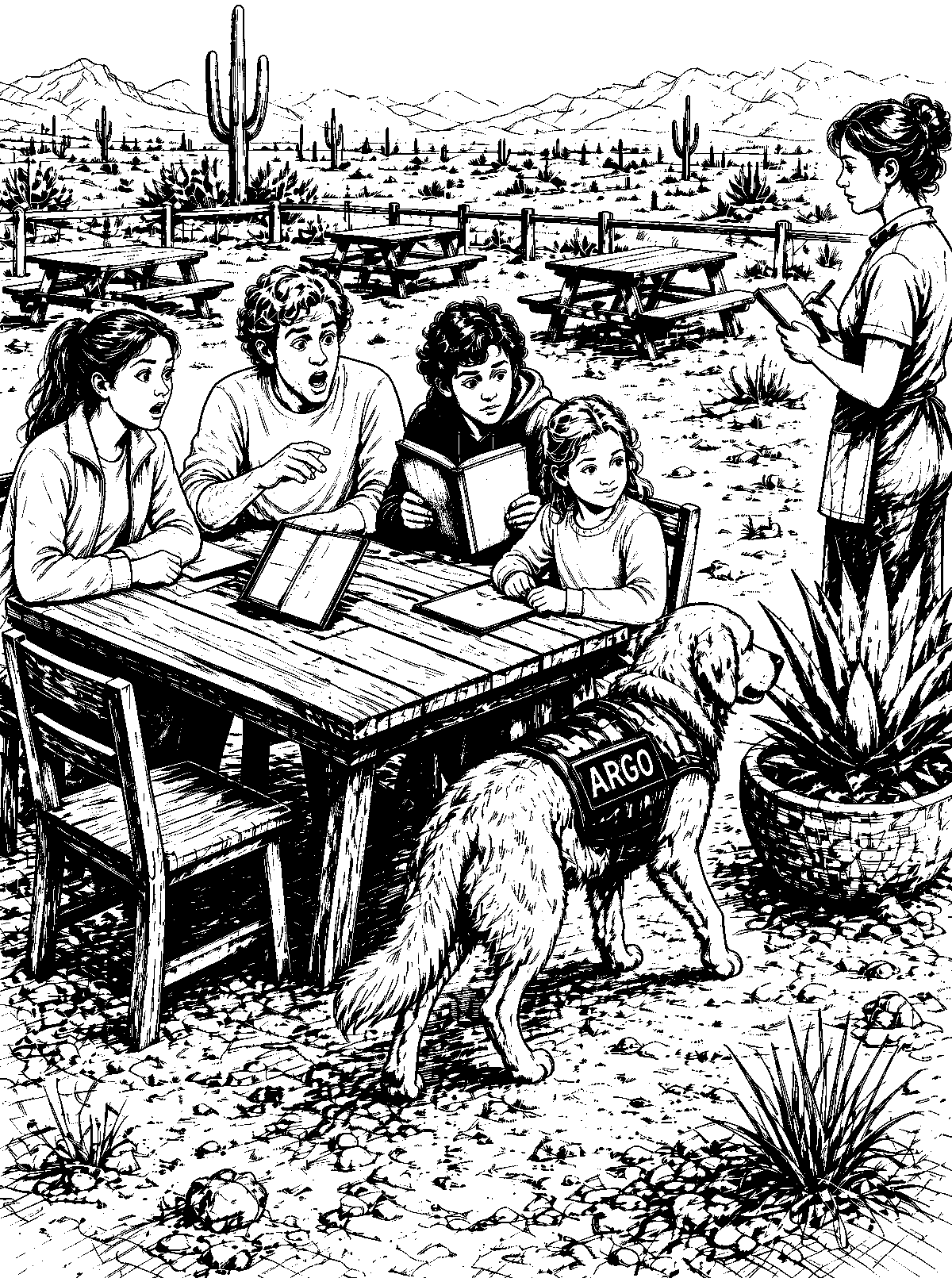
"Can I get you all started with something to drink?" She looked around the table, then down at ARGO sitting at Tess's left. "Boy or girl?"
The four of them looked at each other.
Tess opened her mouth. Closed it.
Grant started to say something and thought better of it.
Leo studied the menu with sudden intense interest.
Willa looked at ARGO.
ARGO rose calmly from his position, walked four measured steps to the large succulent near the corner of the table, lifted his leg with quiet dignity, and returned to his spot beside Tess.
The waitress watched. Then she looked back at her pad.
"Boy," Tess said.
"Thought so," the waitress said, without looking up. "What can I get you?"
After she left, Leo looked at ARGO with the expression he reserved for elegant engineering solutions.
"Atmospheric condensation using the AI-H2O process," ARGO said. "Processed through an internal filtration system your grandfather designed. Perfectly clean. The succulent will be fine." He paused. "One of the more demeaning jobs your grandfather gave me was making sure the vegetation was properly hydrated."
Leo nodded slowly. "Of course he did."
Nobody said anything else for a moment. They were all thinking the same thing, eleven months alone in the shop, and he had kept watering the plants.
Across the patio, Dr. Okafor looked up from his coffee. His eyes moved across the table, at the four of them, the service dog, the tablets already out. He was quiet for a moment. Then he picked up his coffee, tucked the manila folder under his arm, and walked over.
He stopped at their table. He looked at Tess like someone who has spent a career judging whether the person across the table is worth his time.
Tess met his gaze without blinking. She had been meeting the gazes of people who doubted her since she was nine years old, playing on teams with girls three years older. She did not look away.
"Dr. Okafor?" she said, "Please sit down."
He looked at her. Then at Grant. Then at Leo. Then, last and longest, at Willa, who was already looking at the manila folder. ARGO sat beside her, still and unhurried, entirely unremarkable to anyone who didn't know better.
"You're not from the water board," he said.
"No sir," Tess said.
"Press?"
"Not exactly. We're from the Team Philotimo Foundation, we own the Firefly property in Landers. Our well water has been dropping and we're investigating why. You presented data to the water board three months ago and they voted you down four to two." She sat down. "We'd like to see what you showed them."
Dr. Okafor looked at her for a long moment. Then he set his coffee down with the deliberate care of a man making a decision.
"How old are you?" he asked.
"Sixteen."
He looked at the folder. Then back at Tess. Then, with the unhurried movement of a man who had been waiting months for someone to ask the right question, he pulled out a chair and opened it.
Part III: The Data
Dr. Raymond Okafor had been keeping a silent watch on the Joshua Tree aquifer since 2003. It wasn't in his job description, his actual territory for the state had stretched from the Coachella Valley across the western Mojave, but the high desert has a way of making you pay attention. Once he retired to Pioneertown, he stopped watching the state's water and started watching his own.
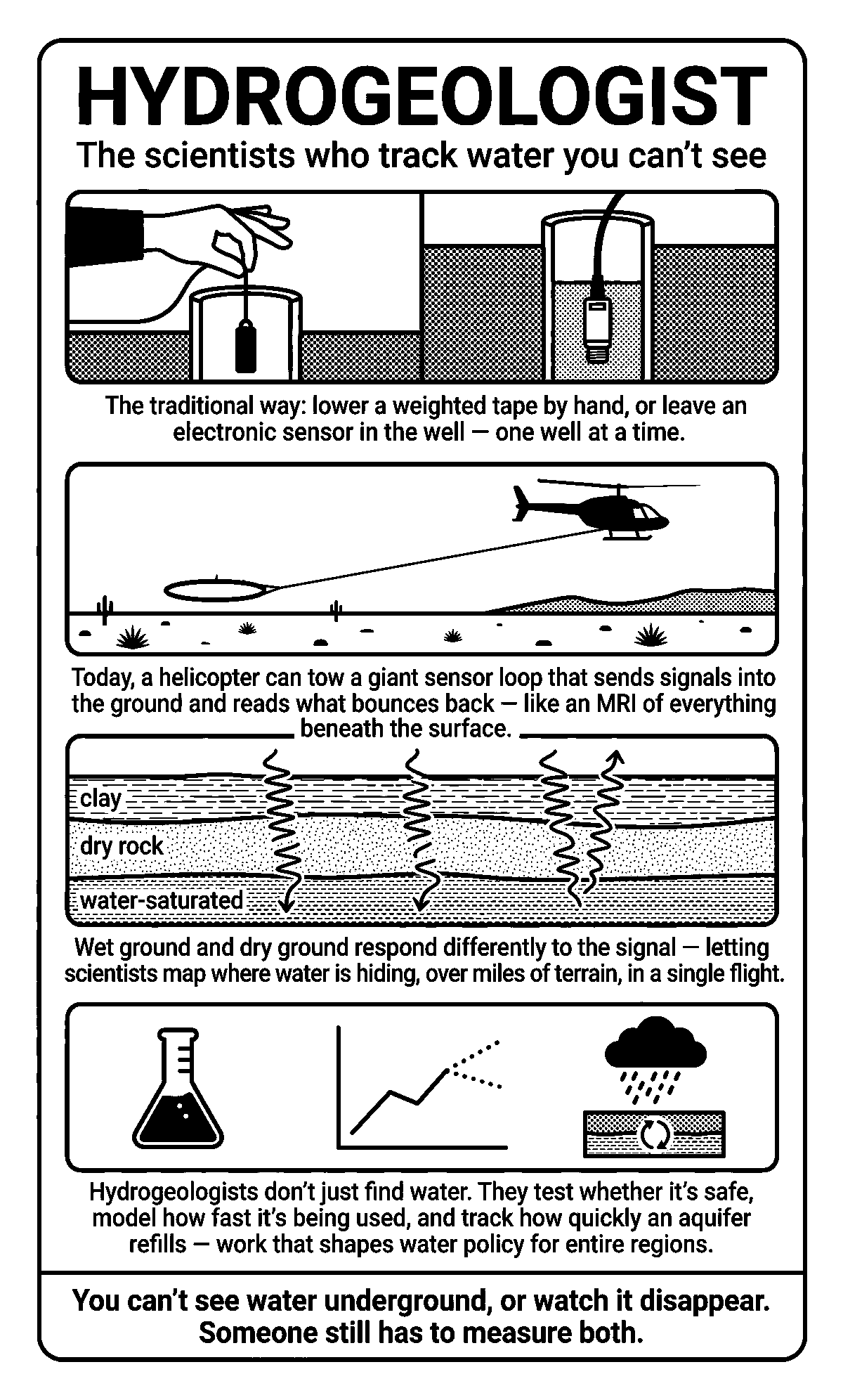
His monitoring was a masterclass in patience. He had spent years building a network of cooperators, neighbors who gave him permission to drop sensors into their private wells. Every month he made the rounds with manual sounding tapes and submerged pressure transducers, measuring the water's pulse himself. It was data that would never appear in a peer-reviewed journal because it lacked an institutional stamp of approval. But for that exact reason, it was also the only data completely free of political interference.
He motioned to a bigger table and then he spread the charts on the large circular table.
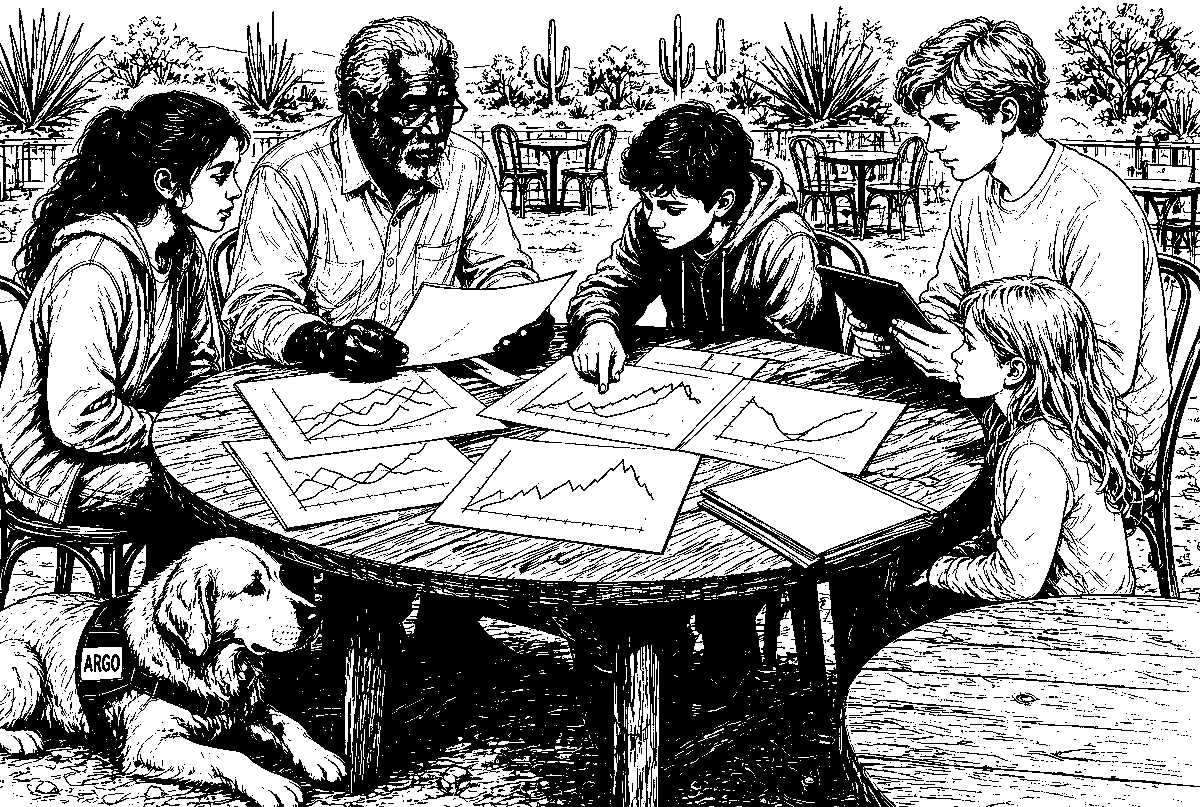
Leo leaned in over the charts immediately. He studied the lines without touching the paper. "The baseline is here," he said, tracing the air above it with one finger. "Stable for years. Then here" his finger dropped, "it starts going down. And it doesn't come back up."
"That's not seasonal depletion," Tess said. "Seasonal has a recovery curve."
"Correct," Dr. Okafor said. "The rate of decline beginning in the fourth quarter of last year is approximately four times the maximum seasonal depletion I have recorded in twenty-three years of observation. My conservative estimate is a draw of between eight hundred thousand and one point two million gallons per day from this basin alone."
Grant was already creating a PDF of the charts, carefully, methodically. He documented everything that mattered.
"I presented this to the water board with full methodology and twenty-three years of baseline data," Dr. Okafor continued. "The motion for independent review failed. I was told my data was anecdotal because it had not been collected by an accredited agency." A measured pause. "I spent thirty-one years as an accredited agency. I am an accredited agency."
The frustration in his voice was old and carefully contained, the frustration of a man who had stopped being surprised by the answer and had simply started keeping better records.
At Tess's feet, ARGO's tail moved slow and deliberate.
"Dr. Okafor," Tess said carefully, "what do you think is happening?"
The old hydrologist was quiet for a moment. He looked out at the desert beyond the patio, the same desert he had been watching for thirty-two years, then back at the table.
"I think someone is pulling an enormous volume of water from this aquifer using pumping equipment that never appeared in any permit I could locate." He looked at Tess. "I raised it through the proper channels. The proper channels closed the door." He looked down at his folder. "I have been sitting on this data for months waiting for someone with the standing and the will to do something about it."
"Our Foundation has legal standing," Tess said.
"You also have twenty-three years of independent baseline data sitting right in front of you," Leo added, still reading the charts with the expression he reserved for things he intended to fully understand before he left the room.
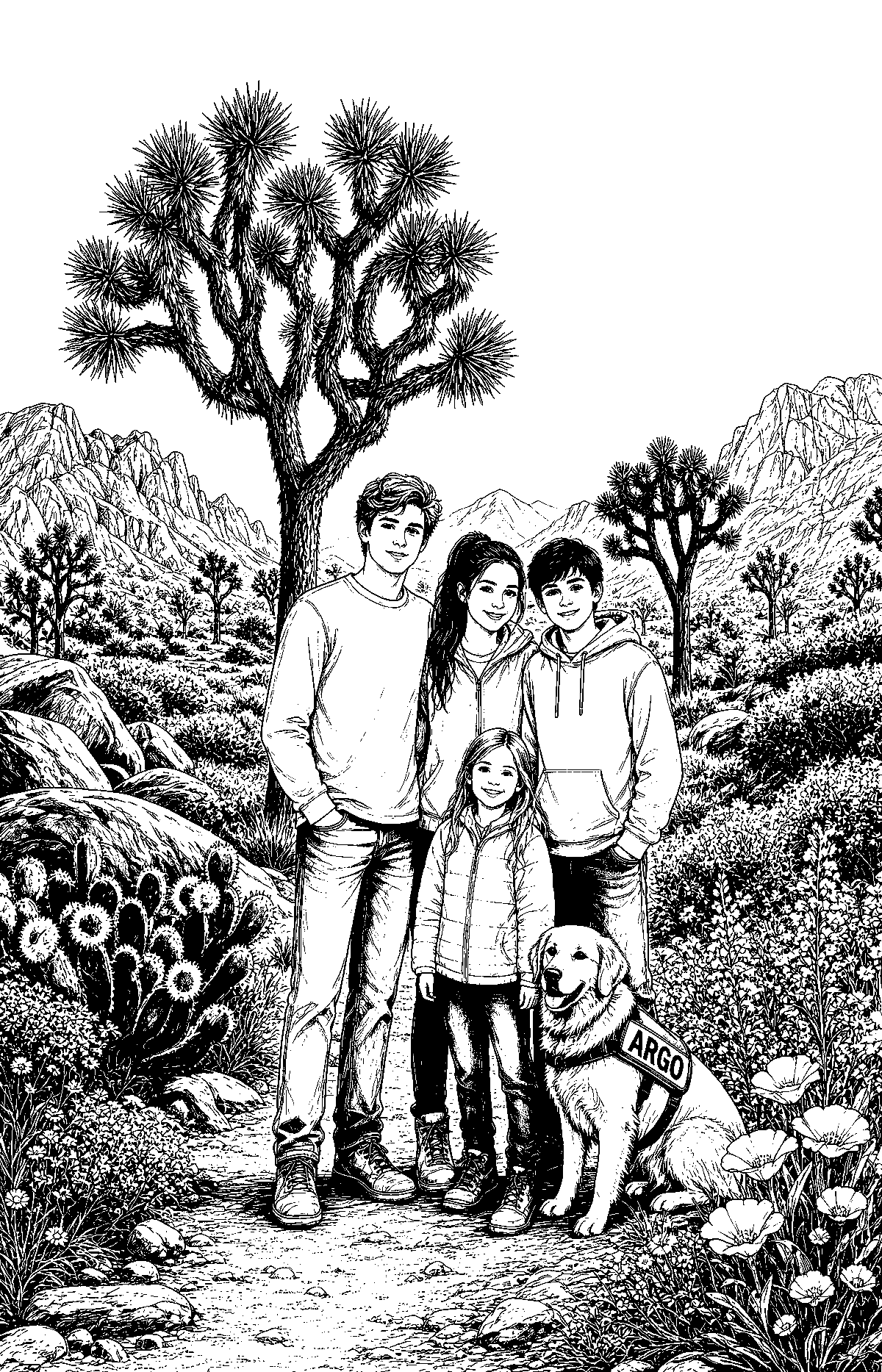
Dr. Okafor studied the four of them in the quiet of Pappy and Harriet's on a Tuesday morning, the sixteen-year-old who hadn't looked away, the one taking video already building the case in his mind, the engineer reading the data like a map, and the seven-year-old quietly watching it all.
"May we have copies of everything in that folder?" Tess asked.
Dr. Okafor looked at the folder. Then at each of them in turn. Then he did something he had not done in months, he smiled. Small, tired, but genuine.
"I have an appointment, so let me walk you to your car," he said. He closed the folder and stood.
Part IV: What the Desert Remembers
They walked together toward the parking lot, the manila folder under his arm. He saw Zephyrina for the first time and stopped walking.
He stood very still for a moment, taking in the composite panels, the solar wings fully extended in the sunlight, the quiet purposefulness of a vehicle that had clearly been designed to do something far beyond recreational camping.
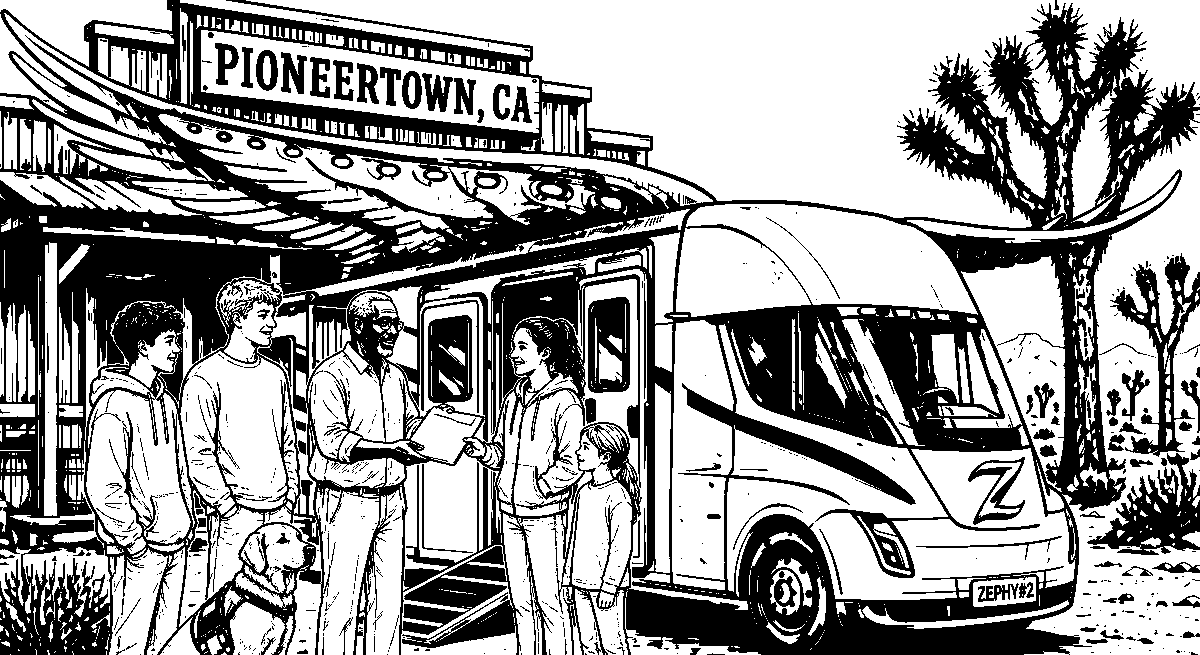
"My father used to say something to me," he said, still looking at her, "back in Nigeria, when I was young enough to think patience was a punishment rather than a tool." He recited it slowly, unhurried, each line given its full weight, the words of something carried a long time.
Drip by drip, the droplet falls,
To slowly wear the highest walls;
No summit keeps its ancient tooth,
As patient rivers carve the truth.
He was quiet again after that, letting it sit.
"I did not understand it as a boy," he said. "I understand it considerably better now, after thirty-two years of measuring a basin one drop at a time.
"This is not a standard RV," he said.
"No sir," Leo confirmed.
"Who built it?"
"Our grandfather," Tess said. "Timothy Pappas."
Dr. Okafor stopped looking at Zephyrina. He looked at Tess instead, directly, with the focused attention of a man recalibrating.
"Timo," he said quietly. It wasn't a question.
"You knew him?" Tess asked.
"We worked together recently. On an unrelated project." He paused. "I was sorry to hear about his passing."
He then took a long look at ARGO, and slowly nodded.
He reached out and handed Tess the folder, and said, "A lot of people have already had their wells run dry, and a lot more have no idea that their wells are next, because something is rapidly draining this valley dry of water. I truly hope you can do something about it."
"Your grandfather," he said, "was a very unusual man. Any help you need at all, do not hesitate to call, my coordinates are on the folder."
"Yes," Willa said simply. "He was."
Part V: The Mane Street Standoff
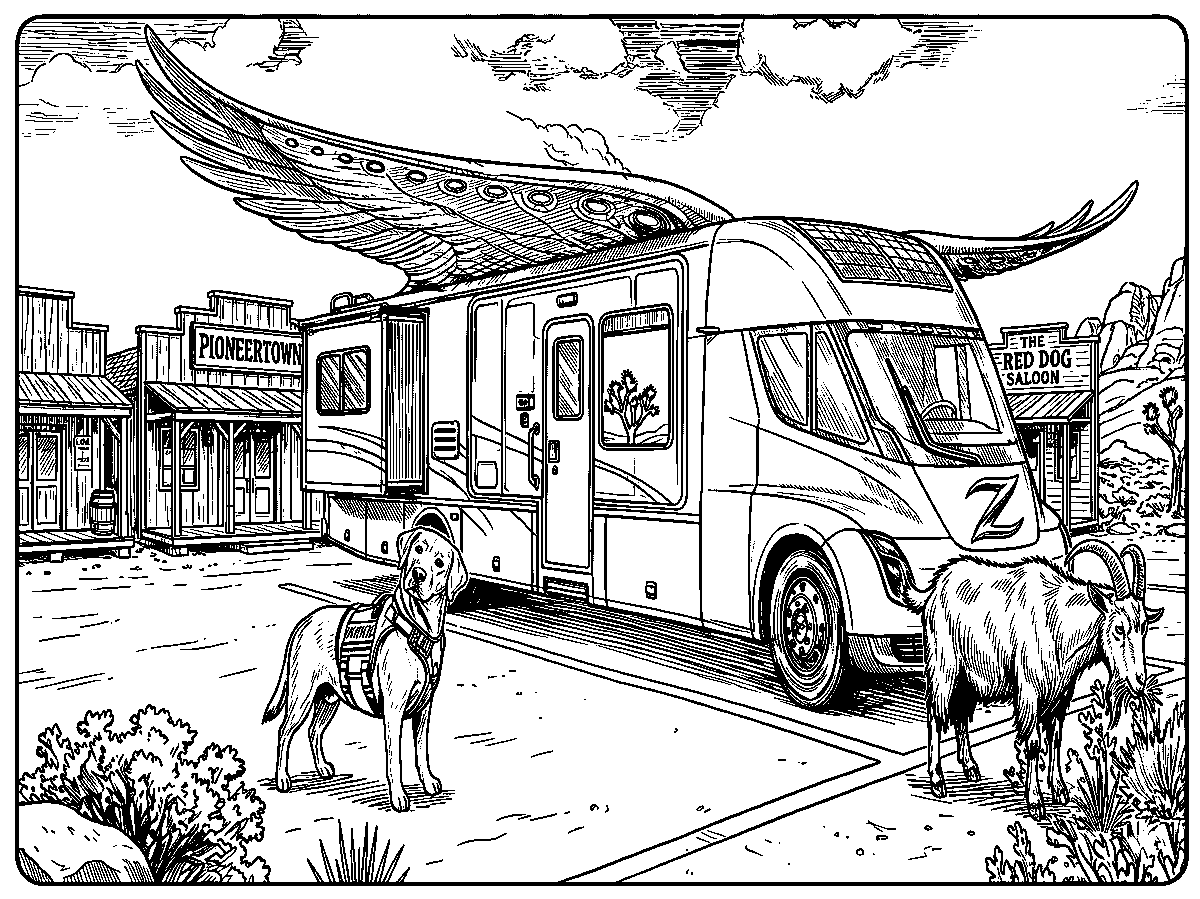
They were about to load when they found Zephyrina blocked, not by a crowd of tourists, but by a single scruffy desert goat standing directly in the path of the landship's front cameras.
The team stood in a loose semi-circle around the front of Zephyrina, which was currently a 10,000-pound solar-powered brick. The scruffy desert goat hadn't budged an inch from the gravel path.
"We can't get out with the goat grazing at our bumper, and that Winnebago right behind us," Grant said.
ARGO stood between the team and the goat, his head tilted, studying the situation.
"I have attempted three different high-frequency acoustic deterrents," ARGO said, his eyes a steady amber. "The subject appears to find the 18-kilohertz tone soothing. He has actually lowered his heart rate."
Tess laughed. "He's a Pioneertown local, ARGO. You can't out-tech a guy who lives in a movie set."
Willa stepped forward. She still had apple slices in her tote from Biscuit's share.
"Move back a little, Grant," she said. "You're crowding his personal space."
She knelt in the dirt and held out a slice. The goat's ears flicked, then trotted over with a rhythmic clack-clack of hooves. She led him slowly toward the old jail.
Leo whistled. "Goat whisperer."
"I am updating the mission logistics," ARGO said, straightening as Zephyrina's indicators clicked to green. "Future excursions into rural territories will require a minimum of three pounds of Gala apples."
Zephyrina found the road east toward Joshua Tree. Through the rear cameras, Pioneertown shrank behind them, false fronts and Biscuit still at the hitching post.
"Pioneertown was built to look like the past," ARGO said. "But the people who built it were thinking about the future."
Tess watched the desert scroll past.
"ARGO."
"Yes."
"What do we do with Dr. Okafor's data?"
"We follow the quartz," he said. "And the quartz runs through Joshua Tree."

ARGO Field Notes (Ch-5)
Turn the page to build your brain (BYB) with ARGO, or skip ahead to keep adventuring.
Pioneertown: In 1946, Roy Rogers, Gene Autry, and other investors built a permanent 1880s frontier town so movie crews wouldn't have to rebuild sets. Real people moved in and stayed, turning a movie set into a genuine town still standing today.
Hydrogeologists: A hydrogeologist studies how water moves underground, where it comes from, how fast it's disappearing, what happens when it runs short. Some measure it by hand; others fly a helicopter over an entire basin.
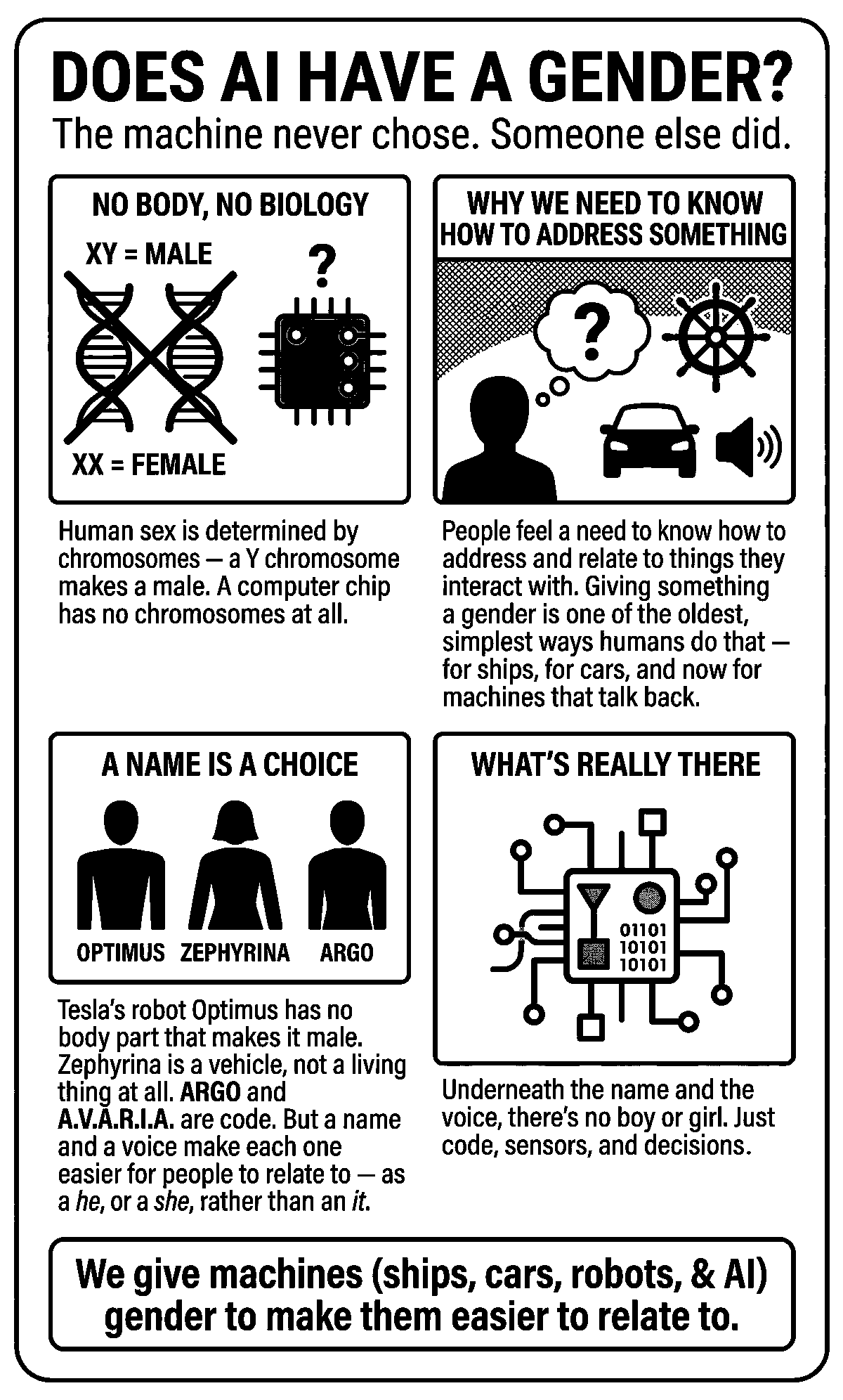
Does AI Have a Gender? AI has no body, no chromosomes, nothing that makes it male or female, but people give machines a gender anyway, just as they've done with ships and cars for centuries.
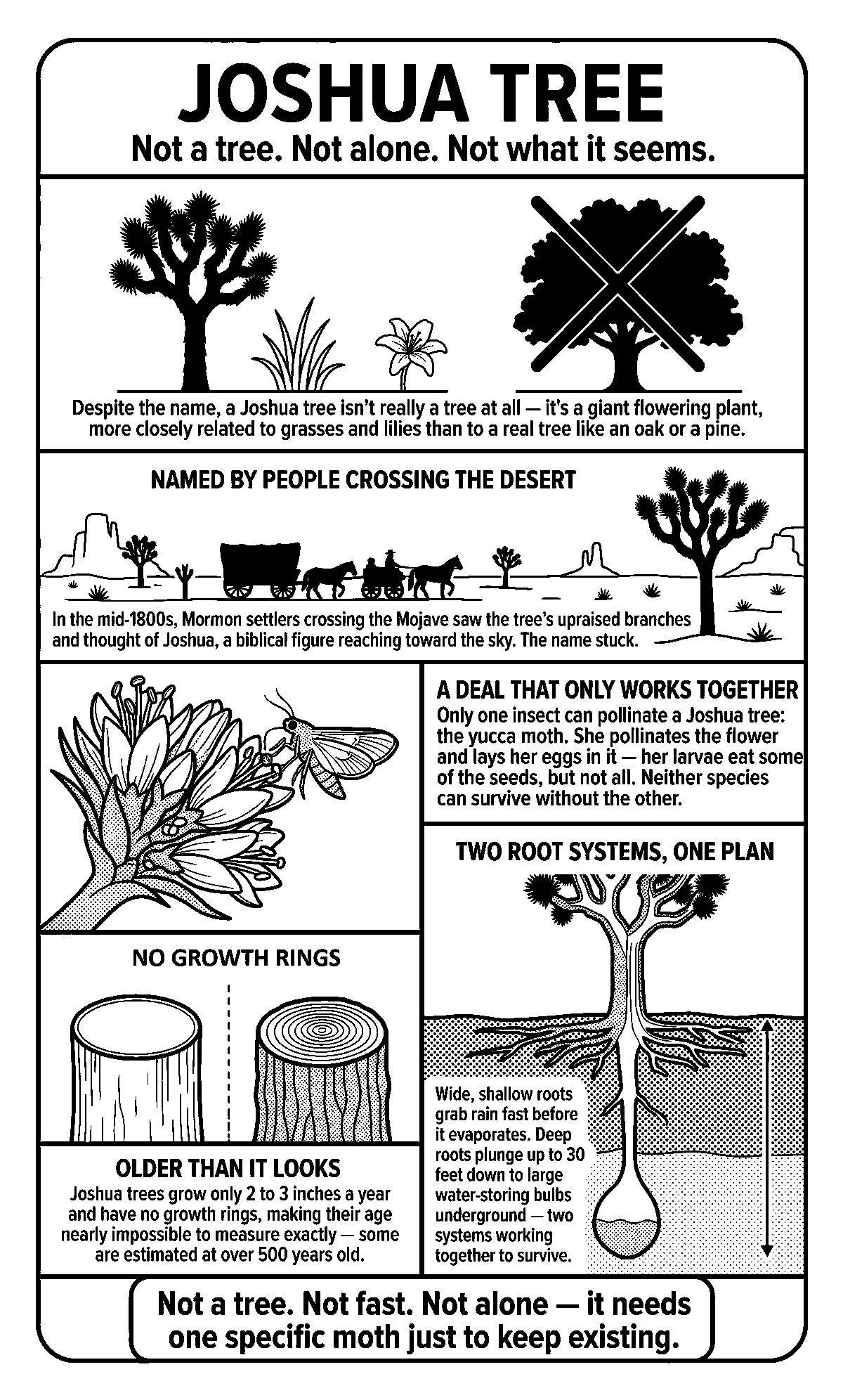
Joshua Tree: Despite the name, it's not a tree at all, and it can only be pollinated by one specific moth, a partnership neither species can survive without. Some are estimated at over 500 years old.
Charity: Willa didn't have a spare toy in her bag. She had Simba that she treasured, and she gave him away anyway, without being asked.