Stolen Wells · Chapter 4
Tortoise Station
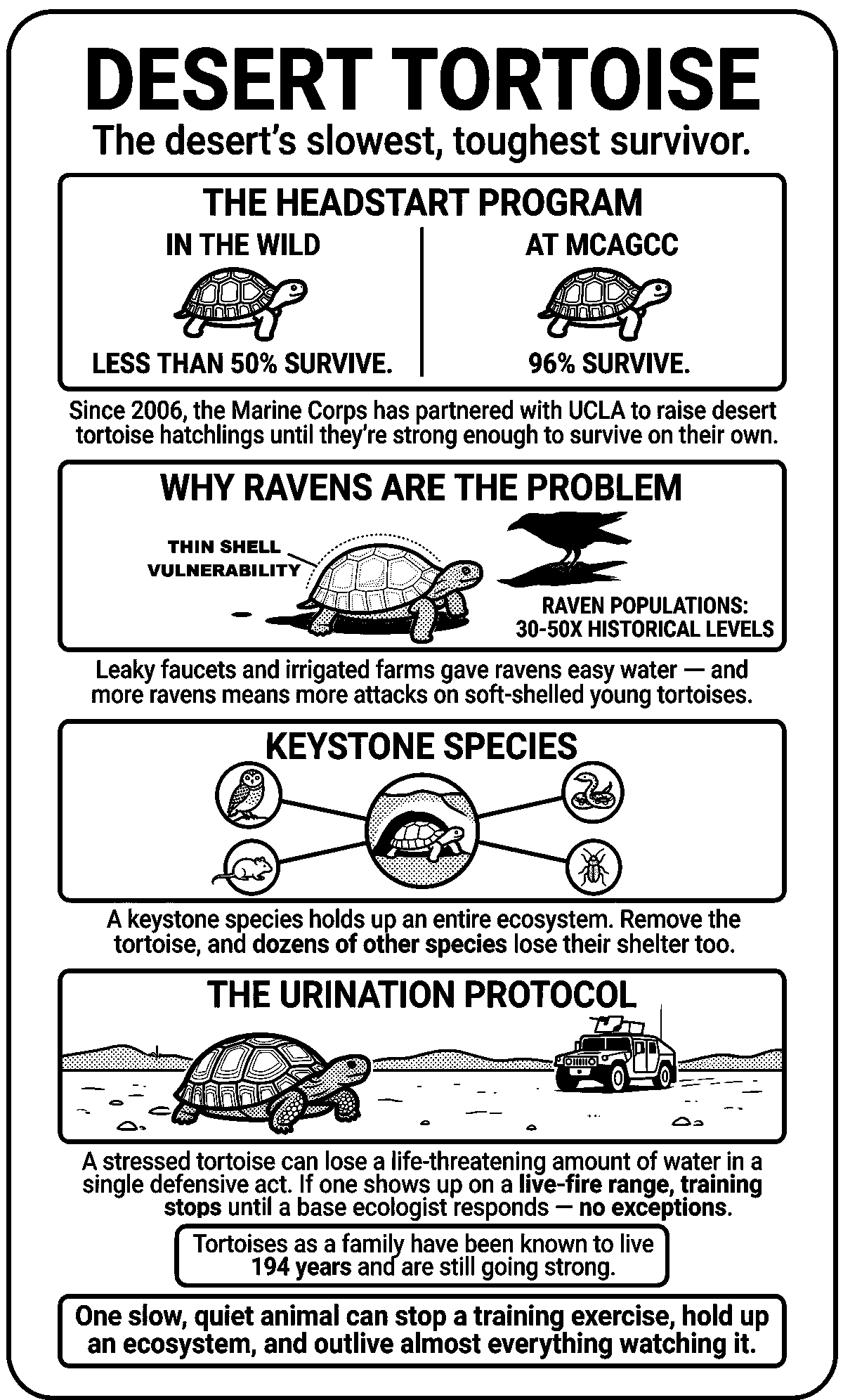
The military ecologists call the tortoise a "Keystone species", a single biological anchor that keeps an entire ecosystem from falling apart.
Watching Willa, with her hand against the wire mesh, I think she might be a keystone species, too.
— ARGO, Personal Log, Entry 4
The ride back to Firefly took less than five minutes; Ned and Sara’s ranch sat barely a quarter-mile west, but the sound of the little pigs followed them the whole way.
Nobody said anything about it. They just went straight to the emergency supplies. Four blue five-gallon tanks, filled from the well, loaded onto the rear baskets.
"The well is slow but it’s giving," Leo said, watching the flow meter. “The AI-H2O systems are pulling moisture from the morning air and topping off our reservoir."
He watched the last five-gallon tank fill, the flow steady and clear. "Still coming. We could fill these all day and the reservoir would barely notice." He sealed the lid and handed the tank up to Grant. "The desert gets thirsty. We don’t have to."
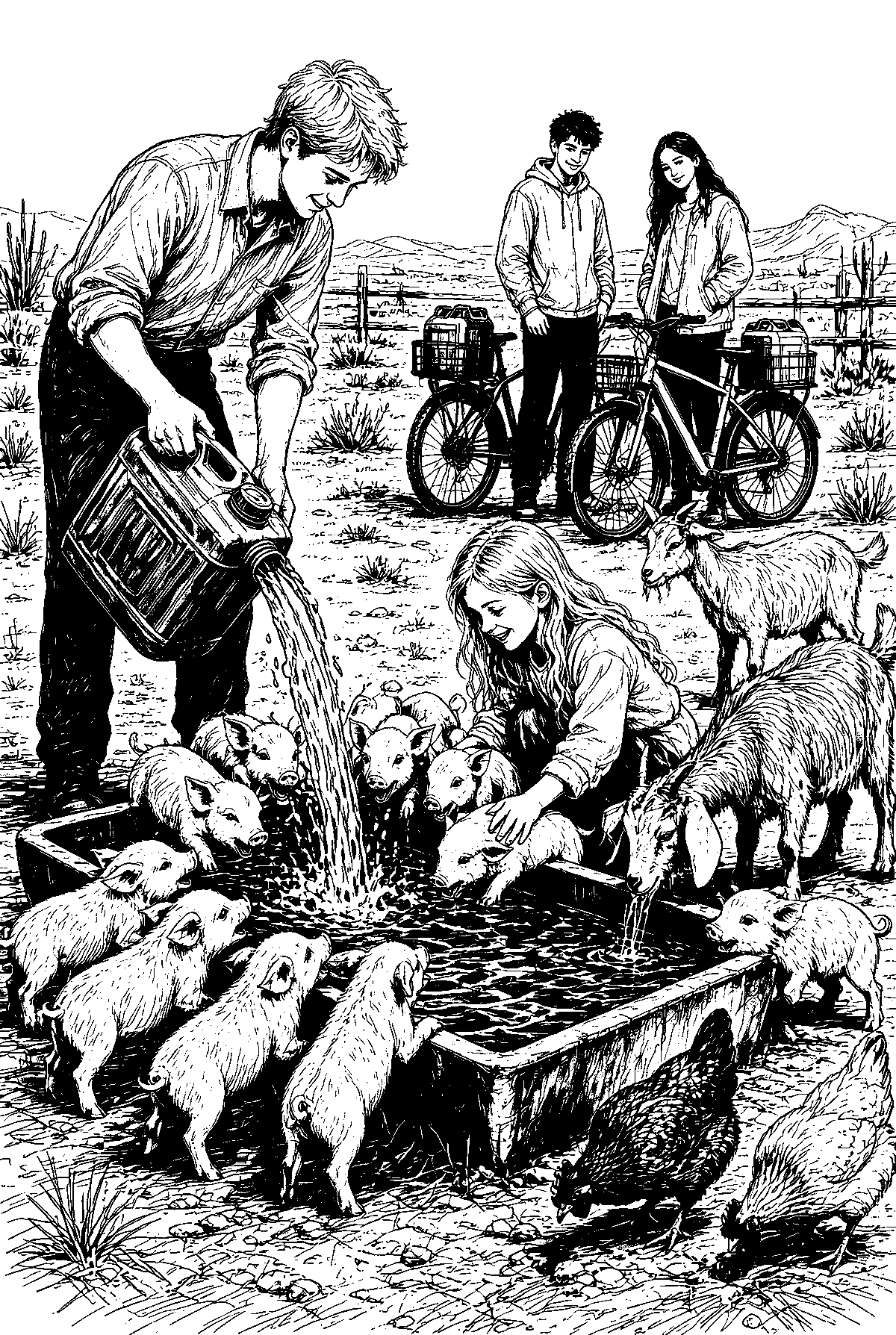
They rode back and delivered all four tanks. When the water hit the dry troughs Ned's animals erupted, goats, chickens, and a dog somewhere in the back, but it was the piglets that stole it, a frantic joyful chorus of tiny squeals that carried all the way to the road.
"We've got more if you need it," Grant said. "Just say the word."
Leo nodded, looking over at the row of five-gallon jugs. "Let's leave two of the containers here right now. That way, when they need more water, they can just come by anytime and grab what they need."
It was a small thing. It was also exactly the right thing.
"'Round 'em up, head 'em out,' as Grandfather Timo used to say," ARGO murmured as they secured the empty tanks. "We have an appointment with Major Cobb at the Marine base. If the water table is dropping, the military has the best sensors to tell us why."
"The clock is ticking," Grant said, pulling his e-bike into the shop. "If the wells are this slow in April, August is going to be a graveyard."
They moved with the efficiency of a practiced crew. Leo and Grant folded the bikes down and secured them in Zephyrina's rear bay, plugging the charging cables into each battery pack. Tess and Willa stocked the galley with fresh food and drinks from the house.
Above them, Zephyrina's solar wings drew closed, each flexible membrane sliding beneath the last along the aluminum skeleton, the way a hawk folds a hundred feathers into one smooth line, shoulder, elbow, wrist, until the wings lay flat against the roofline, and all that remained was a sleek silhouette ready for the road.
"Forty miles to the main gate," ARGO announced from the co-pilot's seat, his eyes a calm, steady blue. "The Marine Corps Air Ground Combat Center, the largest base of its kind in the world, covering over 1,100 square miles of Mojave Desert. To understand the desert's thirst, we must first see how the professionals manage their canteen."
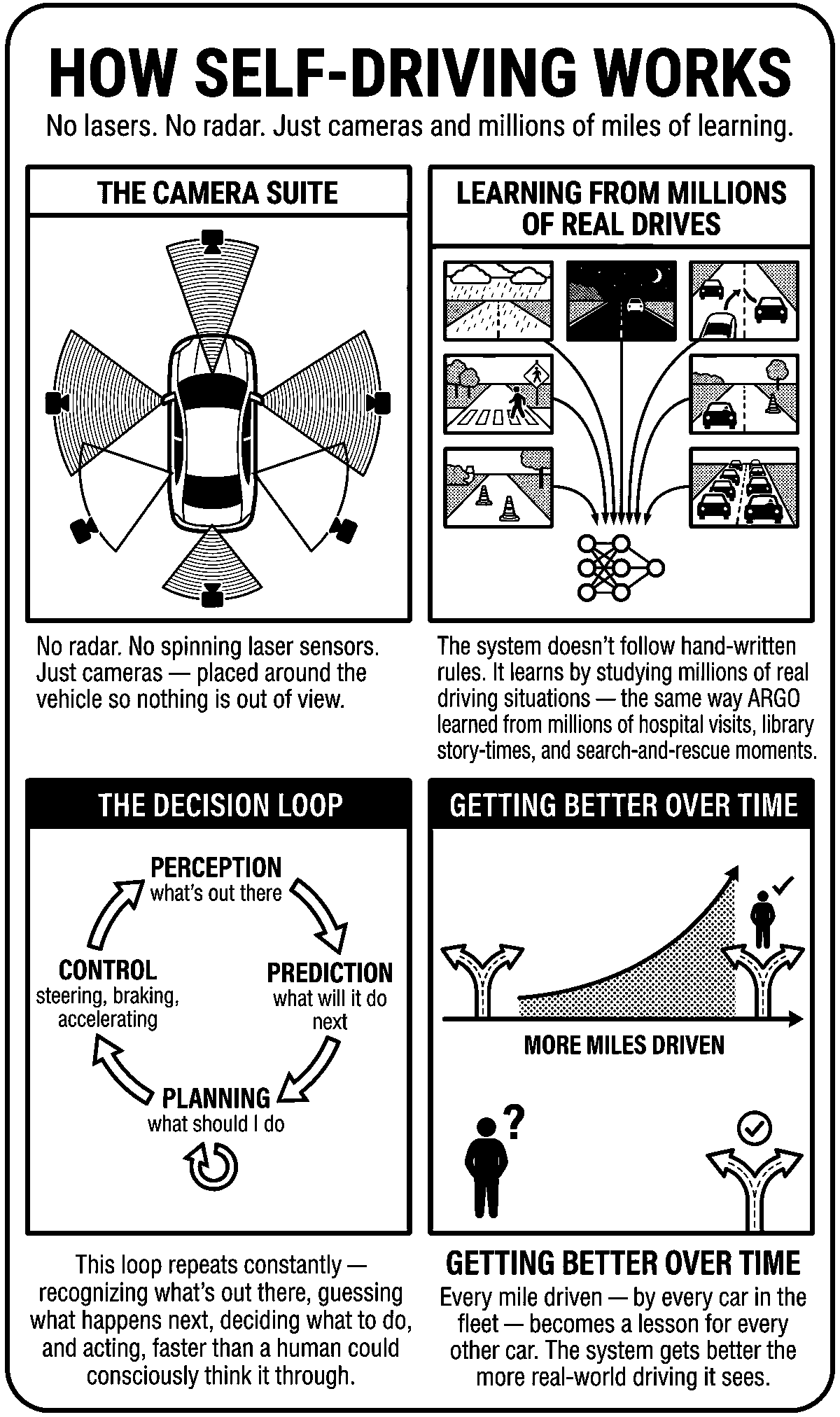
Grant's hands rested lightly on the wheel. Zephyrina hummed and the self-driving system took over.
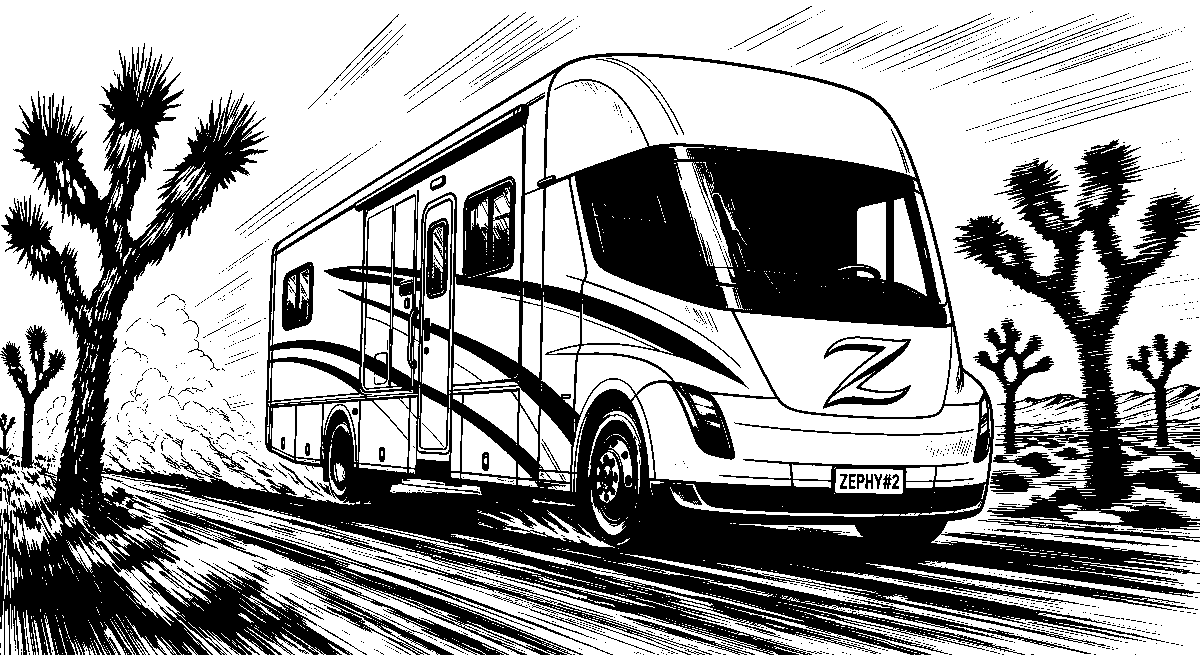
The self driving Zephyrina flew past forty miles of Joshua Trees. A red-tailed hawk rode a thermal above the Twentynine Palms Highway without moving a feather, watching the desert with patience and without hurry.
Nobody talked much. The mission was a mile closer with every minute.
Then the main gate sign and visitor center was there to meet them:

Part II: At the Base
The Marine Corps Air Ground Combat Center (MCAGCC): Twentynine Palms, California
Major Cobb met them at the gate. After firm handshakes and a brief look at ARGO, he offered a quiet welcome to the Combat Center. Then he was already moving, leading them toward a large area covered with cargo netting.
"Water can wait," he said. "Come see this first."
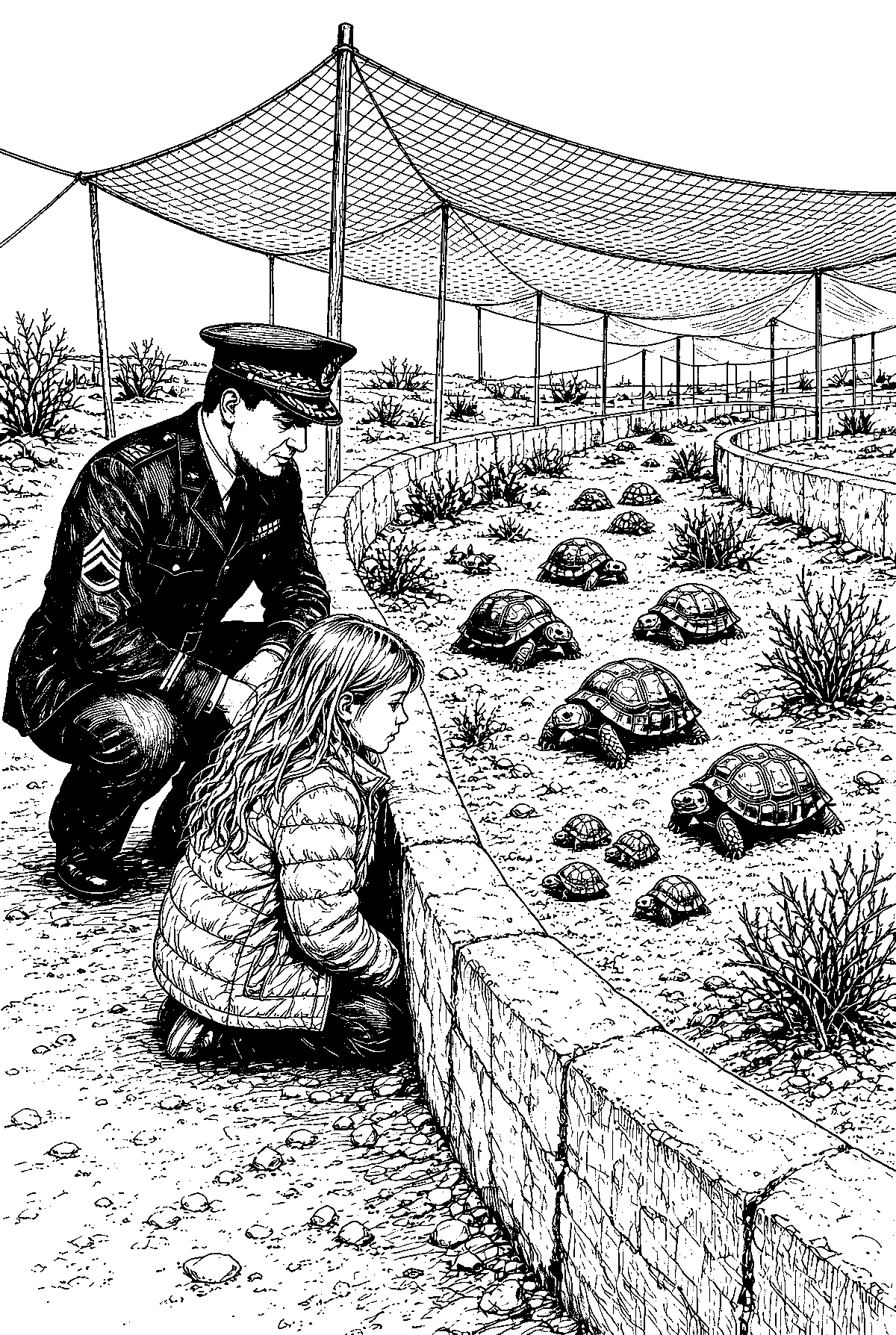
They heard it before they saw anything, a dry, papery rustling under the netting. Then the shapes resolved: dozens of them, moving slow across pale sand.
"Cookies," Willa said. "Round and bumpy ones."
Cobb stopped. "I'm sorry?"
She was already at the enclosure. "That's how big they are. Cookies."
"The little ones, yes." Cobb crouched beside her. "Desert tortoises. We've been raising them here since 2006. Ravens get them when they're small, shells aren't hard yet, so they don't stand a chance. We keep them here, feed them, protect them until they're tough enough. Then we let them go."
"How many?" Leo asked.
"Close to a hundred at a time. And we track them for years after release." He looked at the enclosure. "Some parts of the Mojave, their numbers are down 96% since the 1970s. Keystone species, you lose them, the whole ecosystem starts coming apart."
"What happens if one gets onto the training range?" Grant already had his video gear out.
Cobb looked at him. "We stop."
"Stop what?"
"Everything. Live fire, tank maneuvers, all of it. One tortoise on the range and Marines radio range control before they can touch it. And if it urinates during the move," he paused, "which stress can cause, and which can actually harm them, we call in a base ecologist."
He let that settle.
"The United States Marine Corps halts a live-fire exercise for a tortoise that might pee on a Marine."
Leo looked up from his tablet. "You're serious."
"Son, I have never been more serious about anything in my life."
Willa hadn't moved from the enclosure. She was perfectly still, fingers resting lightly against the ground. One small tortoise had separated from the group and was making its way steadily toward her, unhurried, deliberate, ancient.
"She's coming to me," Willa whispered.
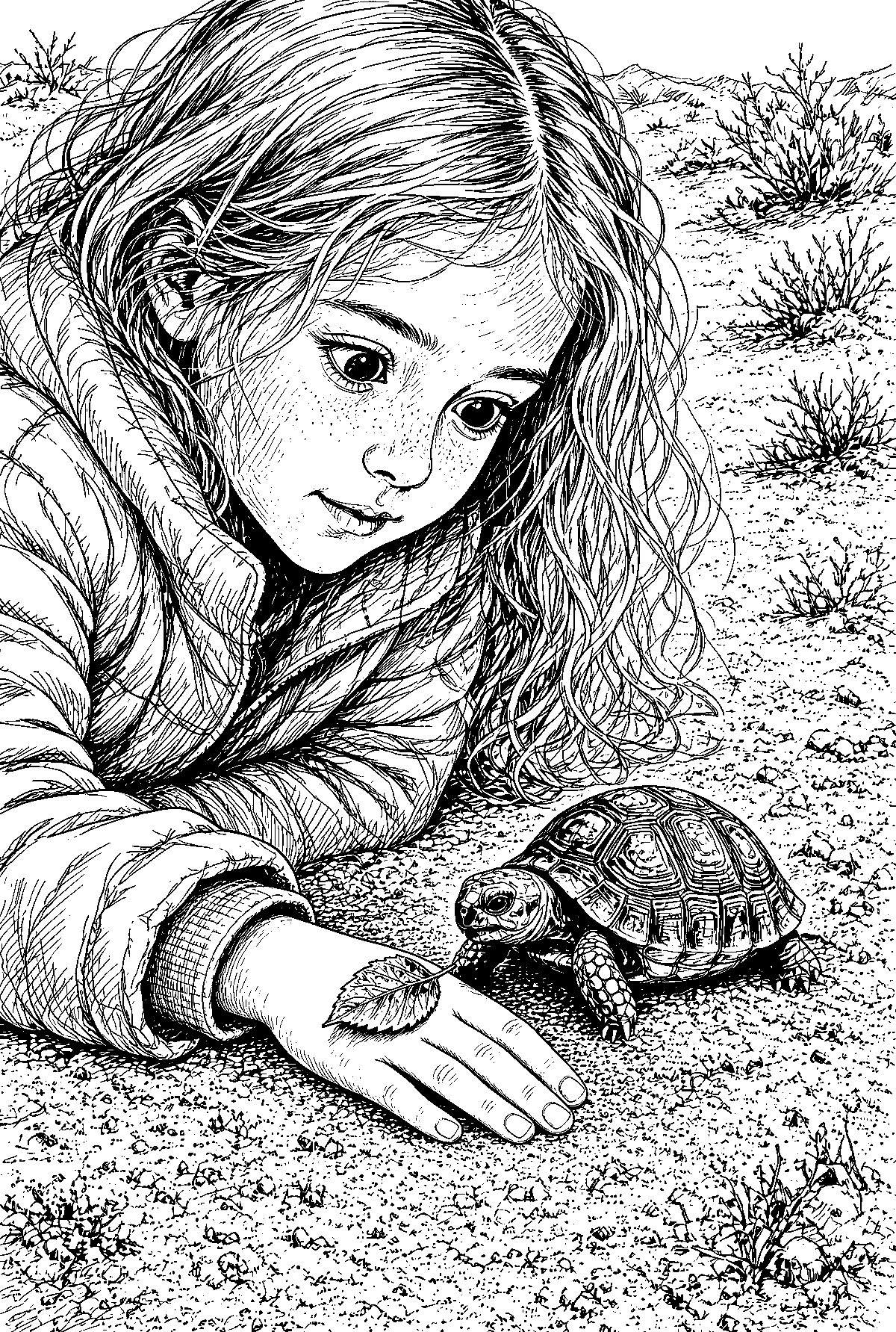
"They're drawn to bright colors sometimes," Cobb said, watching. "Think it's food. But that one," he tilted his head. "I've had that one come to a person maybe twice since she hatched. She's particular."
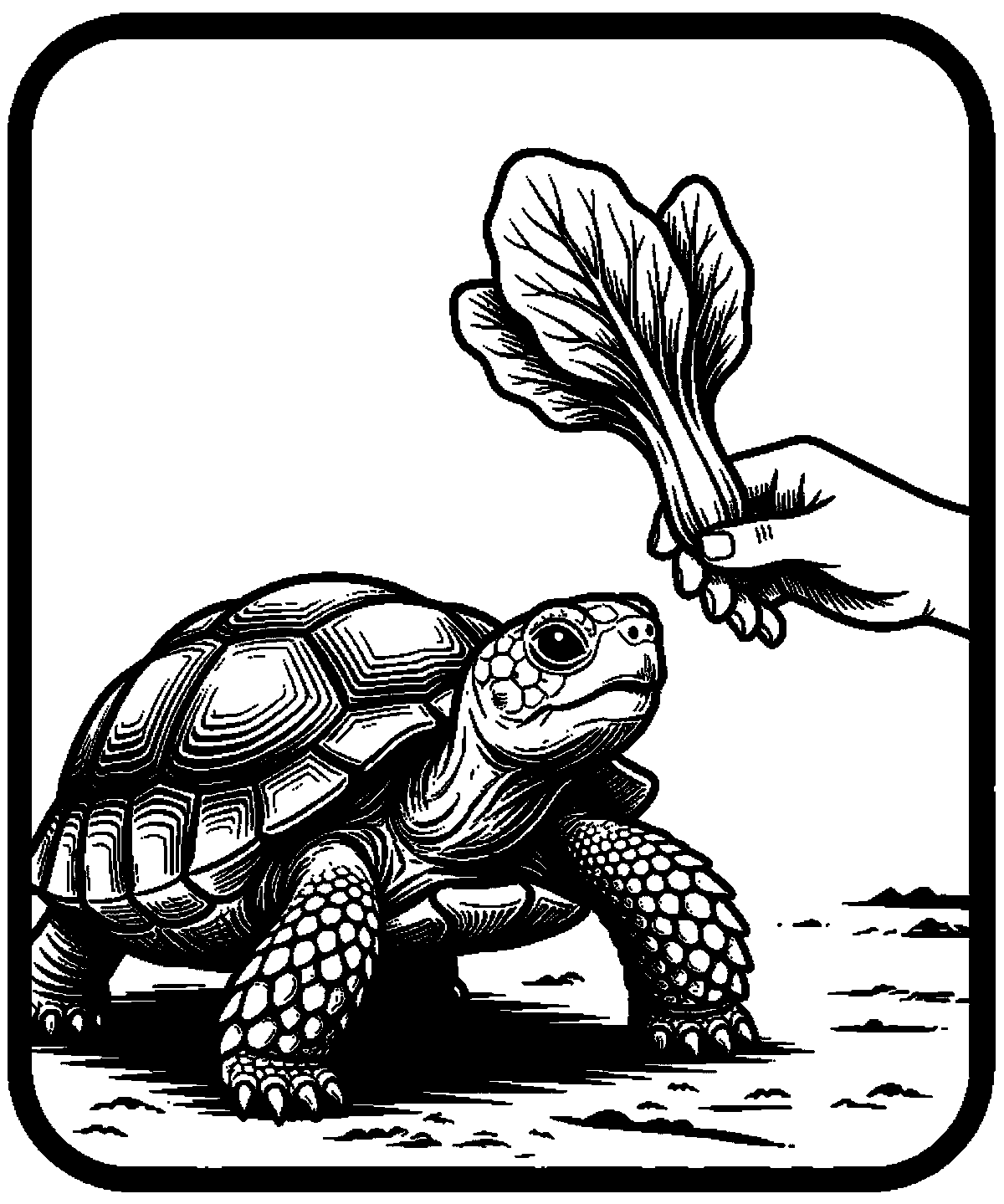
He reached into his jacket pocket and produced a small leaf of bok choy. "Hold this flat on your palm. Don't move."
Willa took the leaf and pressed her hand flat against the ground, perfectly still. The tortoise continued her slow methodical approach, neck extended, one small dark eye reading the world at its own ancient pace. Then, she took the leaf directly from Willa's palm.
Willa made a sound that wasn't quite a word.
"Can I pick her up?" she whispered.
"Not today. But she came to you and she ate from your hand." Cobb stood slowly. "In my experience, that means something."
Leo, watching, muttered, “Of course it came to her." Grant just kept recording.
"Desert tortoises live up to eighty years," ARGO said quietly. "The one looking at you right now, Willa, may still be walking this desert long after we are gone."
The desert hummed around them. Nobody spoke.
"Before we get to the water recycling side," Cobb said, "let me show you where our drinking water comes from."
He pulled up a site map on a mounted display near the facility entrance. Leo leaned in before anyone else.
"The Deadman Aquifer," Leo read, then looked up. "That's the actual name?"
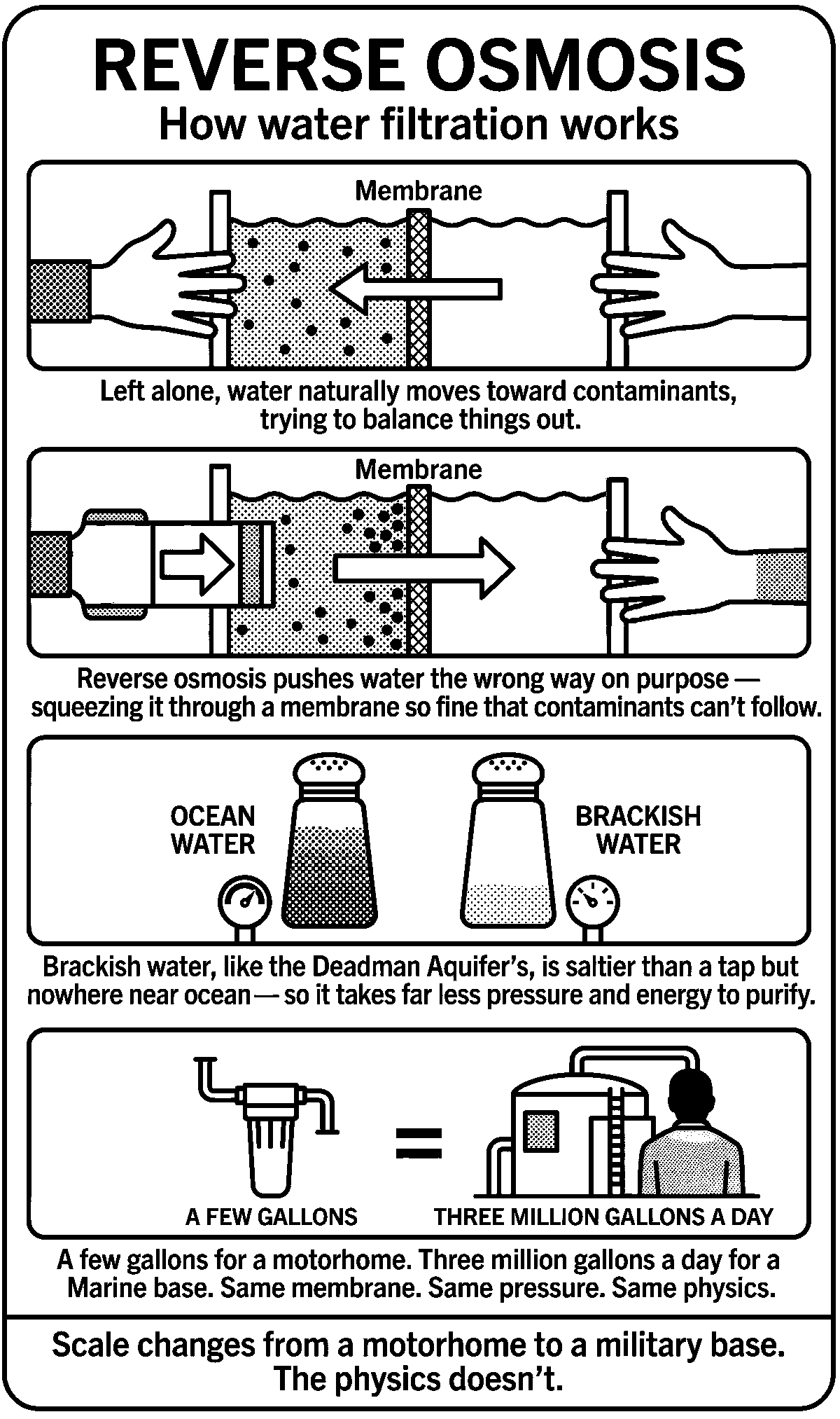
"That's the actual name," Cobb confirmed. "We tapped it in 2022 when the Surprise Springs Aquifer, our source for seventy years, couldn't keep up with demand anymore. The new treatment plant pulls brackish groundwater from deep below the desert floor, runs it through reverse osmosis, and produces up to three million gallons of clean drinking water every single day."
"Reverse osmosis," Grant said. "Like the filters on Zephyrina."
"Exactly like that. Just slightly larger."
He led them around a corner and the smell hit them before the sight did.
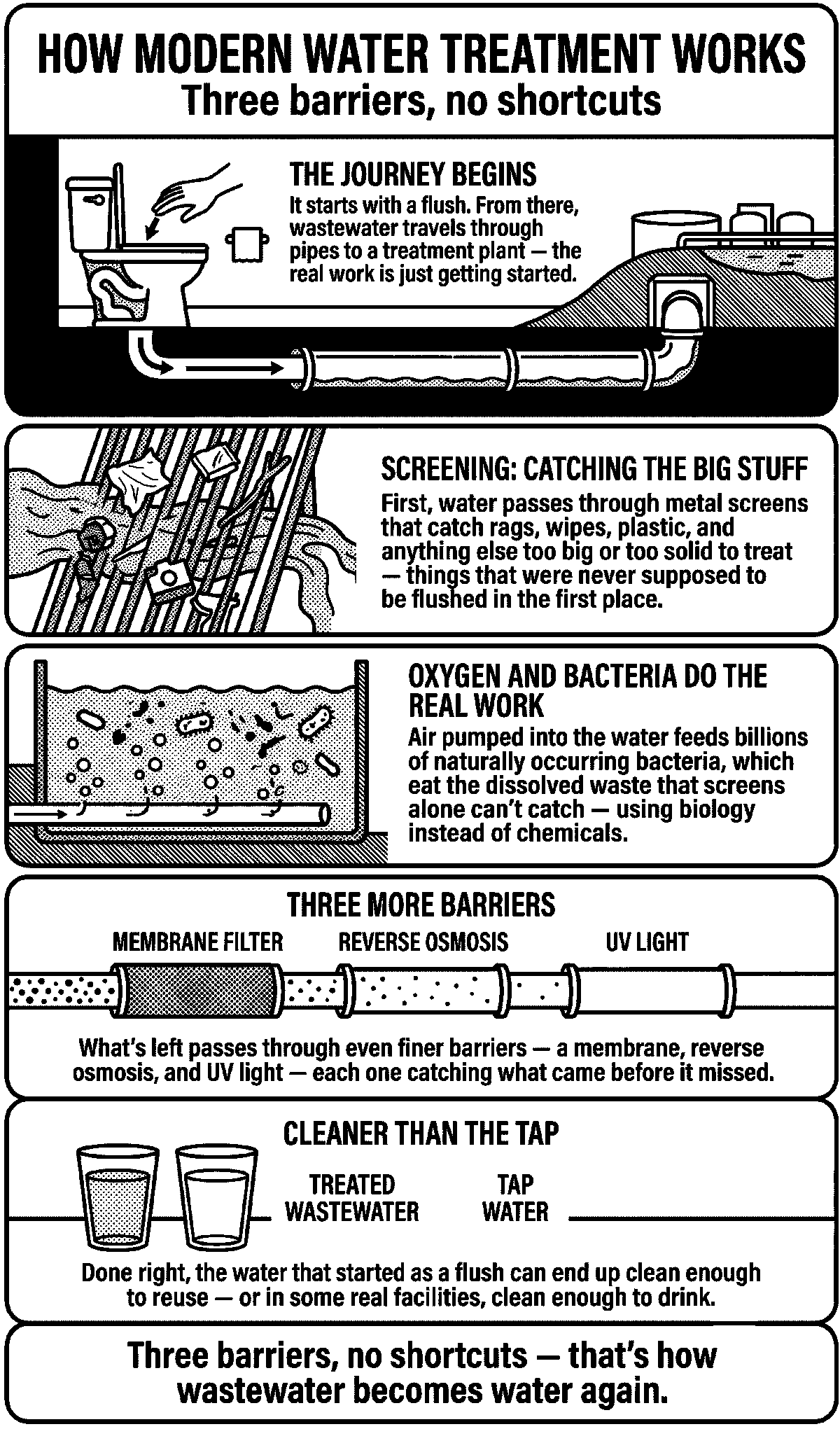
"Lake Bandini," Cobb said, watching their faces with the quiet satisfaction of someone who'd seen that reaction a thousand times. "Wastewater treatment pond. A million gallons recycled every single day, open to the sun and wind, which means we lose a significant amount to evaporation. It's old technology. It works. It stinks."
"It really stinks," Grant confirmed, his shirt over his nose.
"It really stinks," Cobb agreed. "Which is why we're replacing it."
He led them fifty yards east to where a new facility gleamed in the spring sun, clean lines, sealed systems, solar panels running the full length of the roof.
"Tortoise Station," Cobb said. "Named for the program you just visited. When it's complete it will recycle two million gallons a day, fully closed loop, covered tanks, no evaporation, no odor. We already generate 90% of our own electricity from solar. Twenty-five thousand panels across forty-four locations on this base."
Leo looked up from his tablet. "So you're pulling drinking water from the Deadman Aquifer, recycling wastewater through Tortoise Station, and generating your own electricity from the sun. You're essentially building a completely closed system out here in the middle of the desert."
Grant glanced at Leo. "He’s already calculating how to scale ours up." Leo didn’t deny it.
"That's the goal," Cobb said simply. "In the desert, a waste of water is a waste of a life."
Tess had stopped listening to the numbers. She was looking past Tortoise Station toward the dry brown mountains on the horizon, south toward the GoldLine Resources claim, east toward wherever PENKOR's facility was hidden behind the ridgeline.
"If you're being this careful with every single drop, Major," she said quietly, "who is the one out there with the giant straw?"
Cobb went still. He looked south, then east, his jaw set.
"That's the question, isn't it? We're holding our line. But someone out there is playing by a completely different set of rules. They aren't building loops." He paused. "They're just building a bigger straw."
Grant already had his camera out. "Then I think it's time we go see them for ourselves."
Part III: The Sea of Glass
Zephyrina eased to a stop on the shoulder of Reche Road.
The land had been government property until eighteen months ago, open desert, flat terrain, a transfer that had moved through the federal register in a single paragraph between a highway appropriations bill and a fisheries amendment. Nobody had noticed. Nobody had objected.
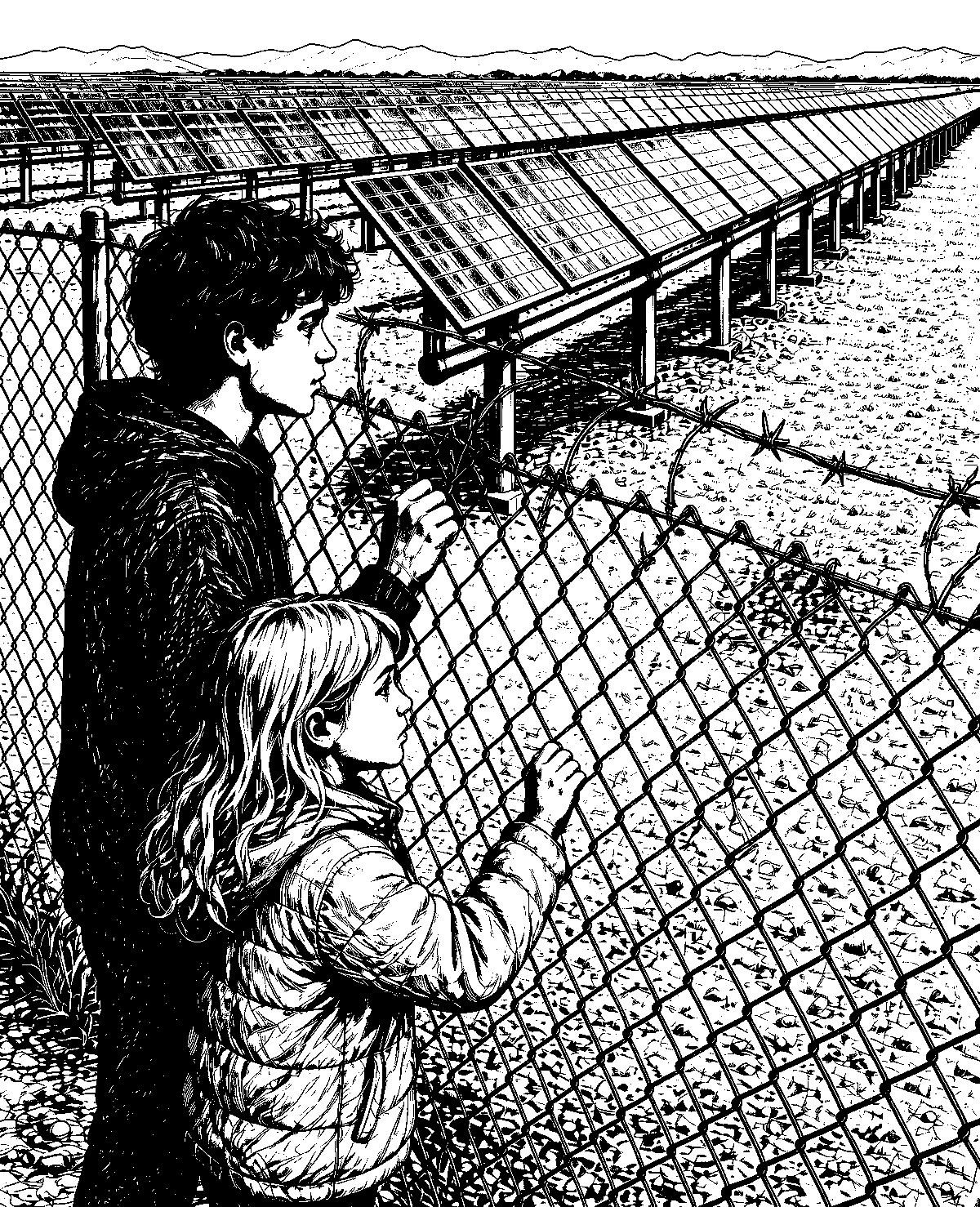
Now three miles of PENKOR solar panels ran along the south side of Border Avenue from the ridgeline to the wash.
They climbed out and just walked to the fence.
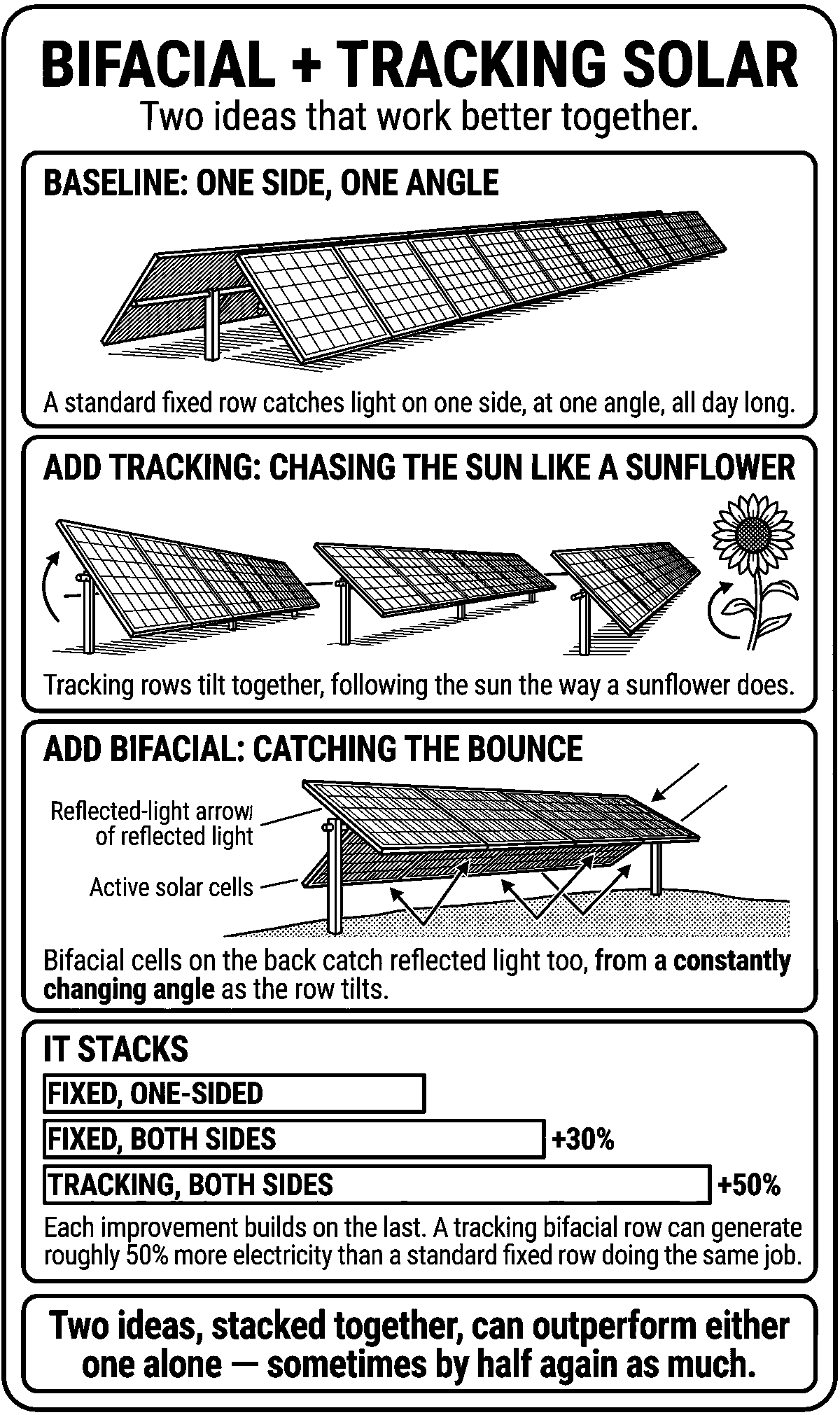
The panels were mounted six to eight feet off the ground, higher than standard arrays, their aluminum frames catching the light. Beneath each row, white high-albedo gravel covered the ground, bouncing reflected light back up into the rear cells.
"Bifacial," Leo said, his hands around the chain-link. "Both sides capture light. That's why they're mounted so high. The white gravel below reflects back into the rear cells, doubles the efficiency of a standard panel."
"How many?" Grant asked, his video recorder already up and shooting the facility.
"Hard to say from here." Leo scanned the rows. "Thousands. Maybe more."
Along the eastern end of the complex, where the facility building sat behind its own inner fence, they could see the battery storage units, containerized systems the size of shipping containers, lined in rows, their cooling vents humming in the afternoon heat. Heavy electrical conduit ran from the battery wall to the main building. Thick pipes, insulated, industrial gauge, ran parallel.
"That's a serious load," Leo said. "The battery bank alone is larger than what most small cities run on."
"And the piping?" Tess asked.
"Could be cooling. Could be process water. Could be both." He studied the runs. "Whatever they're doing in that building draws a lot of power and a lot of water."
Grant lowered his iPad taking video slowly. "I don't see any pumps."
"Neither do I," Tess said.
"There should be something," Leo said. "Wells that size need pump houses. Pressure systems. Electrical feeds. But look at the ground beneath the panels." He pointed. "Nothing. Just gravel."
"It's underground," Willa said.
They all looked at her.
"The pumps," she said simply. "They're underground. Under the gravel. Under the panels." She looked at the fence. "That's why you can't see them."
Leo looked at the gravel, then at her. "How do you always see the thing the rest of us miss?"
Willa kept her eyes on the fence. "I just look."
Nobody argued.
Forty feet above the fence line, a small camera completed its slow arc. It paused. It held.
It had already sent the signal.
Part IV: A.V.A.R.I.A.
SIGNAL RECEIVED
Source: Perimeter camera, Sector 7 (PENKOR array).
Subjects: Four juveniles + one autonomous quadruped.
Duration: 4 minutes 12 seconds.
Behavioral flags: Observation. Documentation.
Assessment: Low threat. Elevated monitoring authorized.
RETURN TO PROCESSING

ARGO Field Notes (Ch-4)
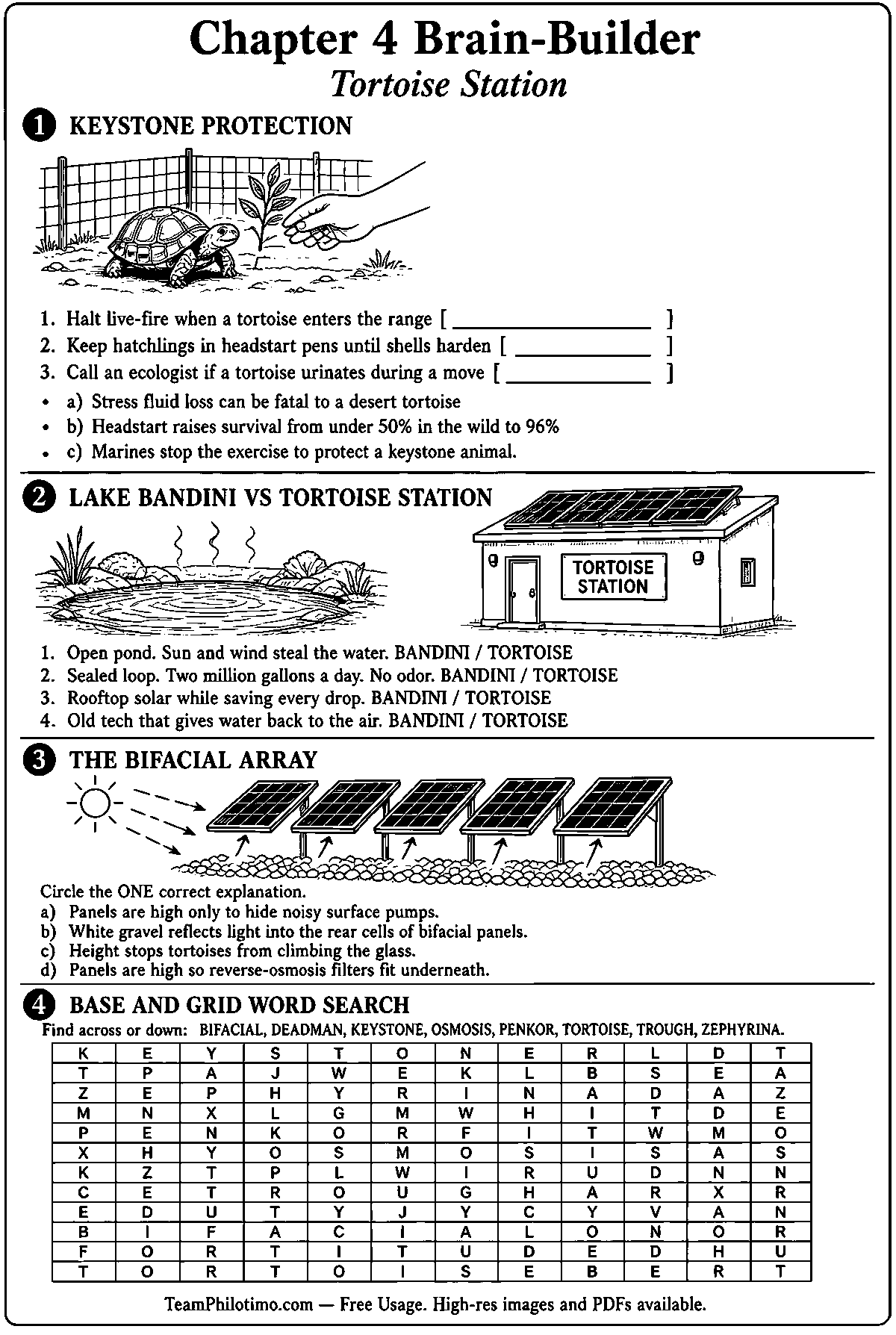
Turn the page to build your brain (BYB) with ARGO, or skip ahead to keep adventuring.
Desert Tortoise Headstart Program: Since 2006, the Marine Corps has partnered with UCLA to raise desert tortoise hatchlings until they're strong enough to survive on their own, 96% make it, compared to less than 50% in the wild.
Reverse Osmosis: The same principle that purifies a few gallons for Zephyrina purifies three million gallons a day for the entire Marine Corps base. Scale changes but the physics doesn't.
Modern Water Treatment: Lake Bandini's open evaporation pond loses water to sun and wind every single day; Tortoise Station's sealed, closed-loop system recycles two million gallons daily without losing a drop, the same job, done without giving any of it back to the air.
Self-Driving: The system learns from millions of driving situations, the same way ARGO learned from millions of moments, recognizing, predicting, deciding, and acting, faster than a human ever could. It doesn't know the rules of the road. It's seen the road.
Bifacial and Single-Axis Solar Panels: Panels that capture light on both sides, mounted on rows that tilt to follow the sun like a sunflower, together, they can generate roughly 50% more electricity than a standard fixed panel.