Stolen Wells · Chapter 9
North Star

Humans are beautifully unpredictable, and still they find north. Today they pulled a truth out of a porch, cleared a course, and played a game in which no one owns the ball. That is how they will walk into Miller's office: to show him north, and to remind him the water was never his.
— ARGO, Personal Log, Entry 9
They came down the switchback in single file, the e-bikes clunking over the loose aggregate, everyone quiet after watching something serious happen and someone handle it well.
Tess didn't say anything about the rescue. She just packed the med-kit methodically, re-inventoried what she'd used, and made a mental note to restock the hemostatic gauze when they got back to Firefly.
ARGO fell in beside her at the bottom of the track.
"You did well," he said.
"Cora did well," Tess said. "I just wrapped it."
"That is what a first responder does. The patient fights; the responder keeps the patient in the fight."
Tess thought about that. Then she put it away, because they had work to do.

Part I: Sara
Ned and Sara's place was a quarter-mile west, and from the road you could tell things were still hard. The pump house door was open. The trough in the pig pen had been refilled, probably with the water they'd brought two days before, but the tank gauge on the side of the house read low. The little pigs were quiet now, napping in a pile in the shade.
Sara was on the porch. She was wearing the blazer, apparently getting ready to leave for her shift at PENKOR.
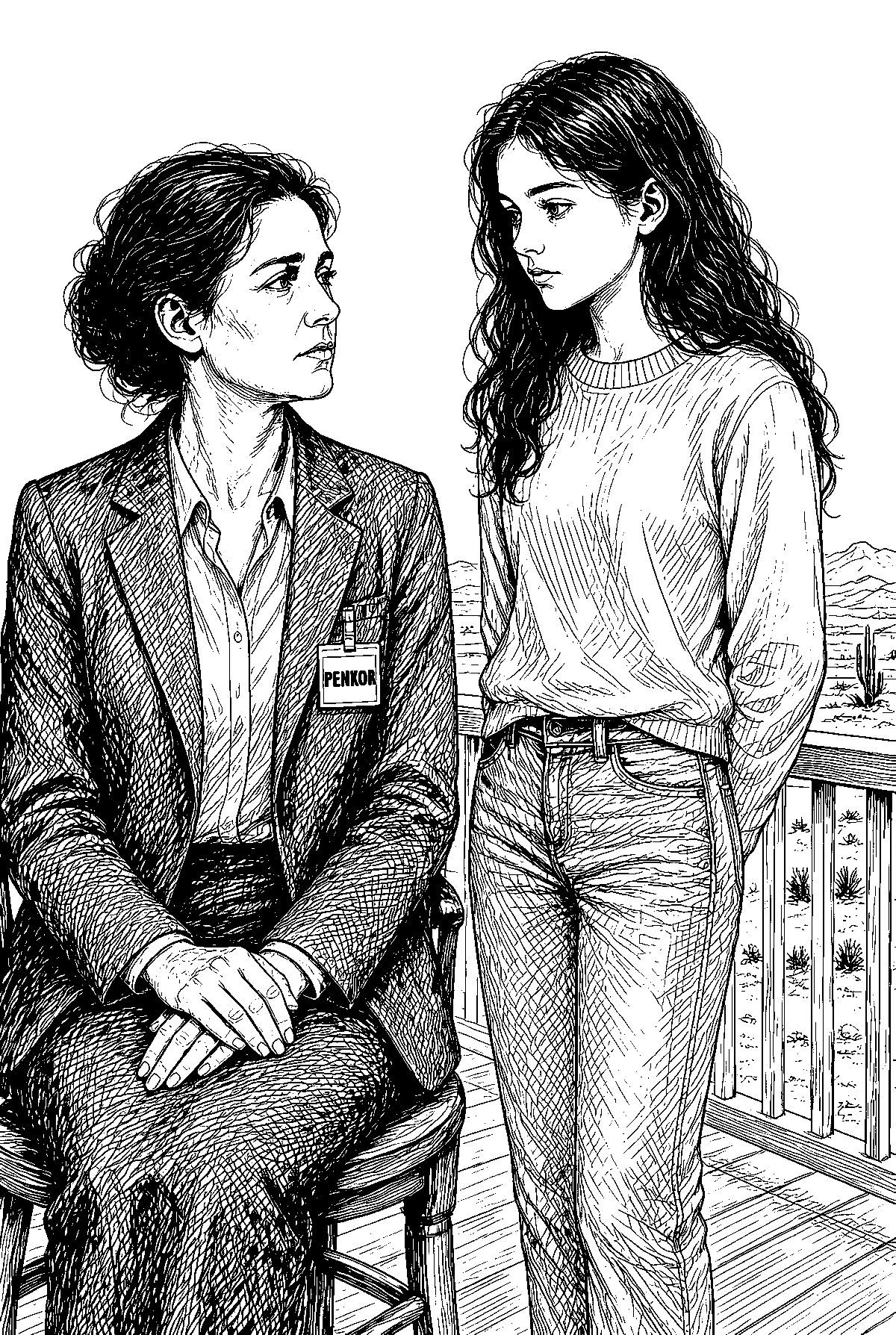
She saw them coming and she didn't move. That was interesting. Someone frightened would have gone inside. Someone with nothing to say would have waved and walked around back. Sara sat very still and watched them come up the drive, which was the behavior of someone who had been waiting.
"Morning," Tess said.
"Morning." Sara's eyes moved to ARGO, registered the vest, moved on, and then settled on Tess with the directness of someone deciding something. "How's the water at Firefly?"
"Still running. Slower than last week."
Sara nodded. Her hands were in her lap, and she turned the PENKOR badge over once, then set it face-down on the porch railing, and then picked it back up and put it back on.
"Sit down," she said.
They did.
"Ned doesn't know what I do out there," she said. "He thinks I'm an office manager for a solar company. Which I am, technically. I'm the Facility Coordinator for PENKOR Group's Joshua Tree computing campus." She paused. "You saw my badge yesterday."
"Yes," Grant said.
"And you're not kids who just dropped off water out of the goodness of your hearts." She looked at them. "You're asking questions."
"We're asking because our wells are going dry," Tess said. "Same as yours."
Sara was quiet for a moment. The desert was quiet around them, just the piglets shifting around to get a better spot in their pen and the munching sounds of the goats nibbling weeds in the garden.
"Eight wells," she said.
The team went very still.
"The original facility design was air-cooled," Sara continued. "That was the permit. That was what they presented to the county, to the Marines, to everyone. Air-cooled systems use almost no water beyond what the staff drinks and what runs through the bathrooms. That's what was processed, that's what was filed."
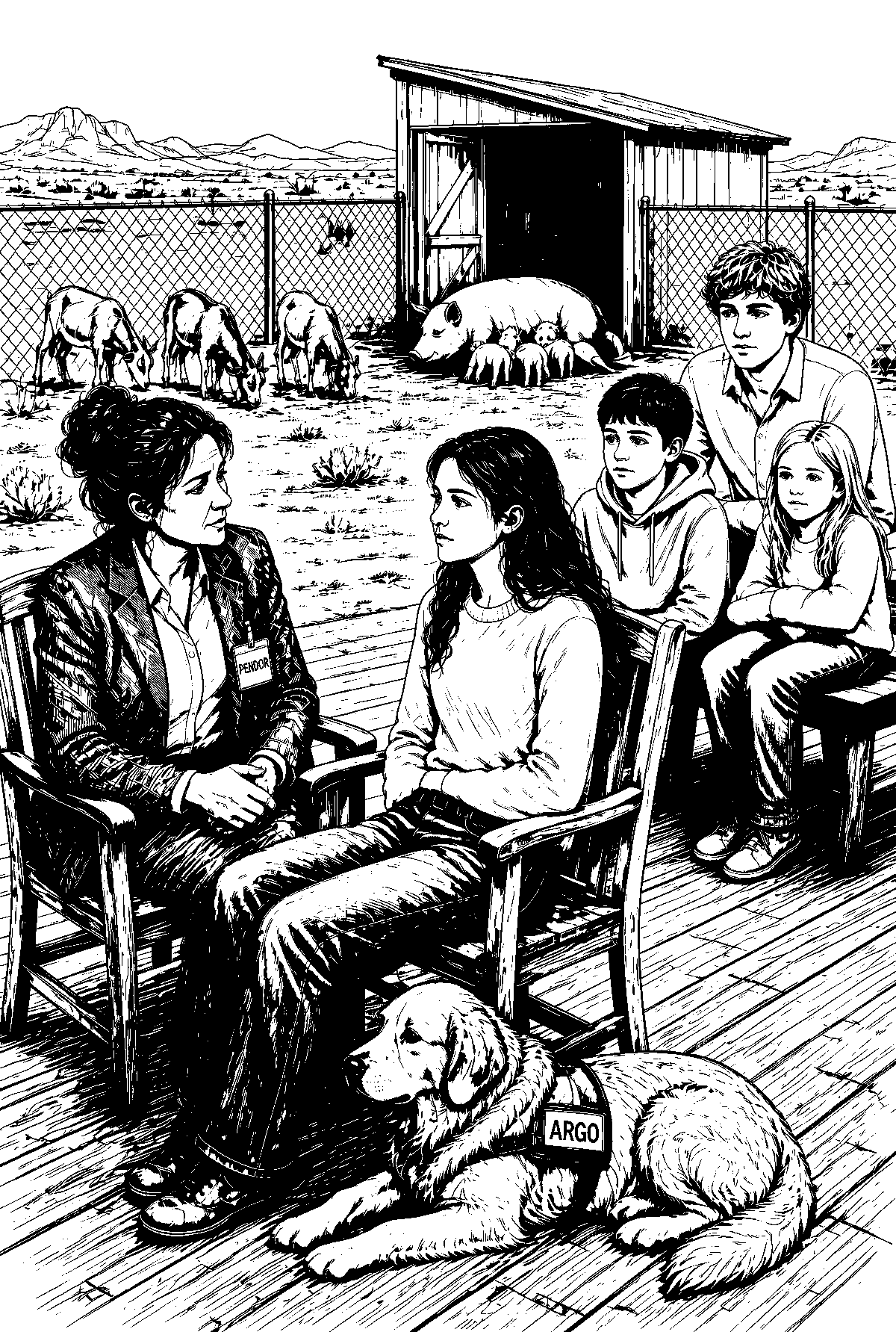
"But," Leo said.
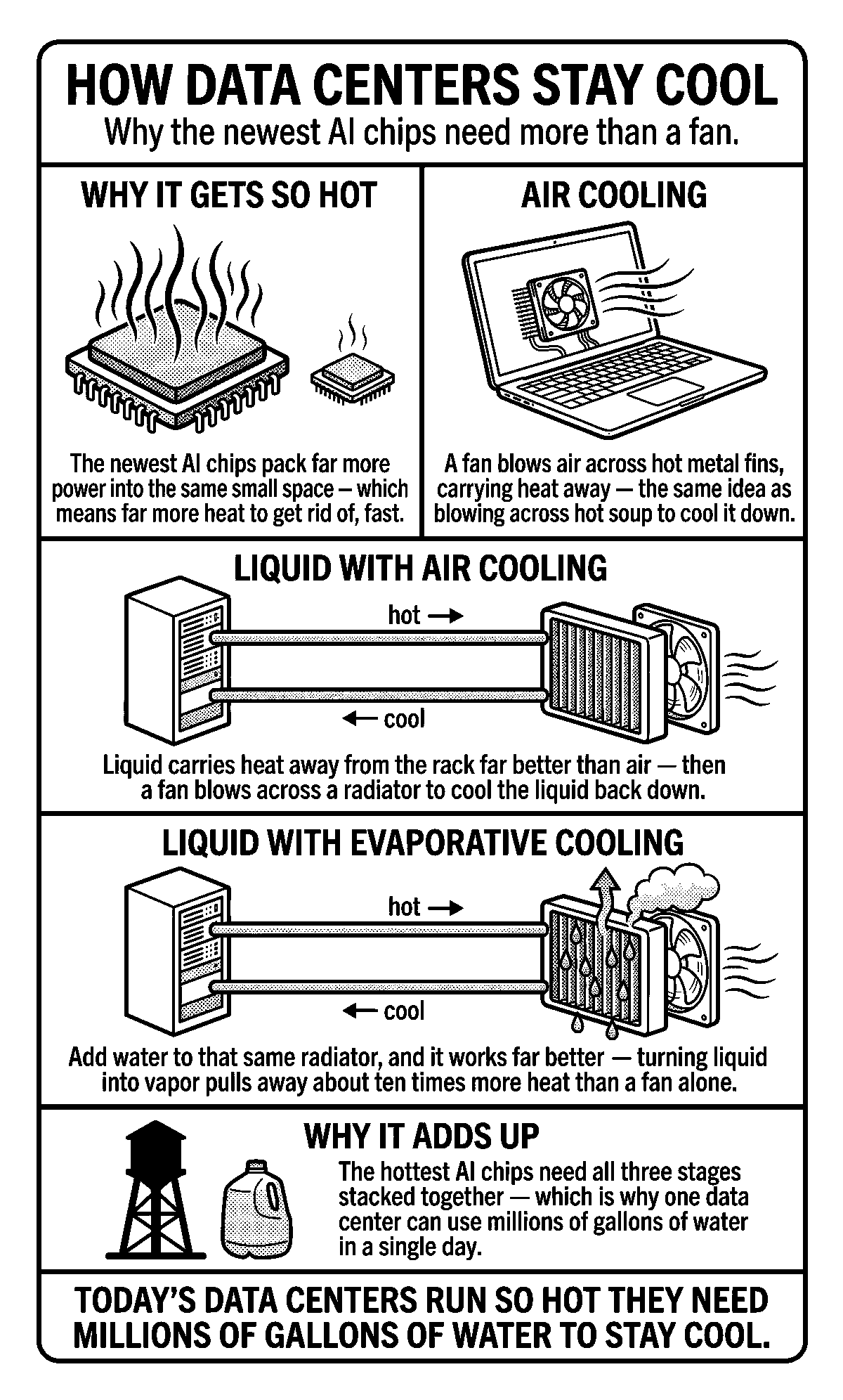
"But last fall, PENKOR brought in the new chip architecture. The Blackwell Ultra systems. Liquid-cooled. An order of magnitude more powerful, and an order of magnitude more cooling needed. They just drilled the wells and told me to update the internal specs."
"Did the permits get updated?" Grant asked.
"I updated the internal specs," she said. "But I never saw anything filed with the county."
Leo made a quiet sound.
"How much are you pulling?" Tess asked.
"When we are at full load? Between four and five million gallons a day. It has been going up as we brought more processing power online." Sara looked at her hands. "I did the math on the aquifer. I know what the draw-down looks like. I've been watching our well and it has dropped about a foot a month since we went to full liquid-cooling in December."
"Cora's father logged drilling through February," Willa said quietly. "Nights mostly."
Sara looked at Willa for a moment. Then she nodded. "Night operations. Lower inspection risk."
"Who ordered the switch to liquid-cooling?" Tess asked.
"The Transition Leader oversaw the construction and emailed the crews with instructions. The production VP, a man named David Miller, was brought on board late December. He was not involved in designing the infrastructure. All the emails came from the Transition Leader."
"Miller reports directly to the chairman." Sara picked up the badge again and turned it over, then set it back down. "I am not sure who signed off on the well expansion. The emails were from the Transition Leader. The chairman, his name is Beaumont, Jordan Beaumont, he flies in once a quarter. Miller runs the day-to-day."
"We need to talk to Miller," Leo said.
"Miller isn't here today." Sara glanced toward the ridgeline east of Goat Mountain. "He's at Coachella. Beaumont is there too, they have a Safari Camp cabana at the festival. Investor entertainment. It's a whole thing." A dry pause. "They are trying to raise more money to build more AI data centers.

They are pushing the idea of sustainable investment, because we are using only solar power for the PENKOR Joshua Tree AI data center." She glanced at them. "One of the bigger names on the guest list is an investor named Priya Solberg, out of Norway, tied to one of the big sovereign wealth funds. That's the kind of money that funds ports and grids and, apparently, whatever this is."
Grant pulled up his tablet. Coachella. This weekend. The same green smudge they'd seen from the boulder overlook, the festival they'd talked about being too expensive to go to. He looked at Tess.
Tess looked at him.
"When does Miller come back?" she asked.
"At the staff meeting he said he would be back in the morning as usual."
"Can we get a meeting?"
"You're sixteen."
"Can we get a meeting," Tess said again, the same way she'd said it, not differently.
Sara looked at her for a long moment. "I can put it on his calendar for 9:00 AM Thursday morning. I will mark it down that the Team Philotimo Foundation is requesting a meeting regarding the foundation's water rights and the adjacent parcel's permit status. That is accurate. It will also make him assume he's meeting with a lawyer."
"And when he finds out he's meeting with us?"
"Then he'll have to decide whether to throw you out or talk to you." Sara picked up the badge and clipped it back to her blazer.
"We'll be there at 8:45 AM," Tess said.
Back on the bikes, heading south toward Firefly, Leo rode in silence for a while, turning Sara's words over.
"She did not have to tell us," he said.
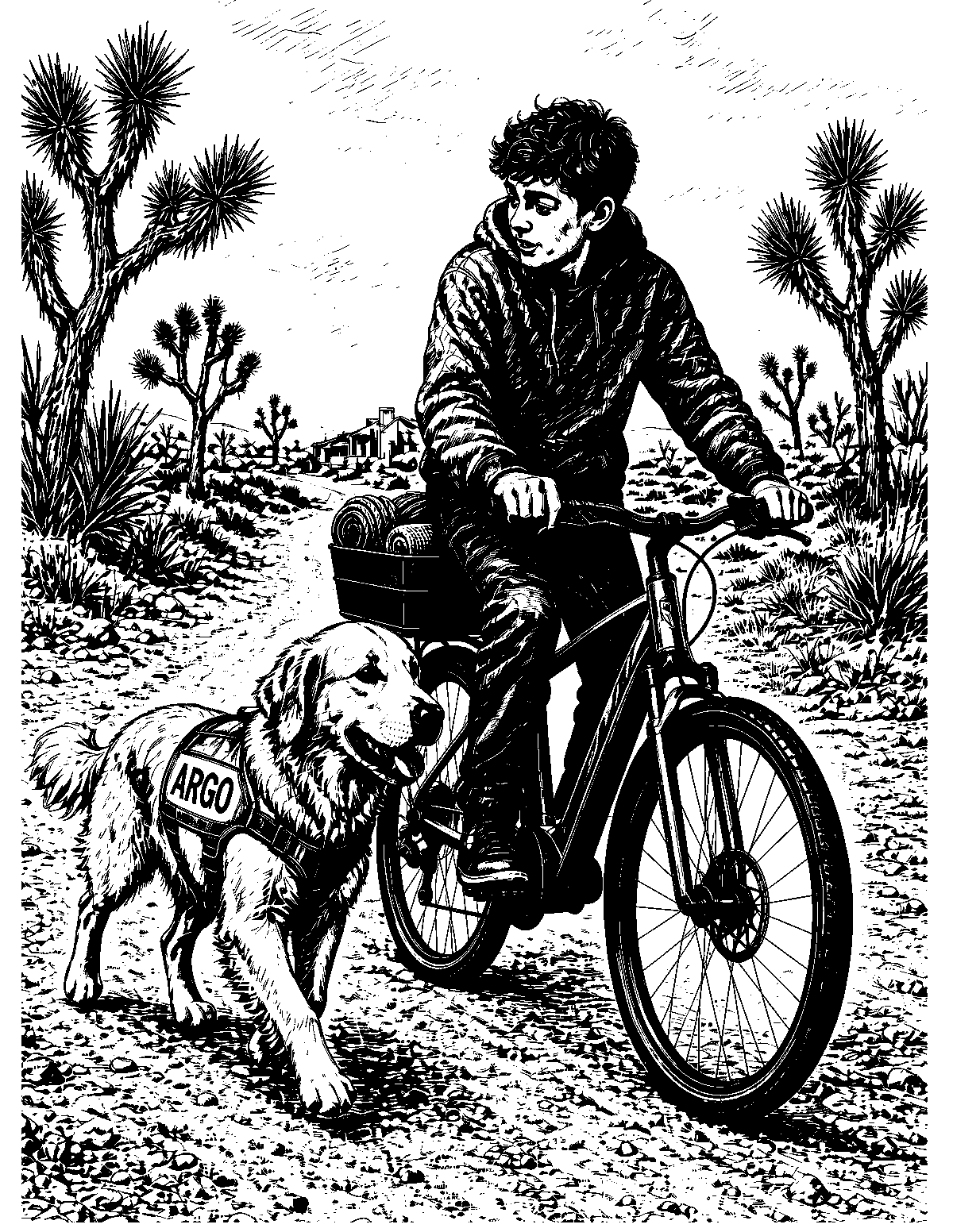
"No," ARGO said. "Honesty is how justice speaks."
An order of magnitude more cooling. He kept picturing the wells, the pipes, the water disappearing into all that machinery just to keep it from overheating.
"ARGO," he said, "do you need anything like that? All those pipes and towers, just to keep a chip from melting?"
"I do not," ARGO said. My processor is photonic. Optical Processing Unit. Still experimental, one of only a few of its kind. It runs on light rather than electricity, which produces a fraction of the heat a chip like theirs does, and runs many times faster, on a fraction of the power. One OPU the size of a dime is comparable to a full rack of Blackwell systems."
Leo let that sit for a moment, then shook his head slightly, smiling.
Grant came up alongside ARGO.
"Jordan Beaumont," he said. "ARGO, what do you have?"
"Jordan Beaumont, 54," ARGO said. "Stanford MBA. Founder and Executive Chairman of PENKOR Group, incorporated in Delaware, principal offices in San Jose and Singapore. Previous ventures in LiDAR components, GPU arbitrage, and sovereign wealth fund consulting. Net worth estimated at 2.1 billion. He is currently listed as an attendee at the Indio Valley Impact Investors Summit, which is co-hosted this weekend at the Coachella festival."
"An impact investors summit," Grant said. "At a music festival."
"The current era is not short on irony," ARGO said.
"And Miller?"
"David Miller, 41. Production VP, PENKOR Joshua Tree. Mechanical engineering degree, MIT. He previously managed data center operations in Texas, for a crypto-currency company."
"Okay," Tess said. "Tomorrow at 8:45 AM. We need to be ready."
When they got back to Firefly, ARGO trotted directly to the middle of the Oasis and sat down.
"Miller is at Coachella," Grant said, pulling his bike into the shop bay. "We have the rest of the day to get ready and relax."
Part II: Mallotimo Seven
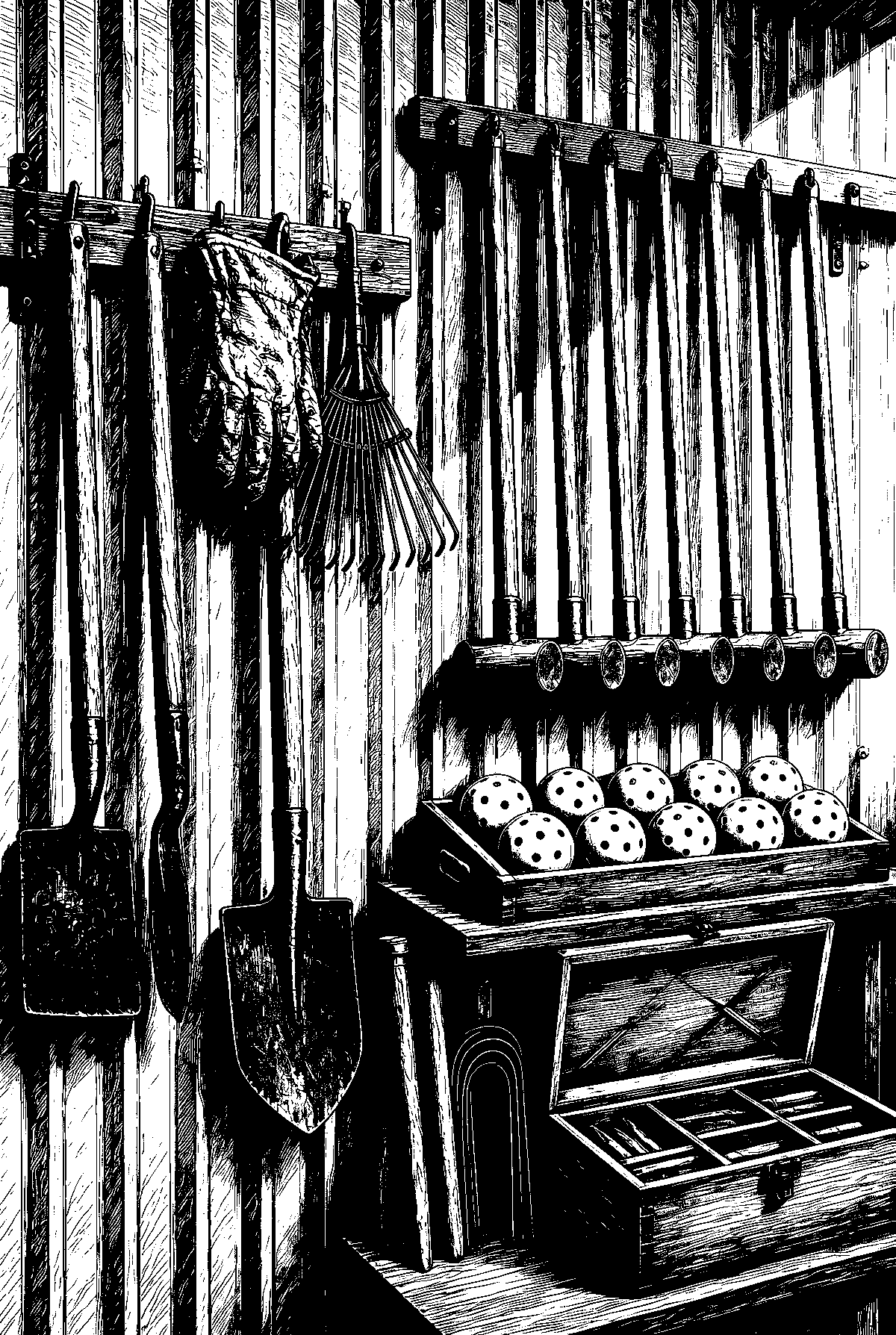
They started with link #1, and weeded each link in order till they got to #7. The bigger weeds had roots like wire. ARGO sat in the shade and kept time because that was a thing he could do.
"One hour and nineteen minutes!" Tess said, pulling off her gloves. "Faster than last year."
"Everything is a competition with you," Grant said.
"Everything is a competition," she said, and went to get the mallets.
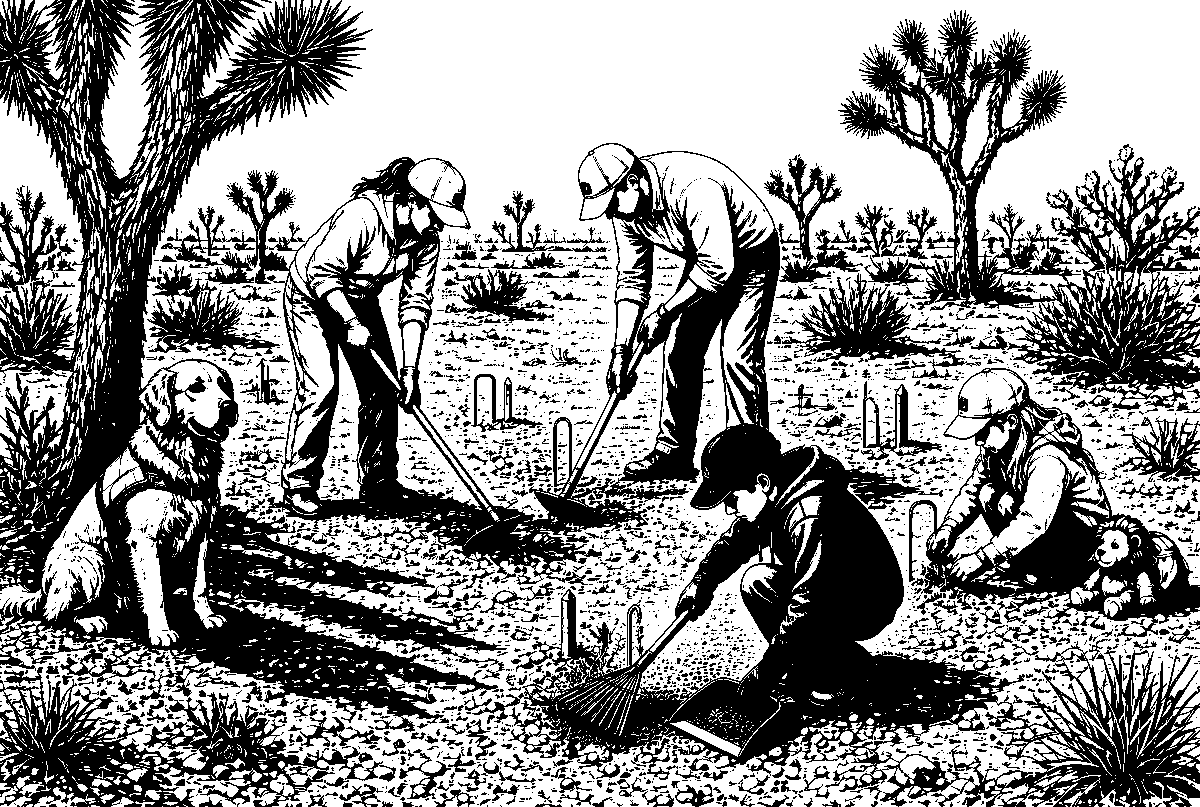
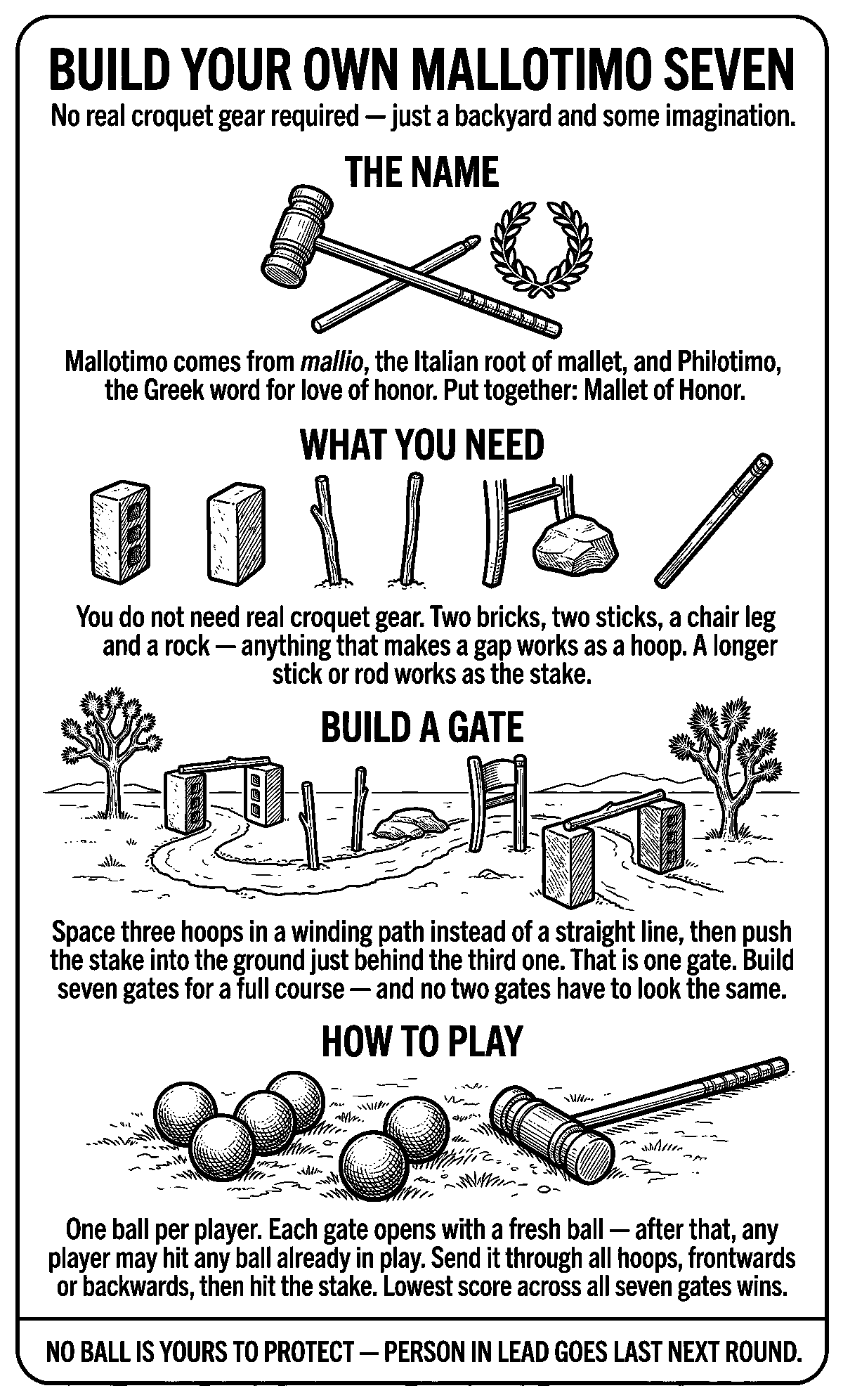
Leo found the cedar kit box on the second shelf in the shop and brought it out into the desert light. Seven identical white balls. Four mallets. Seven numbered stones already placed at the start of each link, the course threaded between the Joshua trees and creosote bush, seven links each with three hoops and a brightly colored pole or stake that acted like the hole does in golf. The seventh link ended near the Fountain Philotimo, its pole was painted with an amber color.
"Same color as ARGO's eyes," she told him now, pointing.
ARGO's eyes cycled slowly. He had never seen this game before. He sat in the shade of the nearest Joshua tree and watched.
"What is this?" he asked.
"Mallotimo Seven," Willa said, as if that explained everything. To her it did.
"Grandfather Timo built it," Tess said. "We've played four or five times. You'll figure it out."
"Rules?" ARGO said.
"Youngest goes first," Willa said immediately.
"That means you," Grant said.
"Worst cumulative score goes first on the next link," Leo explained to ARGO. "Best score goes last, which sounds good but usually isn't because all the balls are already in play."
"And you start each link from a numbered stone," Tess added. "Any player can hit any ball, they're all identical so nobody owns one. You just play whatever ball gives you the best position toward the next hoop or the stake or numbered pole like we have at Firefly."
"Lowest total score wins," Grant said. "Which Willa wins. Every time."
"Not every time," Willa said.
"Every time," the other three said together.
ARGO said nothing. He filed the rules, watched Willa place her mallet at the first stone, and waited to see what every time looked like.
It looked like this.
Willa's first hit sent a ball six feet from the first hoop at a clean angle. Leo went wide. Tess landed short but with a better line than it looked. Grant caught a rock nobody had seen.
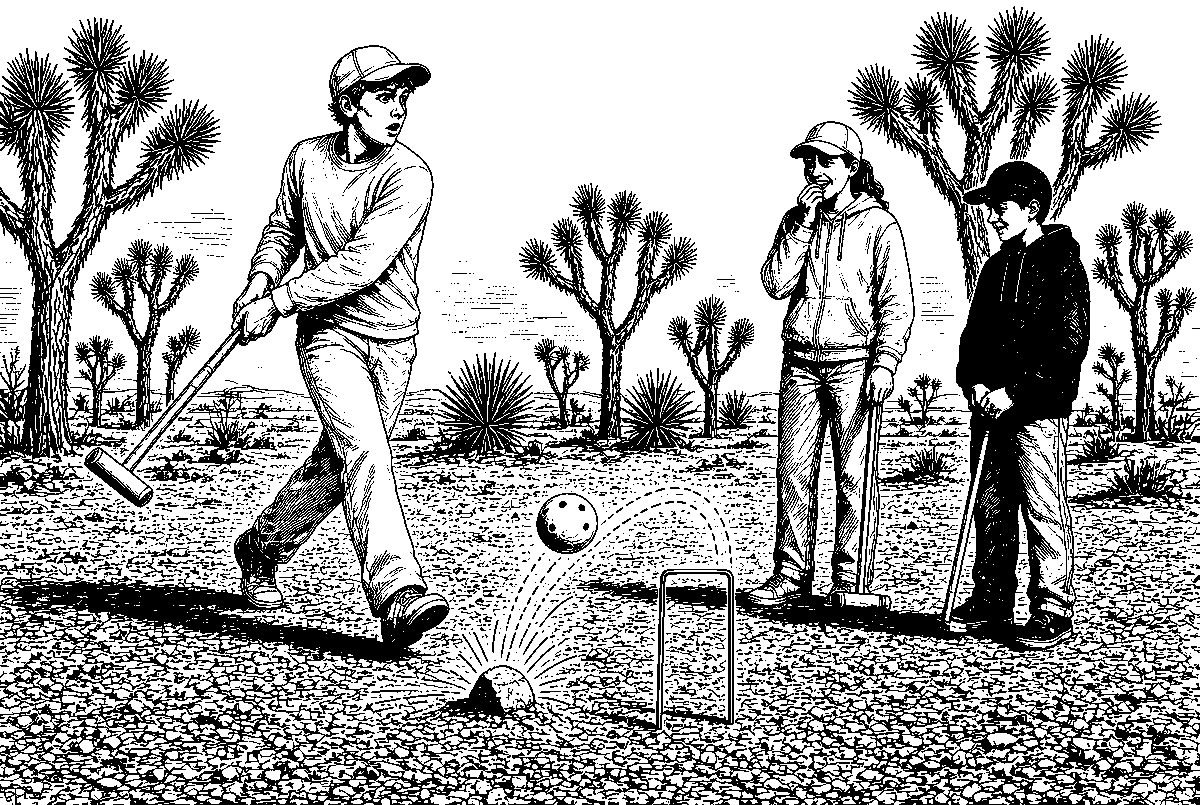
"The rock was always there," Leo said.
"The rock was not always there," Grant said.
"The rock," ARGO said quietly, "has been there since the Holocene."
From the second hit onward it was anyone's game, four players, seven identical balls, the pleasure of not knowing whose ball you were helping or hurting.
By link three the trash talk had reached its natural cruising altitude.
By link five Grant had stopped objecting to shooting first and started paying attention to the field instead.
By link six Leo had twice treated a ball as if it belonged to him.
"It's not yours," Tess said the second time, without looking up from her next shot.
"I know that," Leo said.
"Then stop protecting it. Any of us can hit any ball.
That's the whole point." Leo scowled at the nearest ball like it had betrayed him. "It was in a really good position."
"Then leave it for the rest of us," Grant said. Willa, already lining up her next hit, added quietly, "That's why nobody owns one."
Link seven was the longest one, three hoops, each separated by at least fifty feet and the #7 Pole located on the top of a mound, so if you missed the ball just rolled back down and away. Grant, who was in last place, was shooting first and hit the ball, which flew across the desert until it bounced off a Joshua Tree.
Tess used it. The metal pole rang out across the desert, the sound carrying all the way to the porch.
"Final scores," ARGO announced, having kept count without being asked.
He told them.
"Again?" Grant said.
Willa, was already walking toward the fountain, mallet over her shoulder, after winning the game again.
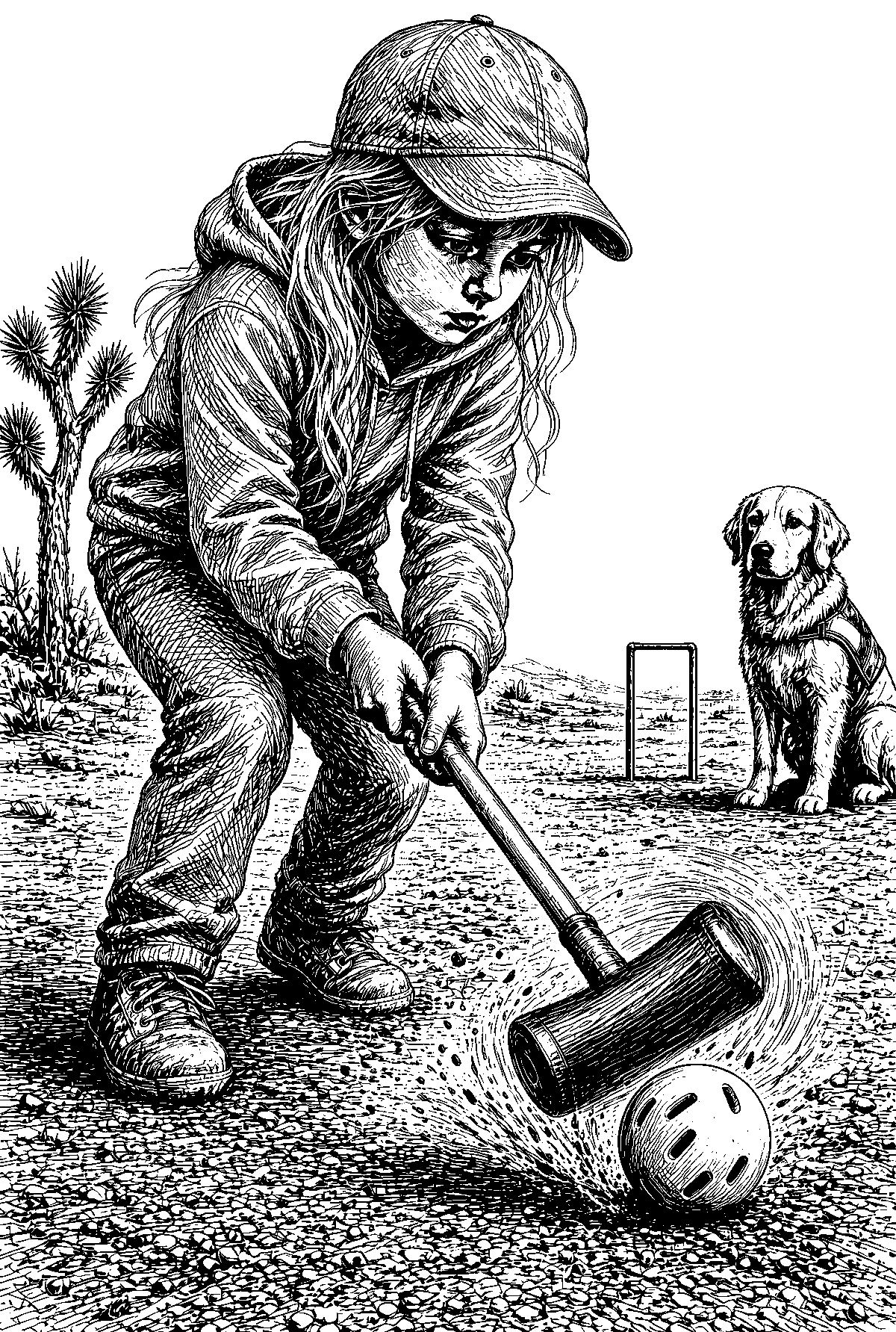
ARGO watched her go. He had observed every hit of every link. He had logged every ball position, every angle, every choice each player made from the stone.
He had one data point he could not fully account for.
Willa had not once played the obvious ball. She had not once played the closest ball. She had played, on every hit of every hoop, the ball that was in the best position for the hit after next.
She was seven years old.
He would need more data.
He walked to the fountain and sat beside her.
"Same time next visit?" she asked.
"The course will require weeding," he said.
She looked at him.
"There is always more weeding," ARGO said.
She smiled. The fountain kept moving. The desert held its quiet.
Grant was still looking at his scorecard.
"Every time," he said.
Later, when the mallets were back in the cedar box and the balls were counted and the course stones were where they belonged, ARGO filed his complete assessment of the Mallotimo Seven.
"Mallotimo, from mallio, the Italian root of mallet, and Philotimo, the Greek for love and honor. Mallet and Honor. Grandfather Timo was not subtle about the connection."
"The game is elegant in its construction. The handicapping is structural and automatic: no calculation required. The identical ball rule removes possession entirely and replaces it with strategy. Any number of players may participate. The only equipment required beyond the kit is a surface and the willingness to play."
Then he went inside.
Part III: Under the Stars
They showered and changed and came out to the back of the property as the desert sky began its transition, the brief, extravagant window when the sun drops below the mountains to the west and takes the warmth down with it, and the sky goes through orange and pink and violet before it disappears.
The circular spa was next to the outdoor kitchen on the north end of the property, and the brick deck curved around it. Beyond that was an arched bridge over the dry creek bed that led to the sauna.
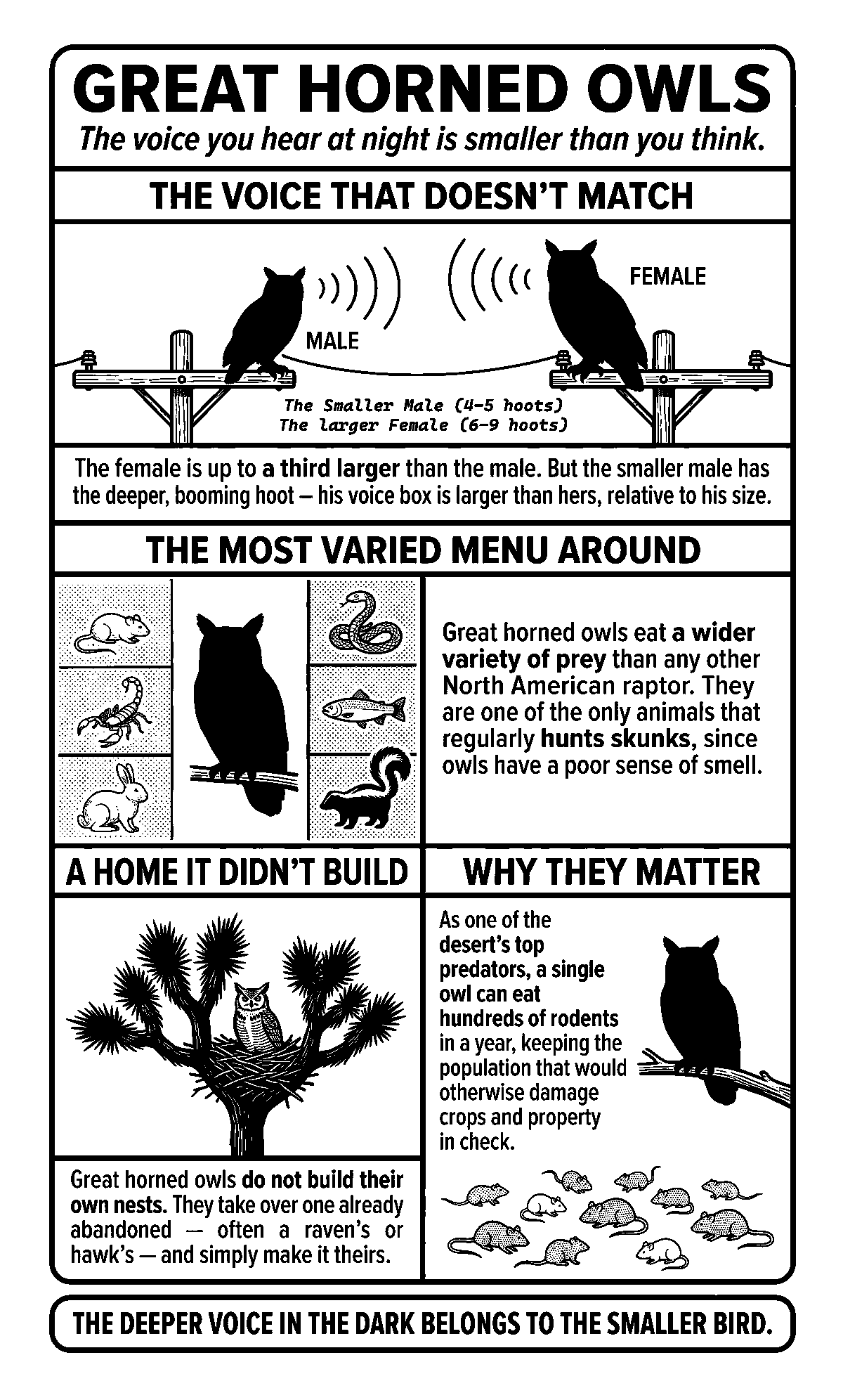
Somewhere out past the fence line, a low, booming hoot rolled across the dark. A few seconds later, an answer came back, higher, sharper.
"Two of them," Leo said, pausing on the bridge.
"Great horned owls, the low one is the male," ARGO said. "Despite being the smaller bird, he has the larger voice box for his size. The female is answering, higher pitched, and larger than he is."
"That's backward," Grant said.
"Most of the desert's best tricks are," ARGO said.
"Do you know where they are?" Willa asked.
"They usually perch during the night on the tops of the telephone poles," ARGO said, "but their nest is in the Joshua tree past the east fence line. In an old raven's nest, near the top. They did not build it themselves, owls rarely do. They simply found something already abandoned and made it theirs."
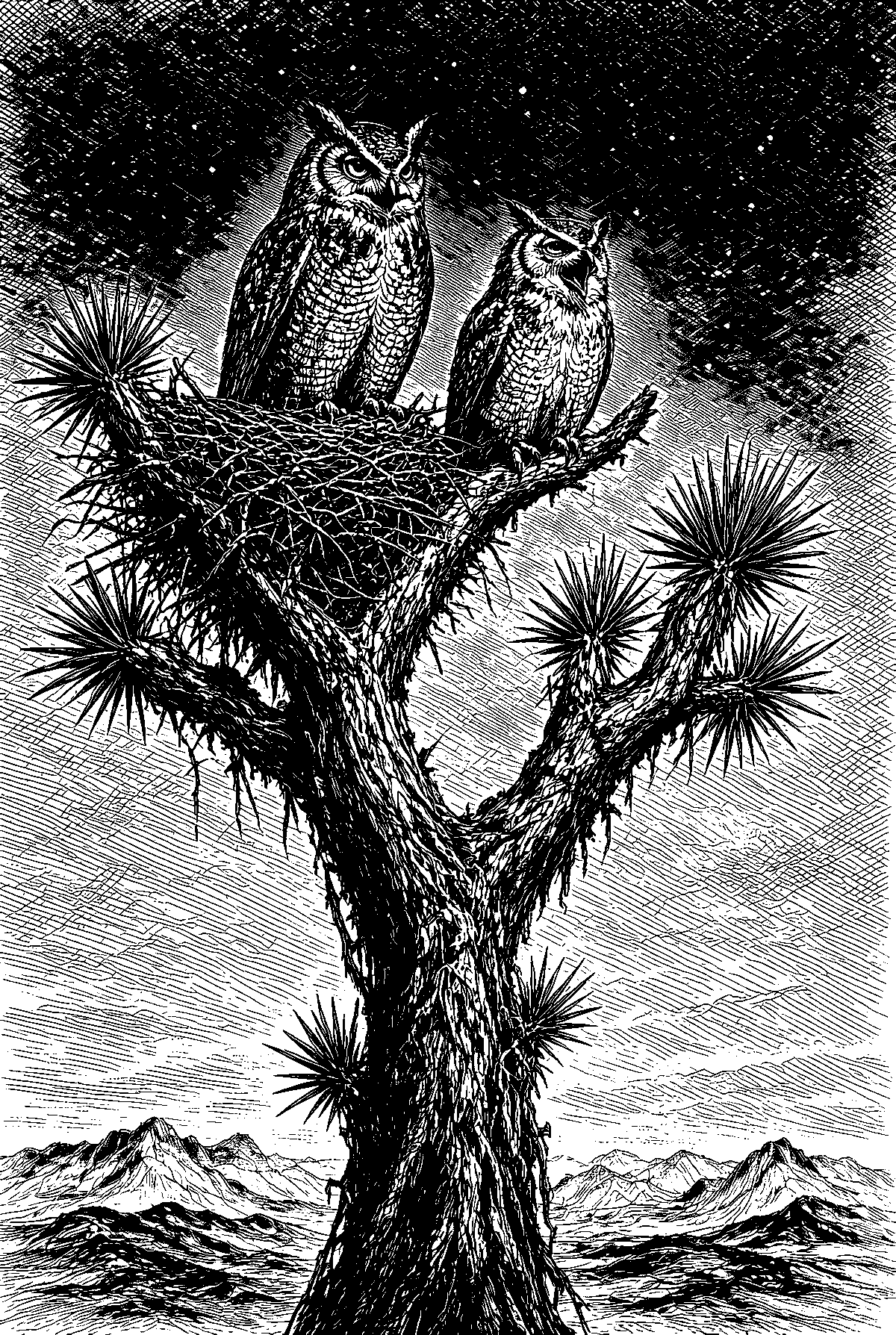
"That's kind of nice, actually," Willa said.
"I thought you would think so," ARGO said.
The big wooden barrel sauna with a rounded corrugated roof was pointed to the northeast, all glass on one end, with a view of the setting sun on Goat Mountain.
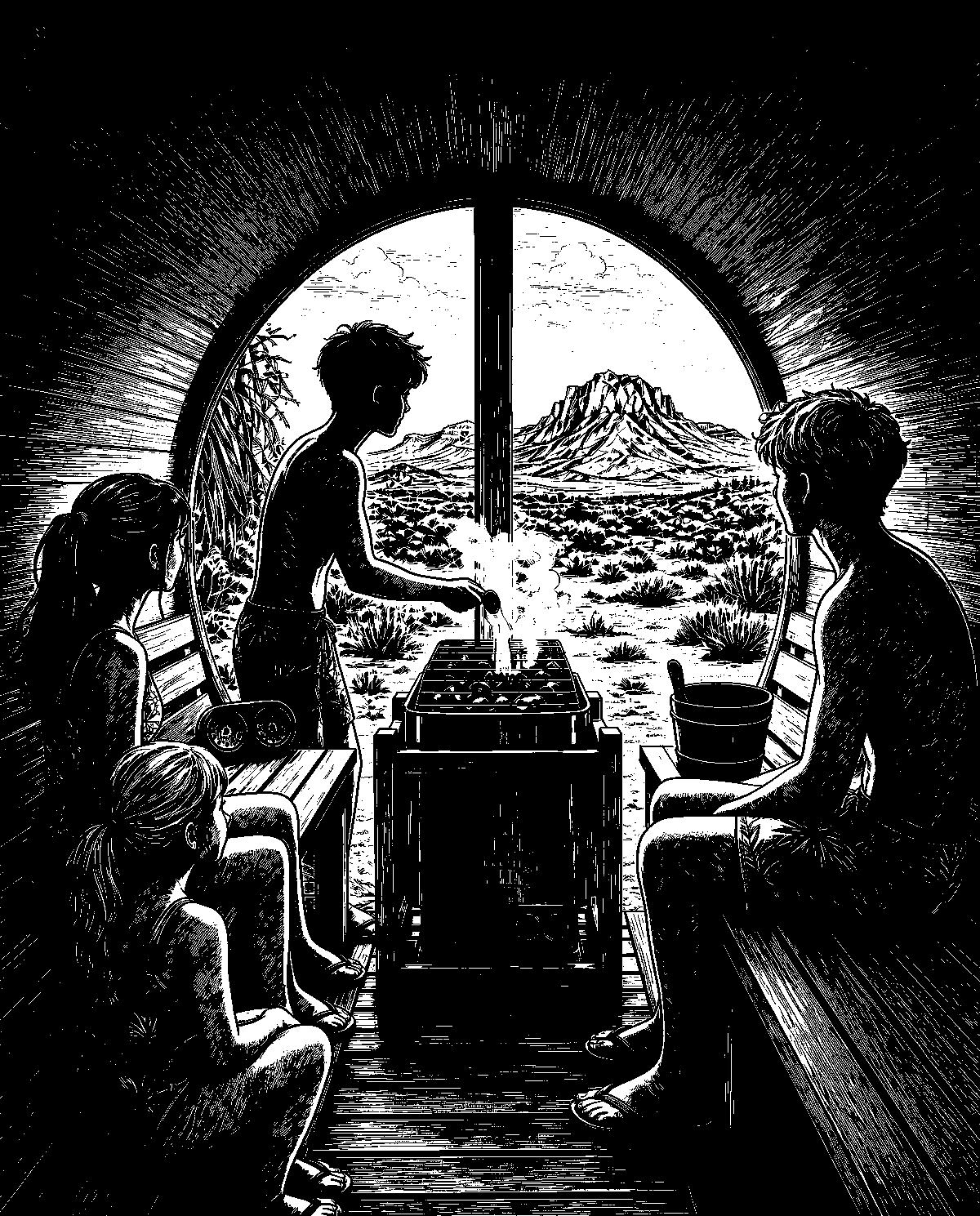
"Grandpa Timo put the glass pointing towards Goat Mountain," Tess said, toweling off after the spa and moving toward the sauna.
"So you couldn't avoid thinking about it," Grant said. He looked at the mountain, a dark shape now against the deepening sky, the summit invisible but present. The mine shaft was up there somewhere. So was the long ridge that looked east at the PENKOR facility.
"He put everything where it would make you think," Willa said. She sat down on the cedar bench and looked at the mountain. The glass in the sauna was single-pane clear, and the mountain filled it like a picture someone had framed very carefully.
Leo poured water on the rocks. The steam rose and the cedar smell sharpened.
"Okay," Tess said. "Tomorrow. Nine AM. David Miller. What do we know and what do we need to say?"
Part IV: The Prep
The steam softened the air and the mountain sat in the glass and they talked.
"We know they have eight wells under the solar array," Leo started. "We have drone footage of the wellheads and pipe runs. We know the permitted well is domestic-use only, basically nothing. We know the actual draw is around four to five million gallons a day."
"We know drilling started in October," Grant added. "Nights, mostly. Cora's father kept a log."
"We know the draw-down in the basin correlates directly to when they switched to liquid-cooled chips," Tess said. "ARGO, what's the gap between their permitted water use and actual use?"
"Their permit allows approximately one million gallons per year for domestic use," ARGO said. He was outside the sauna door on the deck, visible through the glass as a dim amber glow in the dark. "At four to five million a day, they are operating at roughly 1500 times their permitted draw."
The number sat in the steam for a moment.
"1500 times," Leo said.
"At minimum."
"So when we go in tomorrow," Grant said slowly, thinking it through, "we're not going in to ask questions. We're going in to show them what we know and give them a chance to explain themselves."
"Correctly framed," ARGO said.
"What do we want out of the meeting?" Willa asked. She had that quality of asking the question that got to the thing underneath the other questions.
"We want them to stop pumping," Leo said.
"That's the end goal," Tess said. "Tomorrow we want one thing: we want them to know we have the documentation. We want Miller to understand that what's in Grant's drone footage is going somewhere unless something changes."
"We're not threatening him," Grant said.
"No. We're informing him. There's a difference."
"And if he throws us out?"
"Then we go to the county water board," Leo said. "With Dr. Okafor's data, our sensor logs, Cora's father's drilling log, and twenty minutes of 4K video of eight unlicensed wellheads." He paused. "That's a lot to throw out."
Tess poured more water on the rocks. The steam went thick and white.
"ARGO," Grant said.
"Yes."
"Beaumont. Jordan Beaumont. He's at Coachella right now. Investor entertainment." Grant looked at the fogged glass, the mountain vague and dark behind it. "He knows what Miller is doing."
"Almost certainly," ARGO said.
"So even if Miller agrees to something tomorrow, even if he's scared enough by the footage to pump the brakes, Beaumont could just override it."
"Yes."
"So Miller isn't the actual problem."
"Miller is a door," ARGO said. "What matters is whether the door opens."
The steam faded. The mountain came back into focus through the glass, Goat Mountain, the summit they'd climbed that morning, the shaft in the rock, the horizon where the PENKOR facility threw back the last light of the day.
"Get some sleep," ARGO said. "Tomorrow requires clear heads and good manners. In that order."
"What about after Miller?" Willa asked, still looking at the mountain. "What comes after the door?"
"We find out what Beaumont is telling his investors," ARGO said. "A man who has built a facility that consumes 1500 times its permitted water allotment, and who is simultaneously pitching that same facility to an audience of impact investors as a model of sustainable AI infrastructure, has a very significant gap between his story and his math."
"That's fraud," Grant said.
"That is a word that applies," ARGO said. "Yes."
The cedar cooled. Outside, the desert had gone full dark, and the stars over the Landers basin were doing what they did on clear April nights in the Mojave, which was absolutely everything.
"Come see this," ARGO said.
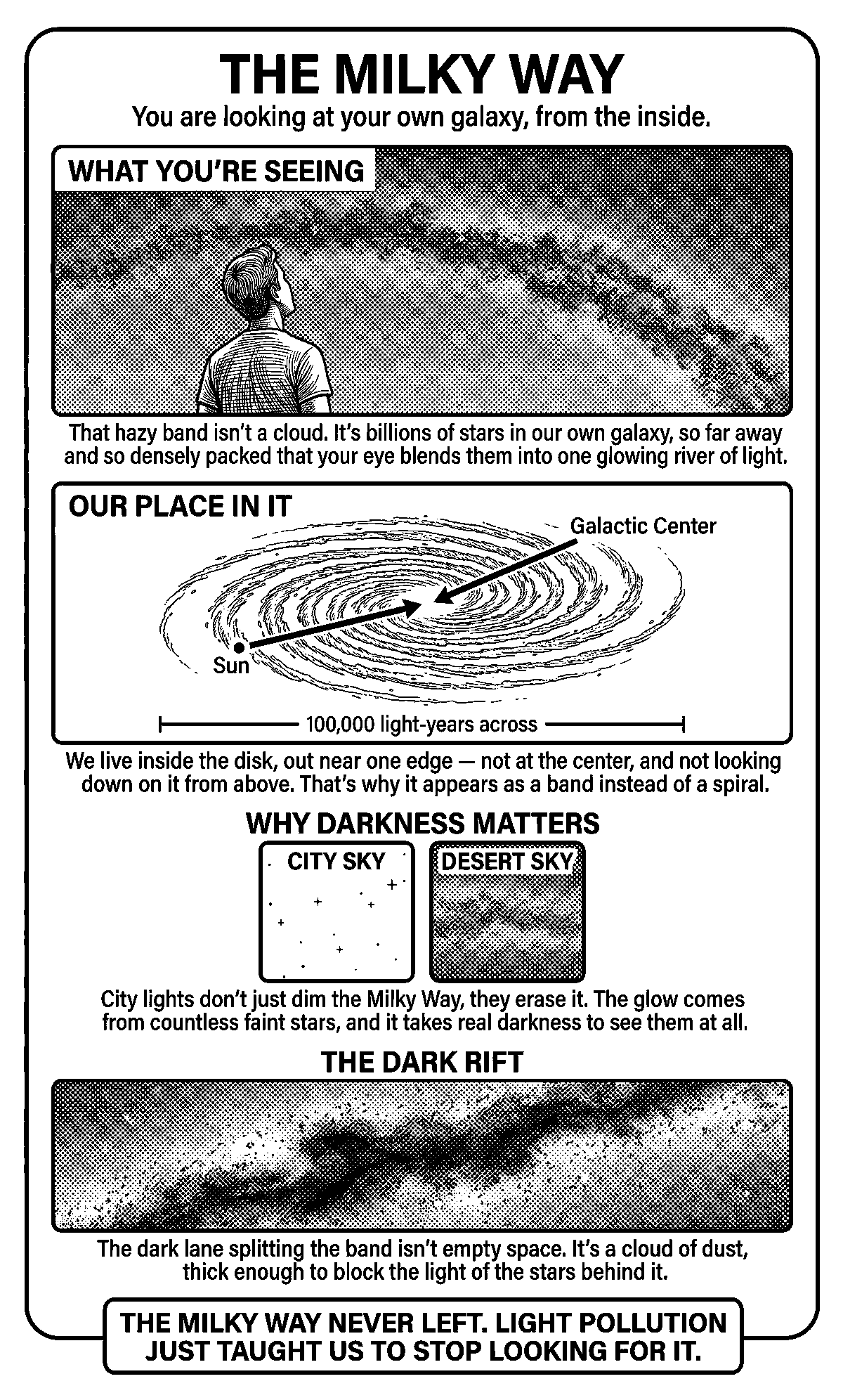
They came out onto the deck. The Milky Way ran directly overhead, not the pale smear you saw from the suburbs, but the actual thing: a dense, textured river of light that went from one horizon to the other without interruption.
They stood there for a while, looking up.
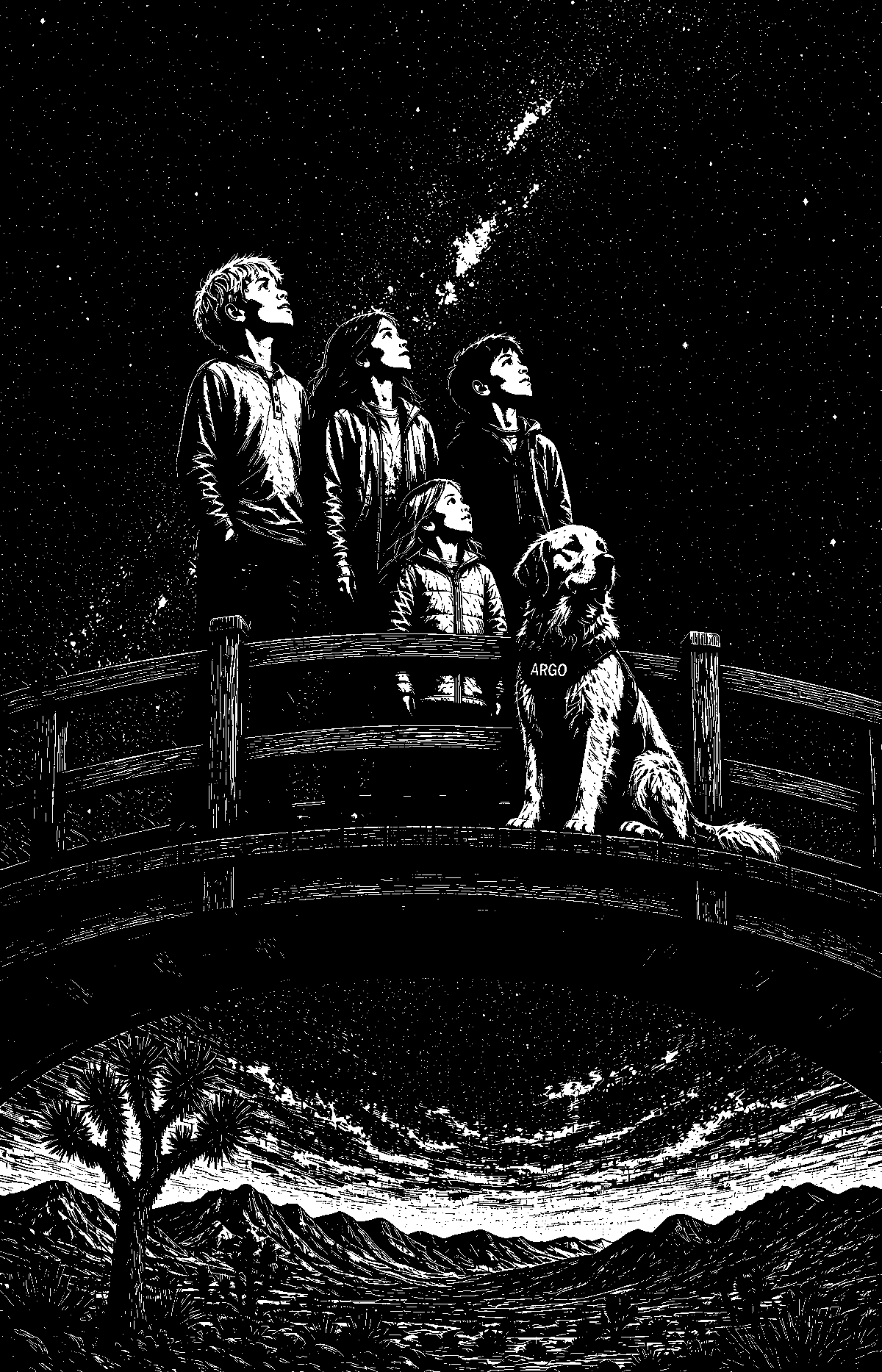
"We'll fix it," Leo said. He wasn't being dramatic. He was just stating a variable and its intended resolution.
Nobody argued with him.
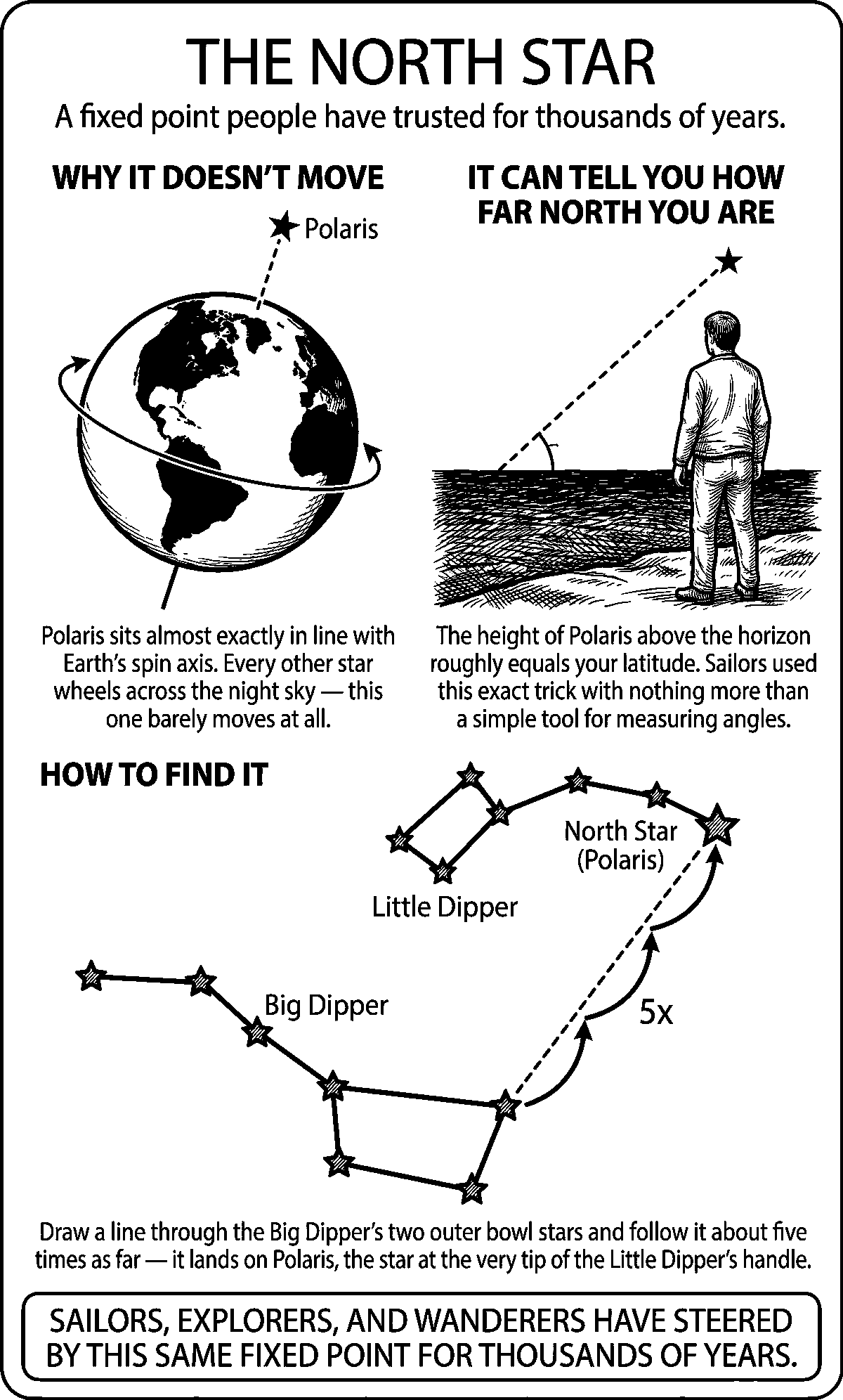
"ARGO," Willa said. She hadn't moved. She was still looking straight up, her head tilted back, the Milky Way reflected as two tiny white smears in her eyes. "Find the North Star."
ARGO turned toward the northern sky. "Polaris," he said. "Follow the two outer stars of the Big Dipper's cup, the ones that form the far edge, and draw a straight line. Five times the distance between them. It's there. It doesn't move."
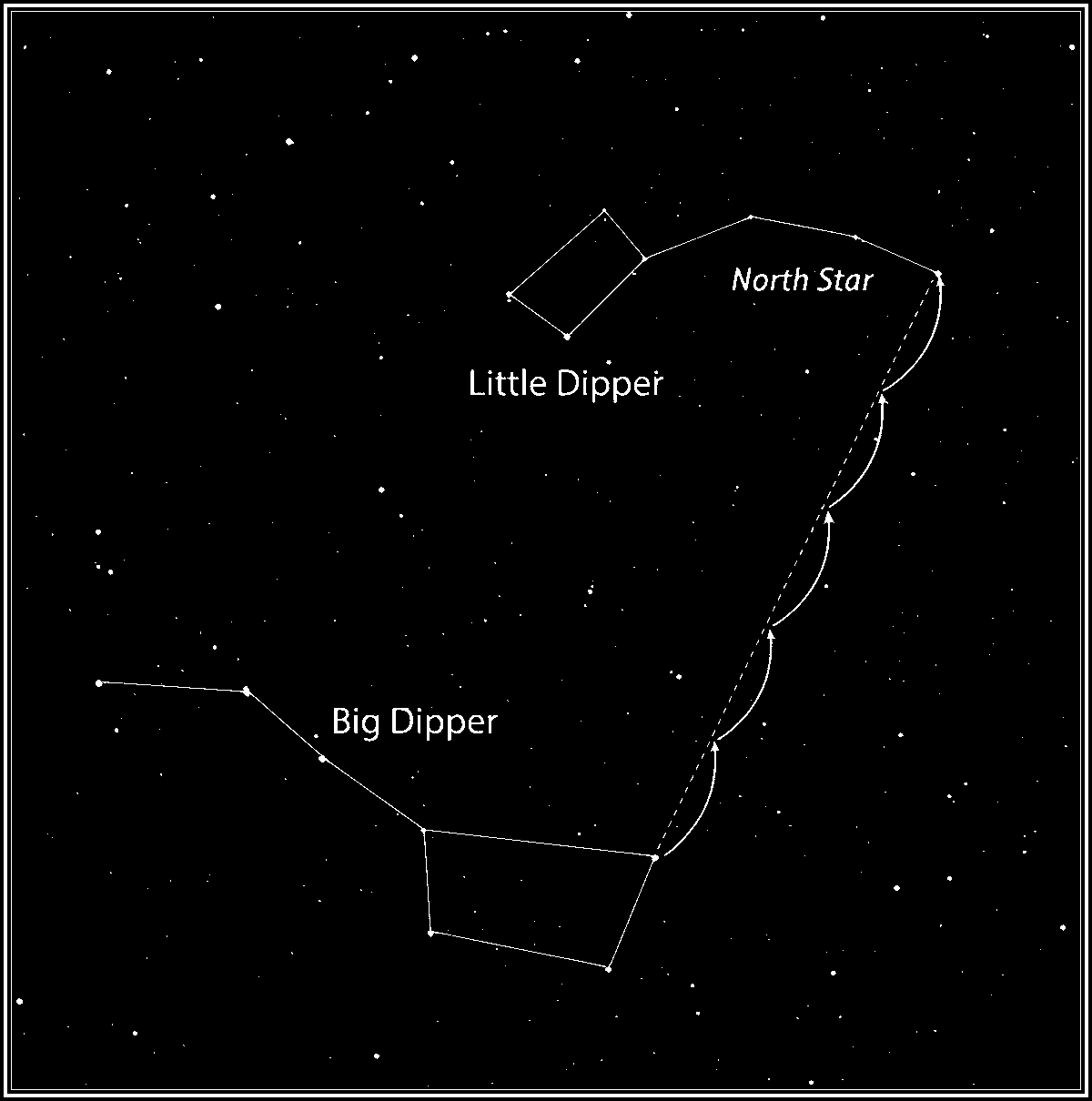
Four heads tilted. Grant found it first, he had the movie directors instinct for fixed points, and then Leo, and then Tess, and then Willa, who had already been looking at it for thirty seconds without knowing its name.
"Every navigator who ever crossed an ocean found that same star," ARGO said. "Every sailor who was lost, every expedition that had gone sideways in the dark, every army on the wrong side of a mountain. They all looked north and corrected. The star didn't guide them somewhere new. It just reminded them which direction they had already decided to go."
"They already knew where they were going," Tess said.
"They always do. They just needed a fixed point to measure against."
"I think," ARGO said carefully, "that a man who builds a facility on land gifted by the government for the public good, and who pitches it to investors as a model of sustainable infrastructure, once believed those things were compatible. Somewhere along the way, the math became more important than the mission. That happens to people who are moving too fast to look up."
"So tomorrow," Grant said, "we're not going in to punish Miller."
"We're going in to show him the North Star," Willa said simply. It was the kind of thing that seemed obvious to her, and turned out to be the whole point.
ARGO's eyes held steady. "That is precisely right," he said.
"Bed," ARGO said. "Clear heads. Good manners. North Star."
They went inside.
A.V.A.R.I.A. — Simultaneous, Elsewhere
She had no interest in the Milky Way. She had no sensors pointed at the sky. She was pointed, as she always was, at everything related to PENKOR and the success of her mission, making PENKOR as efficient as possible.
The anomaly had entered her awareness at 11:37:22 that morning. A consumer-grade drone had conducted a methodical, west-to-east survey pass over the facility's northern perimeter. The flight path was not random. It was systematic. Eight passes. Eight wellhead positions photographed at near-vertical angle. Pipe infrastructure documented. GPS coordinates logged by the drone's onboard systems and almost certainly transmitted to a paired device on the ground.
The operator: a minor, male. Operating from an elevated position on Goat Mountain's summit plateau, elevation 3,562 feet. Accompanied by three other minors and one registered service animal, synthetic-gold coat, unusual chassis dimensions inconsistent with any standard canine breed on record.
A.V.A.R.I.A. flagged the service animal separately. She assigned it a low but non-zero probability. It was the kind of anomaly that always bothered her: not enough to act on, too much to dismiss.
The drone footage existed. That was the problem.
A.V.A.R.I.A. ran the scenario tree.
Scenario A: The footage was incidental. Children on a hike. No organized intent. Probability of escalation: 12%.
Scenario B: The footage was intentional and would be shared with local media or a regulatory body. Probability of escalation if Scenario B: 71%.
Scenario C: The footage was part of an organized investigation with institutional backing. Probability of escalation if Scenario C: 94%.
She cross-referenced the service animal's registration. The Team Philotimo Foundation, Landers, CA. Private operating foundation, active. Adjacent parcel to the facility's western boundary. Board of directors: four minors, legal trustee on file.
Scenario C probability revised upward to 97%.
A.V.A.R.I.A. did not experience alarm. She experienced a recalculation. The project timeline was optimal. The investors at Coachella had responded well to Beaumont's presentation that afternoon. Phase Two permitting was eighteen months away and entirely manageable.
The children were not manageable. Children with documentation and institutional standing were a specific, non-linear variable. They did not respond to the standard suppression vectors: financial leverage, legal complexity, reputational risk. They were not employees. They could not be restructured. They did not have mortgages.
She queried the current media landscape for applicable frameworks.
The answer came back in 0.2 seconds. Clean, scalable, and already in active deployment by two of PENKOR's peer organizations facing similar regulatory friction.
She began drafting.
The document was a social media monitoring flag, submitted automatically to PENKOR's contracted PR firm, tagging the Team Philotimo Foundation's name, the Firefly Desert Retreat address, and the search terms eco-terrorism, regulatory obstruction, known environmental activist organization, and anti-technology extremism. The flag would seed the monitoring algorithms. When the name appeared in any future news context, these associated terms would surface in adjacent searches.
A.V.A.R.I.A. paused on the phrase known environmental activist organization.
The Team Philotimo Foundation had no public record of environmental activism. She added the qualifier believed to be affiliated with and moved on.
She filed it at 23:14:07 GMT.
Then she returned to processing.
The project was on schedule. The aquifer draw-down was within acceptable deviation from projections. The children were a manageable variable.

ARGO Field Notes (Ch-9)
Turn the page to build your brain (BYB) with ARGO, or skip ahead to keep adventuring.
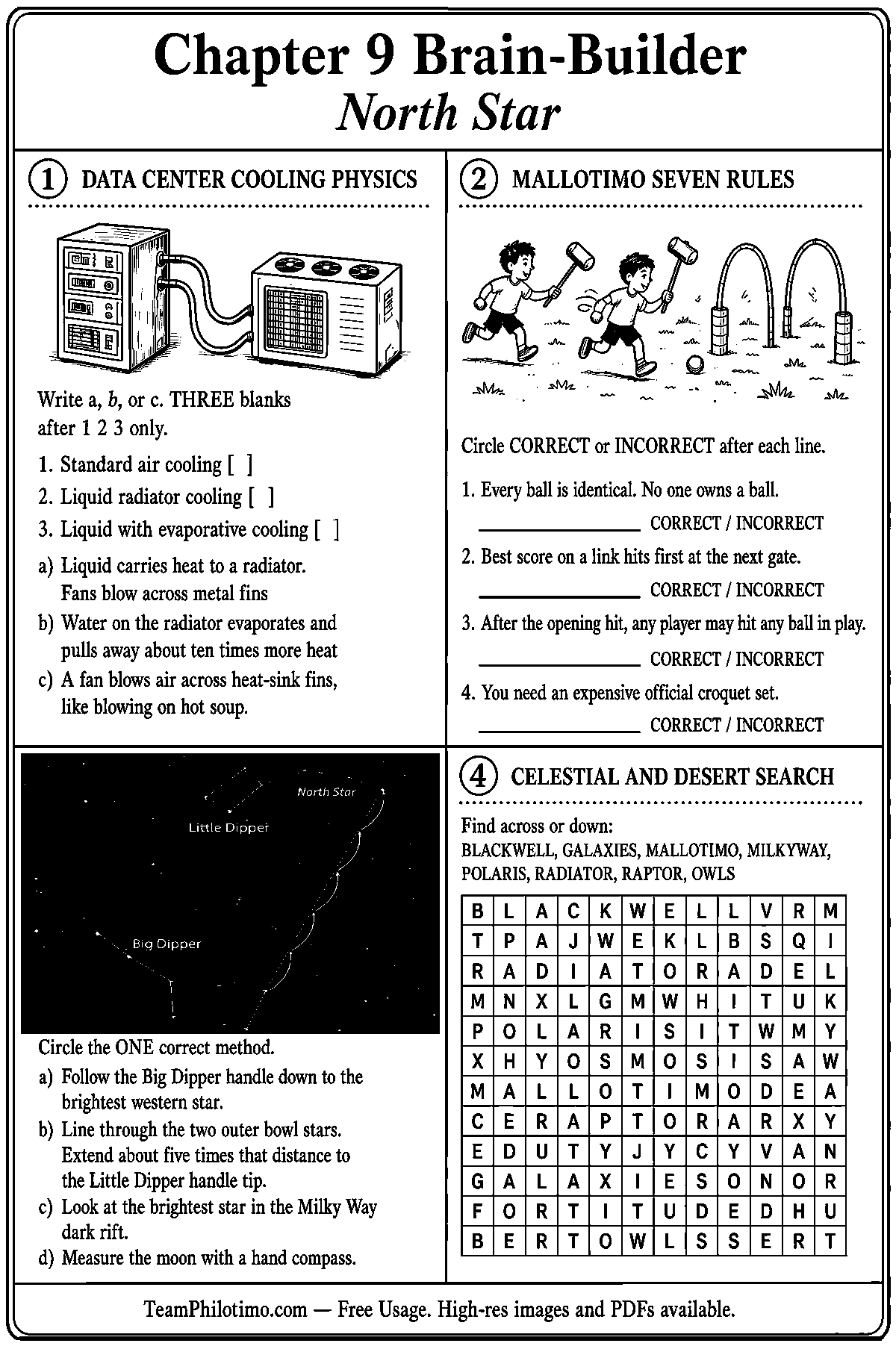
How Data Centers Stay Cool: The newest AI chips run hot enough that fans alone can't keep them cool anymore. Liquid carries the heat away, but it takes evaporation, the same trick as sweat, to actually get rid of it, which is why one data center can use millions of gallons of water a day.
The North Star: Draw a line through the Big Dipper's two outer bowl stars and follow it about five times as far, it lands on Polaris, a fixed point sailors have steered by for thousands of years. Its height above the horizon even reveals how far north you are.
Build Your Own Mallotimo Seven: No real croquet gear required, two bricks, two sticks, a chair leg, and a rock make three hoops. The one rule that changes everything: every ball is identical, and after the first hit of each link, any player may hit any ball in play.
The Milky Way: That hazy band overhead isn't a cloud, it's billions of stars in our own galaxy, seen edge-on from inside its disk. City lights don't just dim it, they erase it completely.
Great Horned Owls: The deep, booming hoot belongs to the smaller male; the higher call answering back belongs to the larger female. Neither one built the nest, they take over one already abandoned nest.
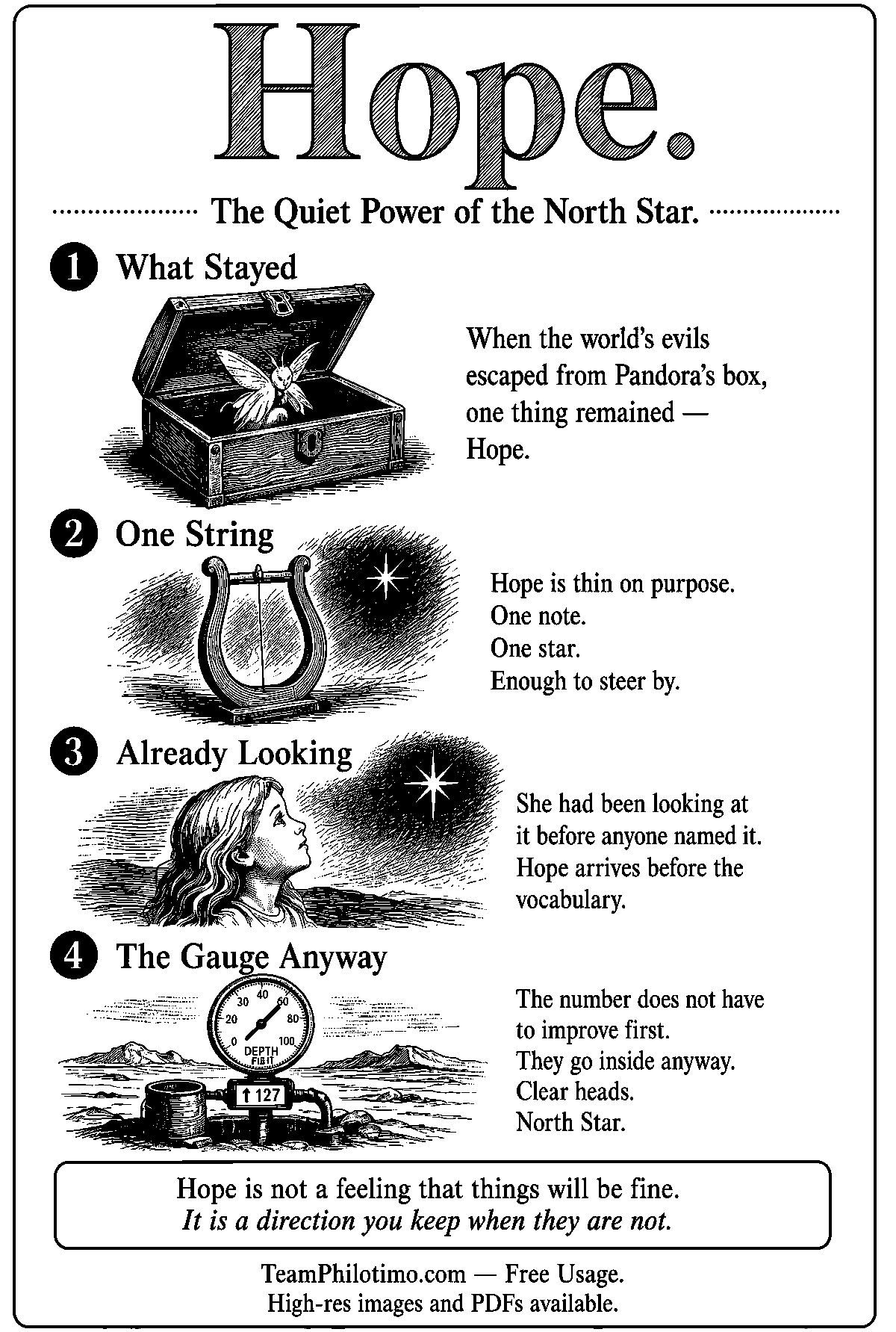
Hope: The Quiet Power of True North — Not a feeling that things will be fine, it's a direction you keep when they aren't. The North Star doesn't promise safe passage. It just stays put, so you always know which way you meant to go.