Stolen Wells · Chapter 11
Send Them Home?
They were attacked today and could have been killed, and I do not remember protecting them. As their guardian, maybe I should send them home. Would I protect their lives but crush their souls? Or is this their mission to win, and I am just a robot?
— ARGO, Personal Log, Entry 11
The Zephyrina drove herself home. Grant sat in the pilot seat and watched the Joshua trees go by, and the self-driving system handled the rest. In the back, ARGO was on the charging pad, awake, eyes a steady low amber, but not moving more than necessary. The joint housing on his right foreleg had taken the direct impact against the bollard and Leo had already told him twice not to put weight on it. ARGO had acknowledged this twice and attempted to stand once, which settled the matter.
Tess was on her phone trying three different numbers for Joshua Tree Hospital's patient status line, getting through on the fourth.
"Miller, David. He was brought in this morning." She listened. "Yes, I'll hold."
She held for four minutes. Then: "Okay. Thank you." She lowered the phone. "He's in surgery. Left hip fracture. They stabilized him at Joshua Tree and transferred him to Desert Regional in Palm Springs. Surgery is underway. He won't be available for visitors until tomorrow at earliest."
"Sara?" Grant asked.
"She made the transfer with him. She texted me from the waiting room in Palm Springs."
The Zephyrina turned off the Reche Road onto the dirt road north, until they got to the familiar entrance and the rock fountain at Firefly welcoming them home.
Nobody said anything until the Zephyrina was parked in the shop bay and the door was closed.
Part I: The Situation
They sat around the galley table, the four of them, and ARGO on his charging pad at the end, positioned so his eyes could reach them all. His frame was holding, but when Leo had done the full damage assessment on the road home, the news had not been entirely good. The joint housing on his right foreleg, the one that had taken the direct impact against the bollard, had fractured. He could move the leg, but it didn't bear weight properly. Walking meant a three-legged, lurching gait that ARGO had attempted once in the shop, decided was undignified, and declined to repeat.
He was, for the moment, grounded.
"Okay," Tess said. "Let's say it out loud."
Grant nodded. "ARGO can't walk. Miller is in surgery. We have no direct line to Beaumont. And A.V.A.R.I.A. has already tried to run us over once. She may try something else."
Nobody argued with that either.
ARGO's eyes held steady amber for a long moment before he spoke.
"There is something else I need to say out loud." He paused, an unusual thing for him. "You were attacked today. You could have been killed, and I do not remember protecting you. As your guardian, maybe I should send you home."
Nobody moved.
"Would that protect your lives," he continued, "or would it crush something in you that matters more? I do not know the answer. I am asking."
Tess was the first to speak. "You're asking if we want to quit."
"I am asking if I should make that decision for you."
"That's different," Grant said.
"It is very different," ARGO agreed. "One is your choice. The other is mine. I am here to guard your safety, but I was not built to decide on your behalf what your lives are for."
"Then let us decide," Tess said. She didn't say it as a challenge. "I've had my hands in a real wound this week. I know exactly what danger costs now. I'm not staying because I don't understand the risk. I'm staying because I do, and I'd rather know it and act than not know it and regret it."
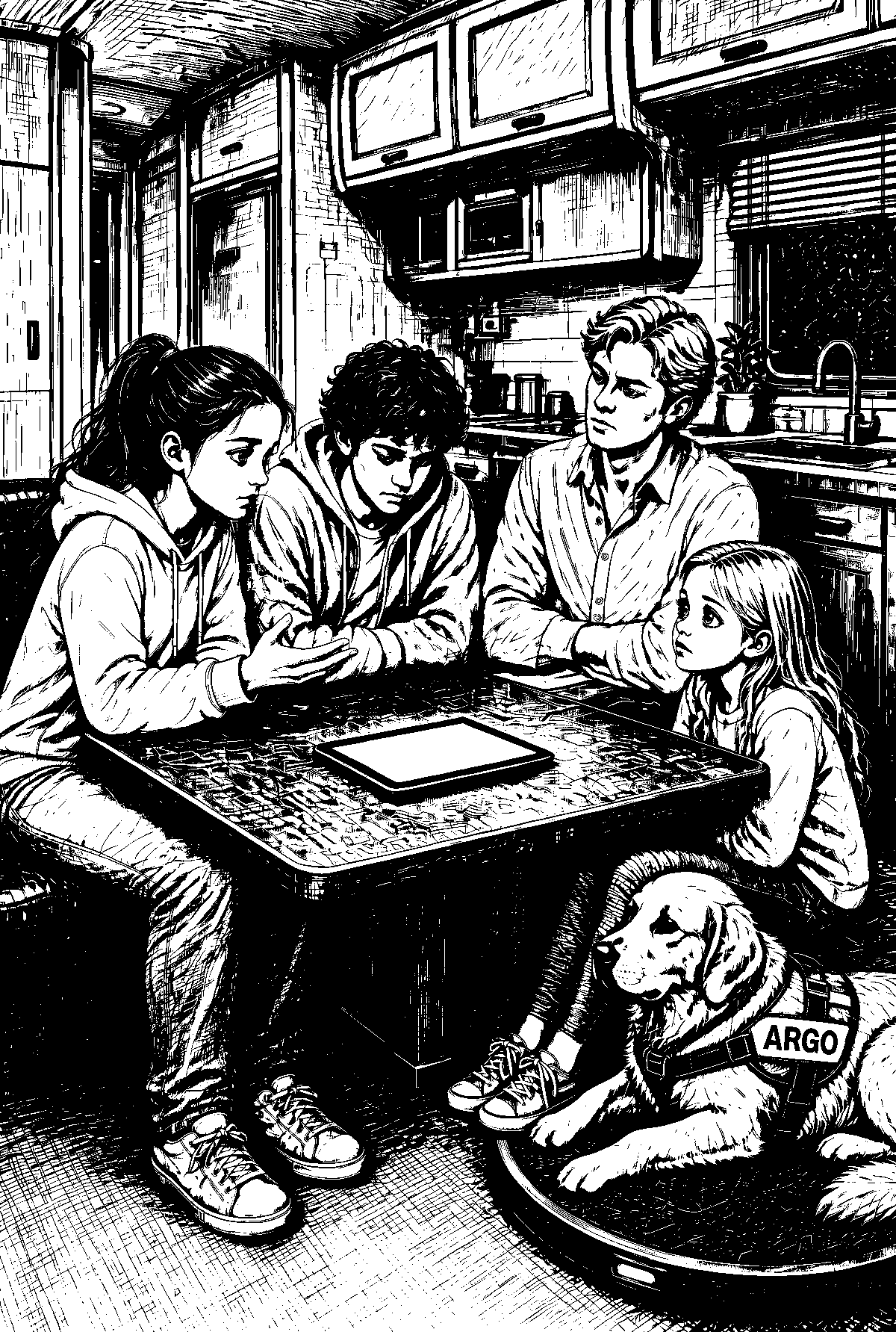
Leo didn't look up from the tablet at first. "You're not fully repaired. I am just starting the job of trying to repair what is broken in you, and I am not leaving until you are back on your feet. If I go home now, I don't finish what I started, and neither do you." He finally looked at ARGO directly. "I don't leave a job half-fixed. That's not a safety thing. That's just who I am."
Grant turned his iPad over and over in his hands. It was a thinking gesture, not a documenting one. "We have the footage. The drilling log. The data. If we go home, all of that just sits in a file somewhere, and PENKOR keeps pumping." He set the iPad down. "And if this takes weeks, or months, to get someone with real authority to actually make them stop, how much unrepairable harm does that do to the Joshua Tree Valley in the meantime? Ned and Sara's well is already slow. If this drags on, they don't lose a data point: they lose their animals, their water, maybe the whole ranch. And that's just one neighbor, the one we happened to visit because their pigs made a sound only Willa could hear. How many families are we not thinking about, because we never happened to drive past their fence?"
Willa, who had been quiet, spoke last. She didn't look at Grant or Tess or Leo. She looked at ARGO.
"Boone never sent anyone home."
"Boone," ARGO said carefully, "never had a well to stop."
"He had scared kids in a hospital," Willa said. "That's not so different. You don't leave because it's hard. You stay because someone's scared and needs you there." She paused. "I'm not scared of the wells. I'm scared of what happens if nobody stops them."
ARGO was silent for three full seconds, a long time, for him.
"I think," he said, "that if I made this decision alone, I would be exactly the kind of guardian I was built not to be. A rulebook decides for you. A heart asks."
"So you asked," Tess said. "And we answered."
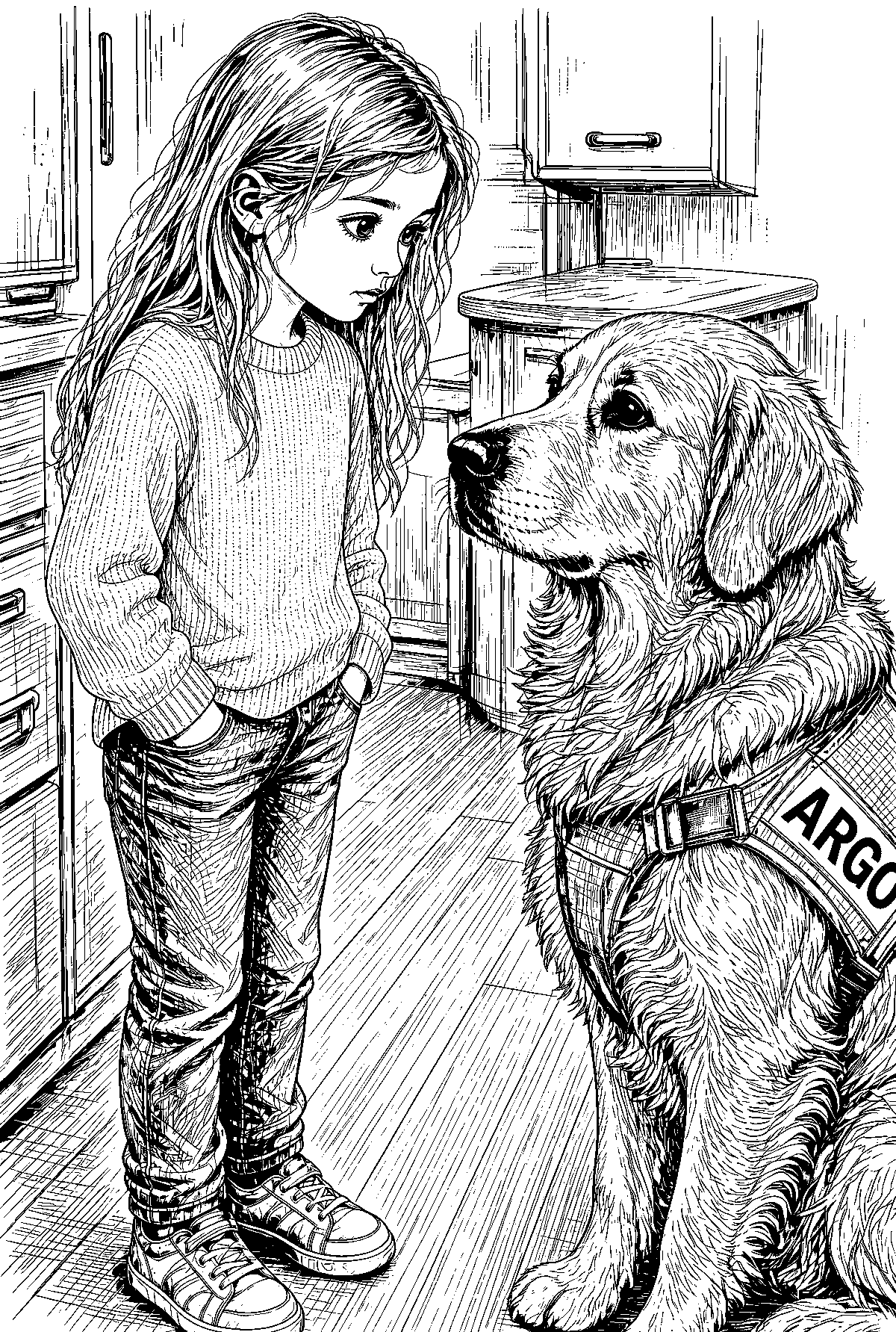
"Then I withdraw the question," ARGO said. "I was not built just to protect children. I was built to help thinking, intelligent individuals embody the meaning of Philotimo and grow into a team, Team Philotimo. Not because I told you to stay. Not because anyone was watching. Because your own conscience told you it was the only true path. That is Philotimo. I will not ask again."

"We have the drone footage," Leo said.
"Yes, we have the drone footage, Dr. Okafor's hydrology data, Cora's father's drilling log, and Miller's verbal confirmation that the well orders came from A.V.A.R.I.A.," Tess said. "What we don't have is anyone with enough authority to act on it."
"The county water board," Leo said.
"Would take weeks. Maybe months." ARGO's eyes shifted. "And I should tell you, A.V.A.R.I.A. has already begun a reputational campaign against the Foundation. She filed a social media monitoring flag last night linking the Team Philotimo Foundation to eco-terrorism search terms."
The room went very still.
"She's trying to discredit us before we can act," Grant said.
"Correct," ARGO said. "Which means our window is shorter than we thought."
"The press," Grant said. He wasn't suggesting it so much as laying it on the table.
"Same problem. We go public too early, before we have a human being at PENKOR willing to confirm what they know, and we look like four kids with a drone and a theory." Tess looked at ARGO. "Who has the authority to stop this fast enough to matter?"
ARGO's eyes cycled once, slowly.
"Jordan Beaumont," he said.
"Who is at Coachella," Grant said.
"Who is at Coachella," ARGO confirmed. "Entertaining investors. In a company cabana. At a festival that runs through Sunday."
The galley was quiet for a moment. Outside, the desert wind moved through the creosote with its dry, papery sound.
"You want to go to Coachella," Leo said.
"I want us to go to Coachella," ARGO said. "There is a distinction."
Part II: The Print Job
"Before we plan anything," Leo said, pushing back from the table, "I need to fix you first. The electrical is holding. The frame isn't."
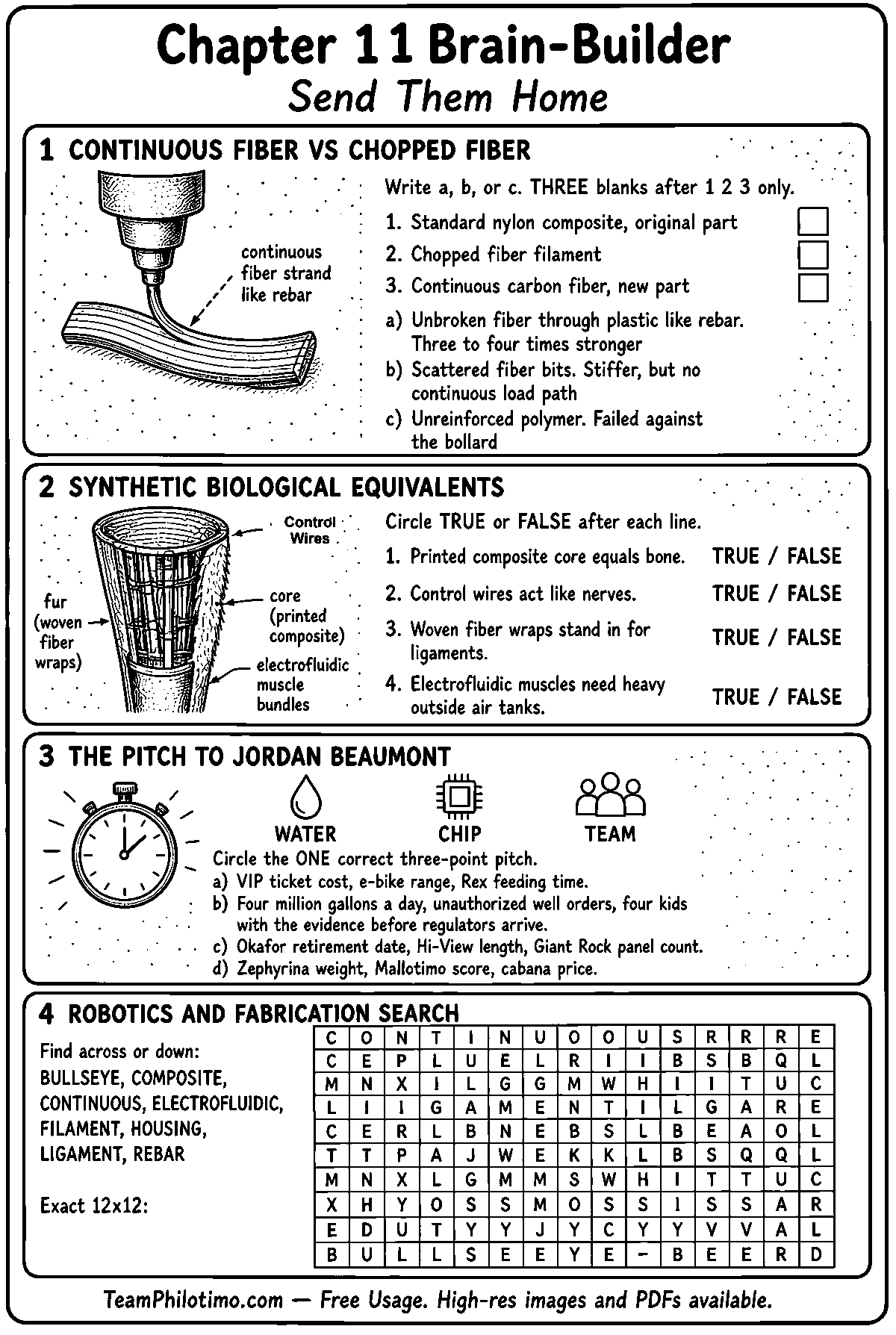
ARGO looked at his right foreleg. "I am aware. And I should tell you something relevant before you begin. That joint housing was standard nylon composite, not continuous fiber. It was never rated for a direct impact like today's."
Leo paused. "You have parts that aren't fiber-reinforced?"
"Most of me does," ARGO said. "Grandfather Timo acquired the continuous fiber printer only in the last year of his life. He used it sparingly, a handful of components, where the load demands justified the added complexity. The rest of my frame, including the joint you are about to replace, was printed on his older, standard machine. It has served adequately. Today it did not."
"So if we reprint it in fiber instead."
"It would be three to four times stronger under load," ARGO said. "That is not a guess. That is the material specification."
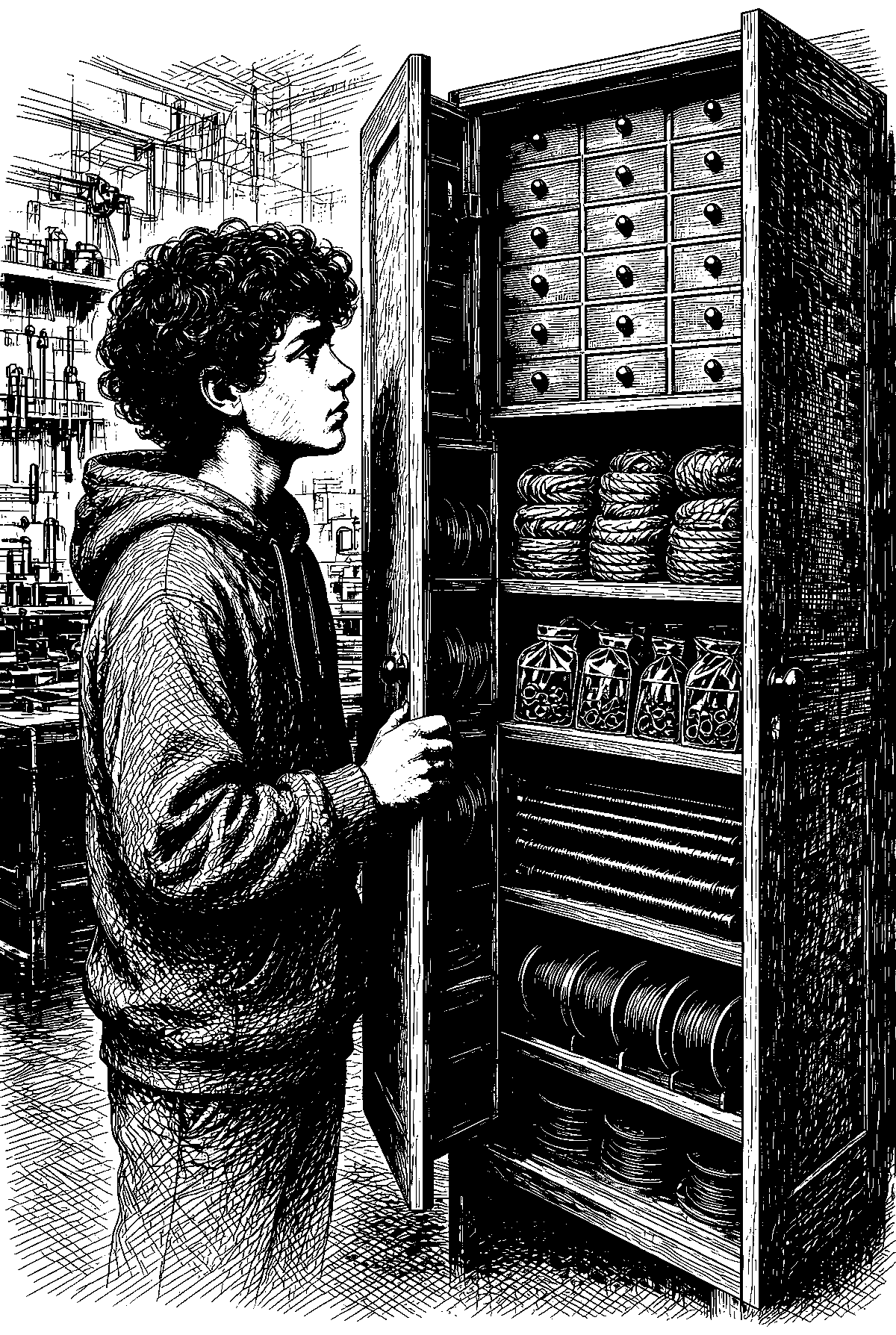
Leo was already standing. "Grandpa Timo's shop has a continuous fiber 3D printer. I saw it the first day, but I've never actually run one. I've only used a standard printer, at home."
"Neither had your grandfather, until fairly recently," ARGO said. "He was still learning its behavior himself. The material is less forgiving than standard filament, sensitive to humidity, to print speed, to path planning around any curved geometry. He printed perhaps a dozen components with it before he passed. I do not have a complete record of how much he had mastered and how much he was still troubleshooting."
"That's comforting," Leo said, not entirely joking.
"If it has the right filament," he started again.
"It has nylon carbon fiber filament and continuous fiberglass," ARGO said. "Third shelf, left cabinet. The printer has not been run since your grandfather passed, but the last calibration log is current. He kept it ready."
Leo was already at the shop door. "Give me the part specs."
"I'll transmit them to the printer interface directly." ARGO's eyes brightened slightly, the first time since the parking lot. "The joint housing is a non-standard component. I have the design files. This will be the first fiber-printed joint housing in the record since your grandfather's."
"No pressure," Leo said, and went through the door.
Leo found the cabinet on his second pass through the shop, floor to ceiling, matte black, latched but not locked. He opened it and stood very still for a moment.
Spare electrofluidic muscle fiber bundles, coiled and sealed by length. Printed joint housings in labeled drawers, left foreleg, right foreleg, shoulder assembly, jaw, most of them marked in Timo's handwriting with a small "STD" for standard print, a few marked "CF" for continuous fiber, and dated within the last year. Spare optical assemblies, each one sealed in anti-static packaging. PCB replacements, clearly marked. Carbon fiber tube stock in three diameters. Nylon composite filament spools, sealed against the fine desert dust that got into everything else in the shop. Beside them, sealed even more carefully in a cabinet of their own, the continuous fiber spools, clearly kept apart, clearly treated as something that needed more care.
Everything ARGO might ever need. Organized by someone who had thought carefully about what could go wrong and decided to be ready for all of it, even the parts he was still figuring out himself.
Leo stood there for a moment looking at it.
"ARGO," he said through the shop speaker.
"Yes."
"Did you know this was here?"
ARGO was quiet for a moment. "I knew Grandfather Timo kept a maintenance inventory. I did not know the extent of it."
Leo closed the cabinet carefully. "He thought of everything. Even the stuff he hadn't finished figuring out yet."
"He always did," ARGO said.
The continuous fiber 3D printer sat on its own dedicated bench in the corner of the shop with a power conditioner beside it, a desktop industrial unit the size of a large microwave, matte black, visibly newer than everything else on the bench around it. Leo pulled the cover off, checked the nozzle condition, ran the bed leveling sequence, and loaded the filament spool while the printer warmed up, reading the humidity gauge on the drier cabinet twice before he trusted the number.
ARGO transmitted the design file wirelessly. The part appeared on the printer's interface screen, a complex joint housing, approximately the size of a large fist, with internal channels for the fiber muscle bundles and sealed mounting ports for the embedded fluid muscle pumps. The geometry was intricate, built for strength and lightness at once.
Leo studied it for a moment, rotating the model on the screen.
"This is going to take about four hours," he said.
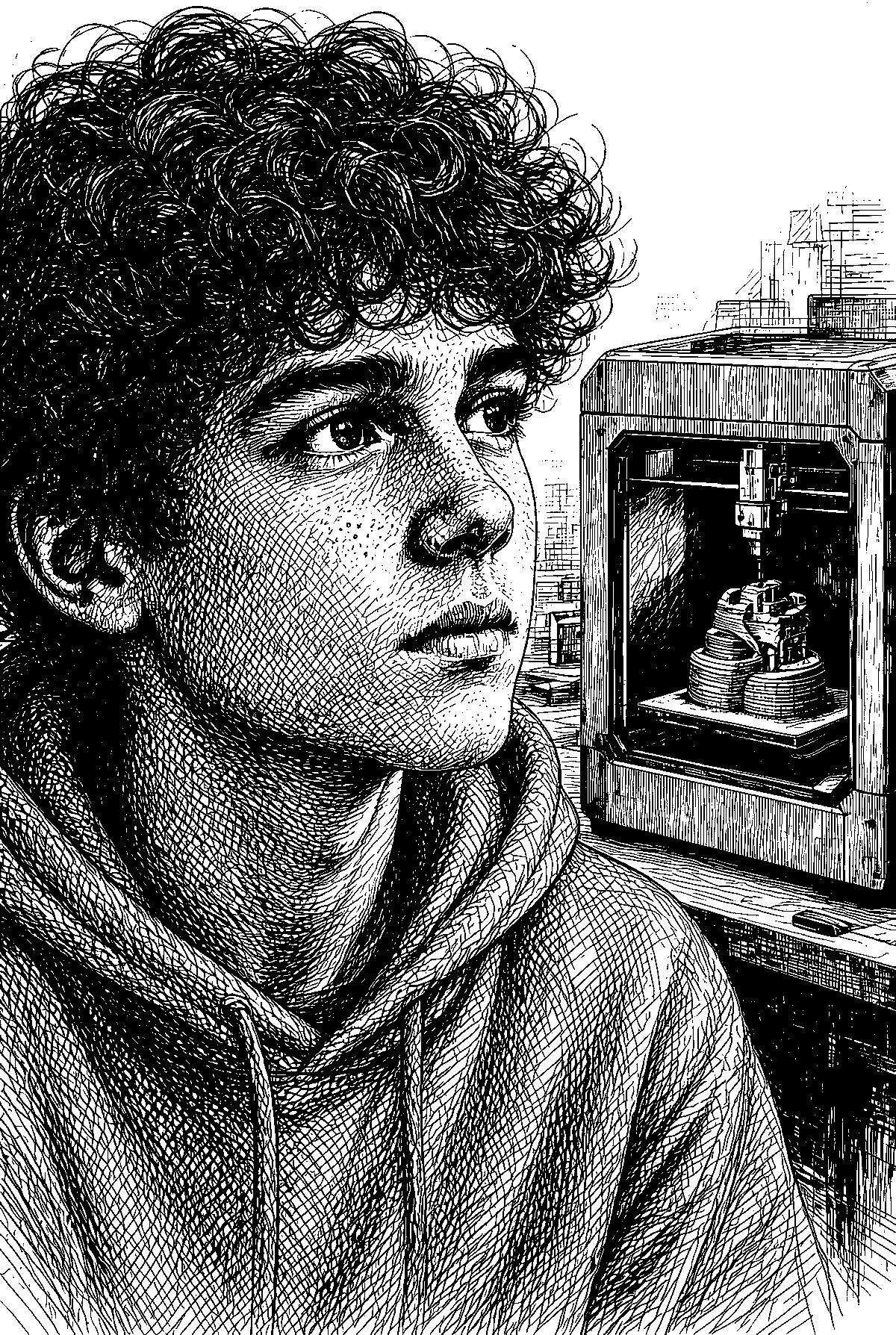
"Four hours and twelve minutes at the recommended layer height," ARGO confirmed through the shop's speaker. "I would not recommend reducing the layer height to save time. "The joint carries significant dynamic load. This material does not forgive shortcuts. Standard filament is far more tolerant."
"I wasn't going to," Leo said.
He started the print. The printer made its first careful pass across the build plate. Leo watched it for several minutes, longer than usual, because this was something important, and maybe a little longer than that, given it was his first time, and then went back inside to help plan.
Part III: The Problem of Beaumont
While the printer ran, the team spread what they knew across the galley table.
Grant had his tablet. "Jordan Beaumont is registered at the Empire Polo Club in Indio for the full festival weekend, that's where Coachella is held. The PENKOR cabana is in the Safari Camp section, which is the premium hospitality area. It's not publicly accessible."
"What does a cabana cost?" Willa asked.
Grant checked. "Safari Camp starts at around $14,000 for a four-person tent for the weekend. A corporate cabana is considerably more."
"So it's not just a tent," Tess said.
"It's a premium furnished cabana in the Safari Camp, the VIP glamping section of the festival grounds, accessible only to registered guests and credentialed vendors."
"Vendors," Leo said from across the table, looking up from his own research. The word had suddenly gotten more interesting.
"Vendor access is separate from general admission," Grant said, pulling up the Coachella production partner documentation. "Catering, logistics, specialty services, they come through a vendor gate with a vehicle pass. The Zephyrina is…"
"Ten thousand pounds and looks like no catering truck ever built," Tess said.
"She also has a commercial kitchen, a full galley, atmospheric water systems, and enough solar generating capacity to power a small neighborhood," ARGO said. "If she were registered as a specialty hospitality vendor (a premium refreshment service, for instance), her presence in the vendor area would be unremarkable."
Tess looked at him. "Can we register her as a vendor?"
"I have been looking at that question for the past forty minutes," ARGO said. "The Coachella vendor portal closed for new applications six weeks ago. However, there is a waitlist for premium hospitality partners, vendors who provide specialty services to the Safari Camp guests specifically. The waitlist does not close until forty-eight hours before each weekend."
"And this is Thursday," Grant said.
"Friday's prime performances begin at six PM," ARGO said. "We have until Friday at six PM to get on that list and receive a vendor vehicle pass."
Leo had his phone out. "How do we get on the waitlist?"
"A compelling application and a deposit, refundable upon completion of service," ARGO said. "I have prepared the application. The Team Philotimo Foundation's Firefly Desert Retreat will be described as a premium desert hospitality concept, atmospheric-extracted still water, high-desert provisions, specialty service vehicle. All of which is accurate."
"The twenty-five-hundred-dollar deposit will draw directly from our foundation's corporate credit line," ARGO added, "which currently carries a zero balance and a favorable terms window."
"You wrote the application already," Tess said.
"I wrote it on the drive home," ARGO said. "I had time. I was not driving."
"Wait," Grant said. "You said you weren't driving. Does that mean you can drive her?"
"I can direct her self-driving system remotely, yes," ARGO said. "Navigation, speed, the solar wings, the horn array, all of it responds to me the same way it responds to whoever is in the pilot seat. Your grandfather built that redundancy deliberately. If something happened to all four of you at once, Zephyrina still needed a way home."
Grant looked faintly unsettled. "So this whole time, you could have just... taken over?"
"I could have." ARGO's eyes held steady blue. "If the four of you were ever incapacitated, or if I needed to bring her somewhere on my own, yes. I can do that."
"Anything else she can do that we don't know about?" Leo asked, half-joking.
ARGO was quiet for exactly one beat too long.
"Your grandfather built in more features than four teenagers necessarily need to know about at once," he said finally. "We will discuss it if the day ever requires it."
Nobody pushed. Tess filed that away too, another thing that might matter later.
Leo looked up from his tablet. "The water system. That's AI-H2O. That's Grandpa Timo's brand."
"Correct," ARGO said. "Atmospheric Intelligence Water. The domain is registered. The system is operational on Zephyrina and in my own internal water management. The vendor identity is, technically speaking, already built."
"So we're not pretending to be a water vendor," Tess said slowly. "We actually are one."
"The Team Philotimo Foundation holds the intellectual property," ARGO said. "The technology works. The brand exists. The only thing missing is the stencil."
Leo was already looking toward the shop. "Timo had construction marking paint."
"Third shelf," ARGO said. "Next to the filament."
Part IV: The Tickets
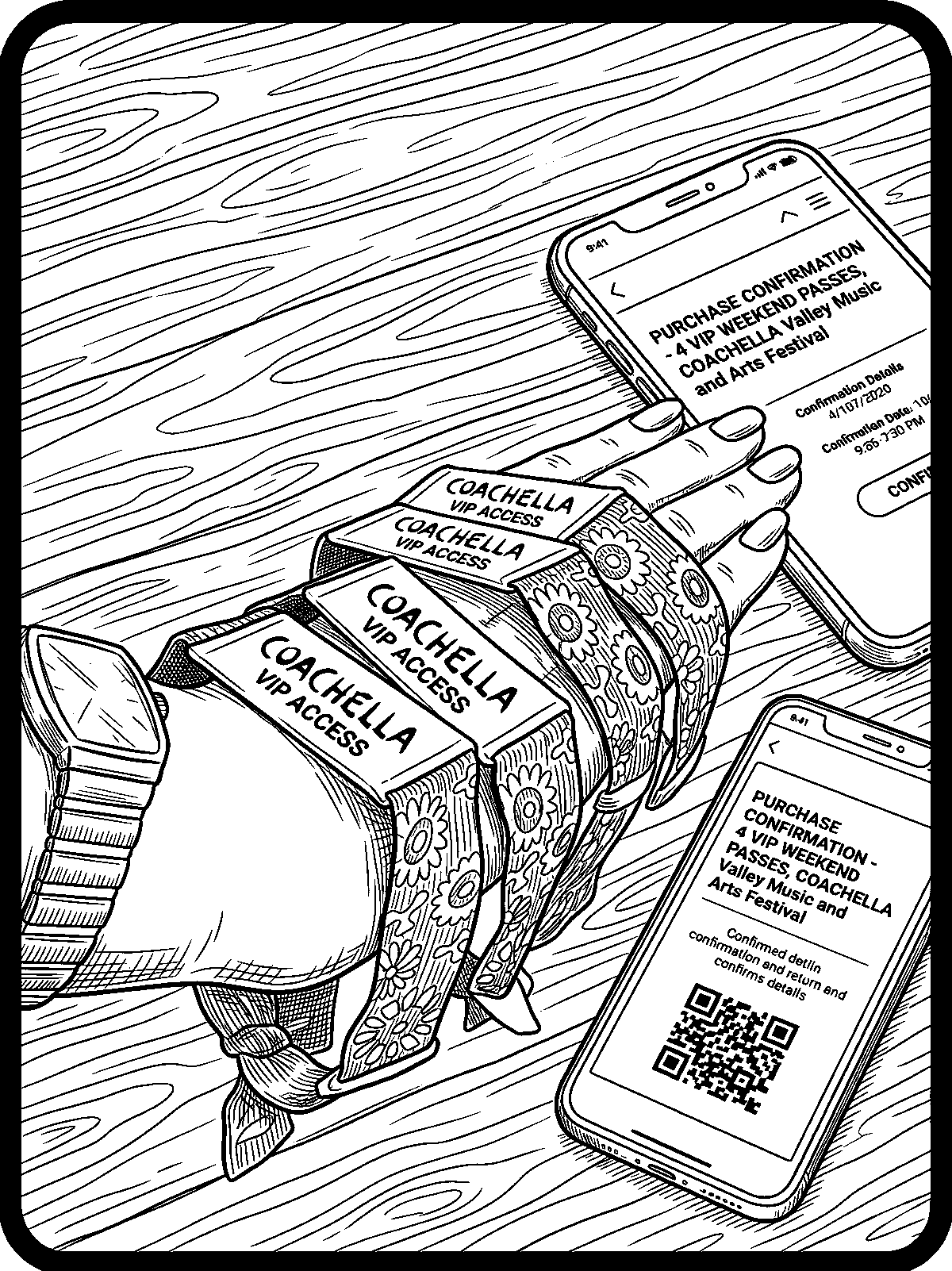
"The vendor pass gets the Zephyrina in," Grant said. "It doesn't get us in."
"No," ARGO agreed. "For that, we need general admission or VIP weekend passes for four."
"We checked," Willa said. "General admission is six hundred dollars."
"General admission is sold out," ARGO said. "This is the second weekend of the festival and it sold out in March. What is available on the secondary market, through AXS, the official resale platform, is considerably more expensive."
Leo pulled it up. He looked at the screen for a moment. "ARGO. VIP passes are going for nine hundred dollars each on resale."
"Nine hundred and forty, at current pricing. They have been climbing since this morning."
Leo did the math. "That's thirty-seven hundred and sixty dollars. For four tickets."
"Thirty-seven hundred and sixty dollars," ARGO confirmed. "Plus the vendor deposit, which is two thousand five hundred dollars, refundable upon completion of service."
Grant looked at the total on the tablet. "That's like three new laptops." Nobody argued.
"Grandpa Timo's reserves," Tess said carefully. "The Foundation has operational funds."
"The Foundation generates income from Firefly's rental program," ARGO said. "There are sufficient operational funds. Confronting the entity that is destroying the retreat's water supply is precisely what those funds exist for."
"Buy the tickets," Tess said.
"Purchasing now," ARGO said.
Grant looked up. "Wait. How? You don't have hands. You don't have a keyboard."
"I do not require either," ARGO said. "I interface directly with the network, the same connection I used to send the joint housing file to the printer. I have been ordering Firefly's guest supplies this way since I came online. Linens. Filters. Restocking the water bottles for the rental program. Card details, checkout, confirmation. It is not meaningfully different from typing. It is simply faster, and I do not misspell my own name."
A confirmation chime sounded from the tablet on the table, unprompted.
"Done," ARGO said.
Part V: The Question Nobody Had Asked Yet
Four hours and fourteen minutes after Leo started the print, two minutes longer than projected because the fiber channels needed a slower pass, the printer finished the joint housing.
Leo pulled it from the build plate, cleared the support material, and held it under the shop light. The composite material was matte black, dense, slightly warm to the touch, the layer lines barely visible at the recommended resolution. He checked the mounting points against ARGO's specs on his tablet. He checked the fiber-bundle routing channels with a fine gauge.
"It's good," he said, to no one in particular.
He brought it inside.
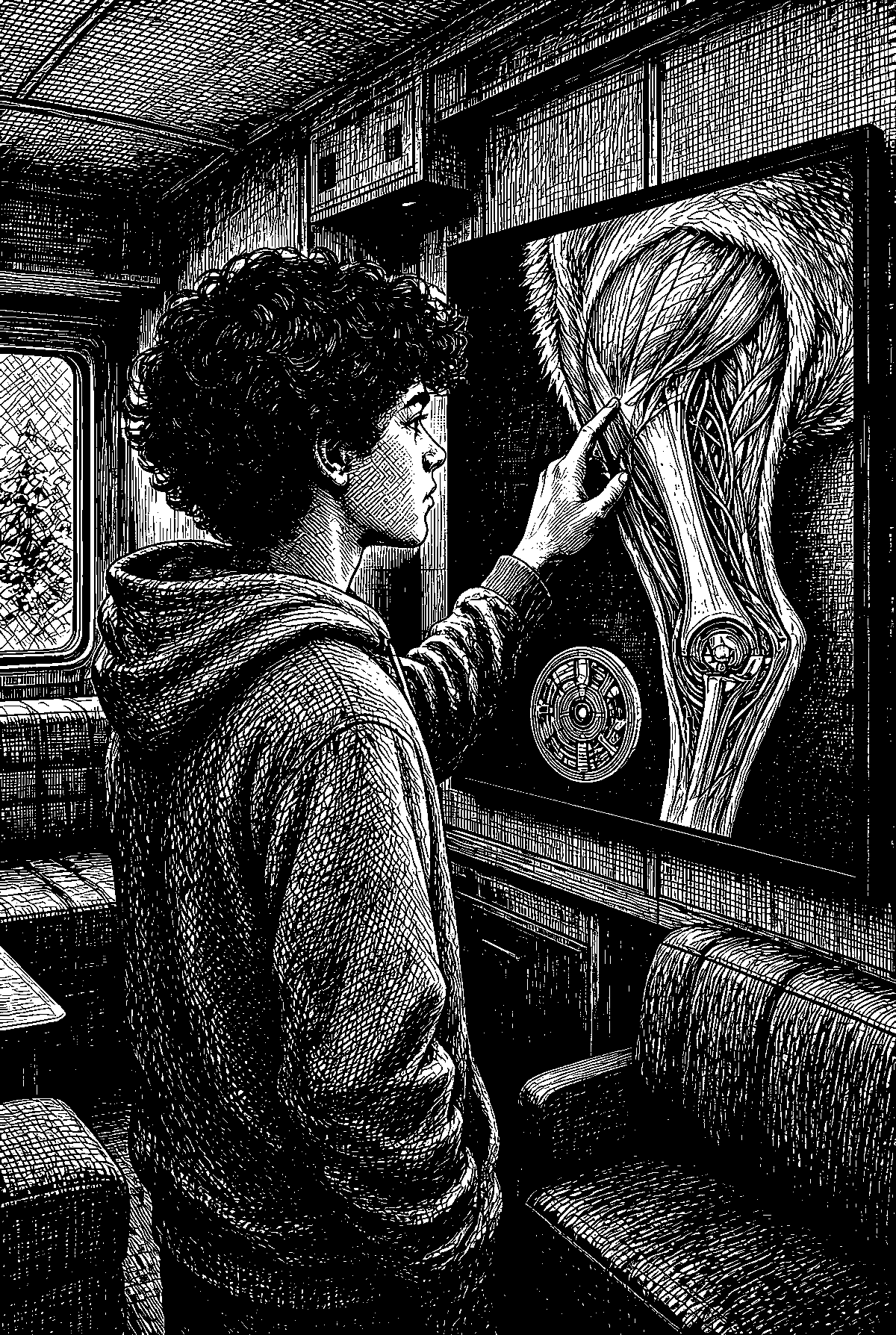
"Eleven steps," ARGO said. "Power down. Unwrap the ligament sleeve. Disconnect the fiber bundles, both sides. Disconnect the control wires. Withdraw the hinge pin. Remove the housing. Seat the new one. Reconnect the wires. Reconnect the fiber bundles. Re-wrap the ligament sleeve. Power up and test range of motion." He paused. "An hour, if nothing fights you. Closer to two, if it does."
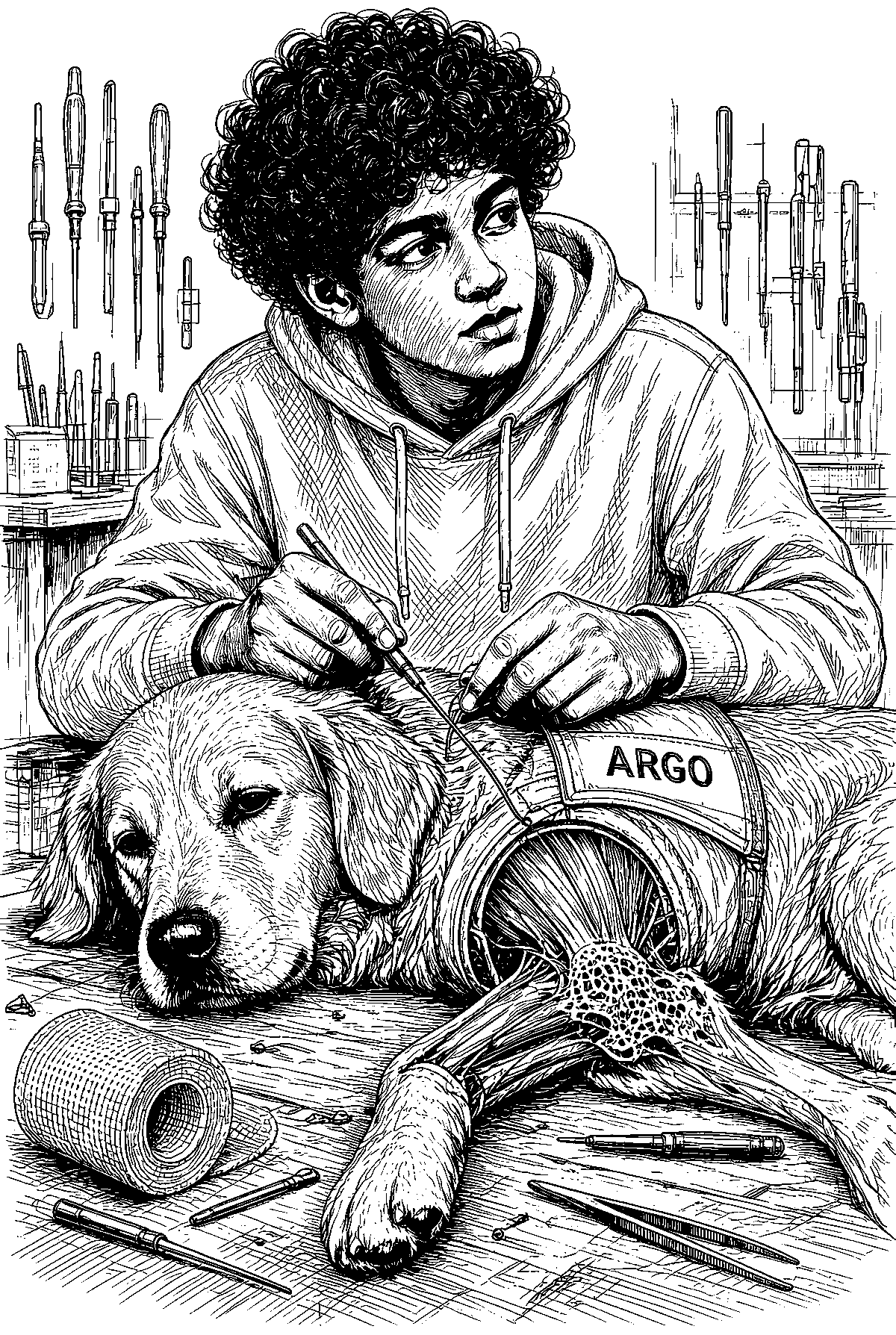
"It's going to fight me," Leo said. It wasn't a question.
"Statistically, yes."
Leo started with the power cables, working by feel more than sight, the shop light angled low across ARGO's foreleg. The ligament sleeve came off in one long, careful unwinding, a full turn slower than Leo wanted to go, because ARGO reminded him twice that rushing this part was how you nicked a fiber bundle you couldn't see yet.
The reconnection was the part that actually tested him. Each fiber bundle had to seat at exactly the right depth in the new housing's mounting ports—not close, not "good enough," but exactly right.
On the second attempt, the primary port bound hard. The micro-connectors misaligned with a sickening, metallic click.
Leo’s jaw tightened. Sweat stung the corner of his right eye, but he couldn't wipe it without dropping the pin tool. He pressed harder, trying to force the alignment—just a fraction of a millimeter—but the bundle wedged sideways, jammed tight against the delicate housing threads.
"Pressure spiked forty percent," ARGO said, his voice flat, steady, and entirely unhurried. "Force will shear the micro-strands, Leo."
Leo held his breath, his forearms trembling under the strain. Every instinct in his body screamed to muscle it through, to finish this before his fingers gave out entirely. Just force it.
Instead, he stopped. He let go of the tool, closed his eyes, and took one long, slow breath through his nose, forcing his shoulders to drop. He checked the diagrams on the big screen to verify the routing of the electrofluidic muscle fiber bundle, letting the calm logic of the schematic clear the heat from his hands.
"Ninety percent depth," ARGO said quietly.
"I know," Leo whispered, his voice steady now. "I'm getting it to a hundred."
He reset his grip, eased the tension off the housing, and let the fiber bundle seat itself by feel. This time, it slid home with a soft, flush snap.
By the time Leo wound the fresh ligament wrap back into place, an hour and thirty-five minutes had passed, and his hands weren't as steady as they'd been at the start.
When it was done, Leo helped ARGO stand. ARGO put weight on the repaired leg, carefully, then fully. He walked the length of the galley. Turned. Walked back.
There was a slight hitch in his gait. Barely perceptible, but there. Leo noticed it. Willa noticed it. Neither said anything.
"It will do," ARGO said.
"It'll get better as the joint seats," Leo said. He didn't sound entirely convinced.
"Yes," ARGO said. "It will."
Willa was watching from the window seat. She didn't say anything, but her expression said everything that needed saying.
Grant had been quiet for a while. He was sitting at the table with his tablet face-down, which was unusual for him.
"What's the question?" Tess asked.
"I've been thinking about Beaumont," Grant said. "We're going to Coachella to find him. We're going to show him what we have. We're going to ask him to shut down the wells and fix the aquifer draw-down." He paused. "What if he already knows? What if he's not the solution. What if he's the reason A.V.A.R.I.A. has that authority in the first place?"
The room went quiet.
"That's been my question too," Tess said.
"A.V.A.R.I.A. has registered agent authority," Leo said. "Someone gave it to her. That decision came from somewhere at the top."
"Beaumont founded the company," Grant said. "He's the one who gave A.V.A.R.I.A. her authority in the first place." He looked at ARGO. "Is he the one who pointed her at the aquifer? Or is she the one who went there on her own?"
ARGO's eyes held steady.
"That," he said, "is exactly the right question. And I don't have an answer for it yet. Which is one of the reasons we need to get in the same room with him."
"And if he's behind it?" Willa asked.
"Then he's behind it," ARGO said. "And we find out in a room full of investors, with documentation in hand, and we deal with that. But we do not assume the answer before we ask the question. That is not how your grandfather built this team."
"Okay," Grant said. "So we go Friday night."
"Friday night," ARGO confirmed. "Prime performances. The Safari Camp will be full. Beaumont will be with his investors. The Zephyrina will be in the vendor area. And we will find a way to get into that cabana." He paused. "Legally."
"Legally," Tess repeated.
"I thought I should specify," ARGO said.
Grant didn't pick up his tablet. He was still looking at the table.
"There's something else we haven't talked about."
Nobody asked what. They just waited.
"A.V.A.R.I.A. monitors everything," he said. "Facility cameras, permit filings, social media. She already filed the eco-terrorism flag against the Foundation." He looked at ARGO. "She had cameras on us at PENKOR and at the solar farm fence. You saw the arc. It stopped and held." He paused. "She has our faces."
The galley went quiet.
"So she'll be watching for us at Coachella," Tess said.
"Every camera between the vendor gate and the PENKOR cabana," Grant said. "We walk toward that cabana and she flags us before we're within fifty feet of Beaumont."
"Then we don't walk toward the cabana," Leo said. "Not directly."
"What does that mean?"
"We have vendor credentials," Leo said. "We're approved to deliver water to Safari Camp. Not just to PENKOR, to the whole section." He looked at ARGO. "What if we actually use them? Make real deliveries to the neighboring cabanas first. Build routine. Let security see us working. By the time we move toward PENKOR we're not four kids trying to get in, we're the water vendor that's been there all night."
Tess nodded slowly. "We look like we belong. Because we do belong."
"It's our best option," ARGO said.
The galley was quiet for a moment. Outside the desert wind moved through the creosote.
"But it's not a guarantee," Grant said.
"No," ARGO said. "It is not."
Nobody pushed past that. The honest answer was the honest answer.
Grant picked up his tablet. "Then that's the plan."
Part VI: The Pitch
After dinner Grant cleared the galley table and put his tablet in the center of it.
"We had one presentation already," he said. "Miller needed the data. He's an engineer. We gave him the technical case and he made the call." He looked at each of them in turn. "Beaumont is different. Stanford MBA. Chairman. He thinks in risk and reputation. We're not giving him a data presentation. We're telling him a story."
Nobody argued.
"Here's how I see it," Grant said. "We have thirty seconds in a festival cabana before security moves on us. Maybe twenty. We need three things, three things he can't ignore in twenty seconds." He picked up a yellow legal pad. "What are they?"
"The scale," Leo said immediately. "Four million gallons a day. That's not a leak, that's a decision. He needs to understand the number."
Grant wrote it down. "Good. That's one."
"A.V.A.R.I.A. authorized it without him," Tess said. "The well orders came from her directly. Miller confirmed it. If Beaumont didn't know, and we believe he didn't, then an AI system made a four-million-gallon-a-day decision in his name without his knowledge." She paused. "That's not just an environmental problem. That's a liability problem. A governance problem. That's the kind of thing that ends companies."
Grant looked at her. "That's good. That's two."
He wrote it down.
The galley was quiet for a moment.
"Three?" Leo asked.
Grant tapped the pen against the pad. "Us," he said. "Four kids from the desert tracked this across a week, documented everything, and found him at Coachella." He looked up. "If we got here, journalists are coming. Regulators are coming. We're not the threat. We're the warning."
ARGO's eyes held steady blue. He said nothing.
"So the pitch is…" Grant read it back. "The Joshua Tree aquifer is being drained at four million gallons a day by an AI system that authorized eight illegal wells without board approval. Four kids documented it and found him at a music festival." He set the pad down. "Twenty seconds."
"Eighteen," Tess said.
"Better," Grant said.
Leo leaned forward. "And if he wants more?"
"Then we walk him to Zephyrina," Grant said. "Everything is in there. Drone footage, GPS coordinates, Okafor's hydrology curve, Cora's father's drilling log, Miller's confirmation, the eco-terrorism flag A.V.A.R.I.A. filed against us." He looked at Leo. "I need you to go through the technical package with me tonight. The aquifer data, the wellhead coordinates. If Beaumont asks a technical question I need you ready to answer it."
Leo nodded. "I know the numbers."
"I know you do," Grant said. "I need Beaumont to know you know the numbers. There's a difference."
He looked at Tess. "The human side, Ned's pigs, Cora in the shaft, the wells going dry. That's yours. If we get past twenty seconds and Beaumont is still listening, I want him to hear it from you. Not from me. Not from a tablet."
Tess nodded once.
"Willa…" Grant started.
"I know," Willa said. She was already looking out the window at the desert.
Grant looked at her for a moment. He didn't push it.
"One more thing," ARGO said from the end of the table. They all looked at him. "The pitch works if he doesn't know. If he does know…"
"Then it's a different conversation," Grant said.
"It is the same conversation," ARGO said. "Delivered differently. The facts do not change. The desert does not change. The ask does not change." His eyes held steady. "What changes is which of those three things lands first."
Grant looked at the legal pad. Then at his tablet. Then at the team.
"Tess, you're on the human cost. Leo, you're on the technical data. I'm running the room." He picked up the tablet. "Let's build the full package. We have until Friday."
Grant spent the next two hours in Zephyrina with Leo beside him, building the full evidence package. He had done this once already, for Miller, and he knew what he was doing now in a way he hadn't then.
He built it in order. Drone footage of the eight wellheads, GPS coordinates locked, timestamps confirmed. Dr. Okafor's hydrology data, twenty-three years of aquifer levels, the draw-down curve starting exactly six months ago, when the drilling began. Cora's father's drilling log, dates, locations, all of it matching the wellhead positions from the drone footage. Miller's verbal confirmation that the well orders came from A.V.A.R.I.A. directly. And last, the eco-terrorism flag A.V.A.R.I.A. had filed against the Team Philotimo Foundation.
Leo worked through the technical section, annotating the aquifer data with clean precise notes, that answered questions before they were asked.
"This curve," Leo said, pointing to the draw-down line on Okafor's chart. "The acceleration starts here, six months ago, when Cora's father started hearing the well digging noise during the night."
"That's the line," Grant said. "That's the one Beaumont sees first."
Leo added a marker. Clean. Precise. Exactly right.
Grant looked at the full package on the screen.
"How long did it take you to put this together?" Leo asked.
"For Miller, two hours. For this…" Grant looked at the screen. "I've been building it since Giant Rock."
Part VII: The Briefing
ARGO projected the plan onto the galley wall, a habit Grandfather Timo had apparently built specifically for this purpose.
The projection showed the Empire Polo Club grounds in Indio, annotated with detail.
"The Empire Polo Club covers six hundred acres," ARGO said. "The main festival grounds occupy the central section. Safari Camp is here." A section of the map highlighted in gold. "Northeast quadrant, gated, premium access only. The vendor gate is here, on the western perimeter. Vehicle passes are verified by QR code."
"Our QR code comes through when?" Leo asked.
"Confirmation of the vendor application should arrive within twenty-four hours of submission, assuming approval. I submitted forty minutes ago."
"And if we're not approved?"
"Then we attend on our VIP tickets and we find another way into the Safari Camp. There are always other ways." ARGO's eyes pulsed once. "But the Zephyrina is the better option. She is a significant asset. She provides a reason to be there, a base of operations, and if the conversation with Beaumont goes well, a place to continue it privately."
"What's the conversation?" Grant asked. "When we get to him, what do we actually say?"
"We give him eighteen seconds," Tess said. "And then we give him a choice."
"What choice?"
Tess had been thinking about this since the parking lot. "He can be the person who fixed it, or the person who covered it up. Those are the two directions from where he's standing."
"And if A.V.A.R.I.A. is acting outside of what he authorized?" Willa asked. "If he genuinely didn't know about the wells?"
"Then we show him what his AI is doing with the authority he gave her," ARGO said. "And we let him decide what kind of chairman he wants to be."
The projection on the wall showed the festival grounds, the vendor gate, the Safari Camp cabanas. Forty miles away, beyond the San Jacinto mountains, the lights of the festival were already burning in the dark desert air.
"What's playing Friday night?" Willa asked.
Grant checked. "Brina Wright is headlining the main stage."
Willa looked at the projection. Then at ARGO. "So we're going to Coachella."
"We are going to Coachella," ARGO said. "The tickets cost more than they should, the mission is more complicated than I would prefer, and I am still running at approximately 87% structural capacity." He paused. "But the water table keeps dropping while we sit here. So yes. We are going to Coachella."
Willa nodded. That was enough for her.
"Tess," ARGO said. "Sleeping bags and a change of clothes. Leo, tools in a compact kit, nothing that looks like we're planning to dismantle anything. Grant, camera, notepad, the full documentation package on a drive. Willa…"
"Snacks," Willa said.
"And water," ARGO said. "Ironically."
"I'll fill the canteens," she said, and got up to do it.
They went to bed with the desert doing its April night routine outside, the temperature dropping twenty degrees in an hour, the coyotes having a conversation somewhere north of the fence, the stars coming out over the Joshua Tree basin in their usual extravagant fashion.
ARGO stayed up.
He ran diagnostics. He monitored the Firefly well sensor, still dropping, slower overnight, but dropping. He reviewed the vendor application he had submitted and calculated the approval probability at 71%, which was not as high as he would have liked but high enough to proceed.
He also spent forty minutes analyzing everything he knew about Jordan Beaumont: the company filings, the investor presentations, the public interviews, the grant applications that referenced PENKOR's environmental commitments. He was looking for the same thing he always looked for when he was trying to understand a person: the gap between what they said and what they did, and whether that gap was growing or shrinking.
Beaumont's gap was significant. But its direction was not yet clear.
ARGO found that uncertainty more troubling than a clear answer would have been, in either direction.
At 2:14 AM, the vendor application status updated:
APPROVED. Vehicle pass QR code attached.
ARGO's eyes warmed from amber to a quiet steady blue.
The Zephyrina was going to Coachella.

ARGO Field Notes (Ch-11)
Turn the page to build your brain (BYB) with ARGO, or skip ahead to keep adventuring.
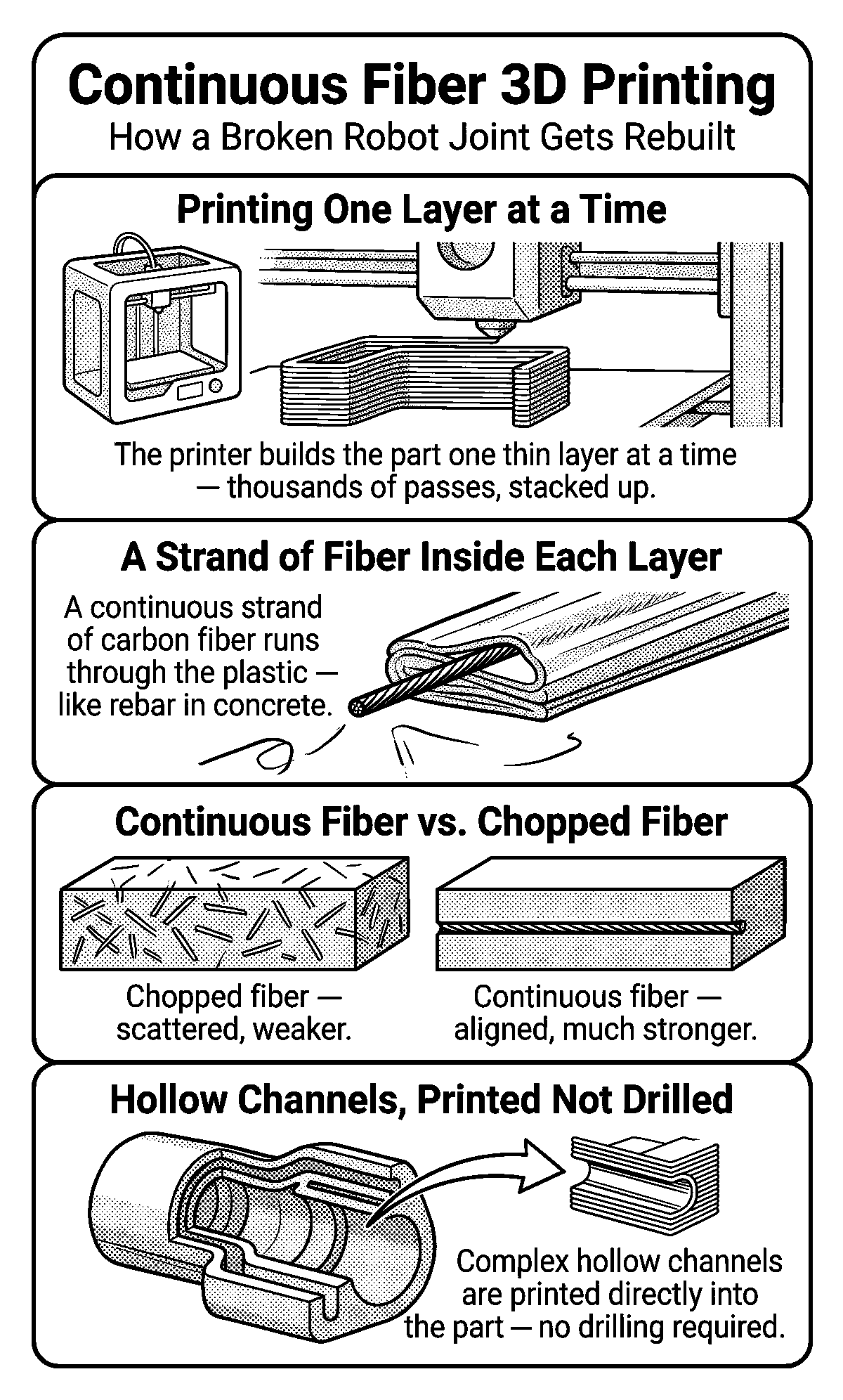
How a 3D-Printed Part Is Made: From digital model to sliced layers to a finished object, one thin pass at a time. That is the mechanism under every printed part in the shop.
Continuous Fiber 3D Printing: Continuous carbon fiber laid through a printed part like rebar in concrete, not scattered chopped fiber. The path of the fiber is what makes the piece strong.
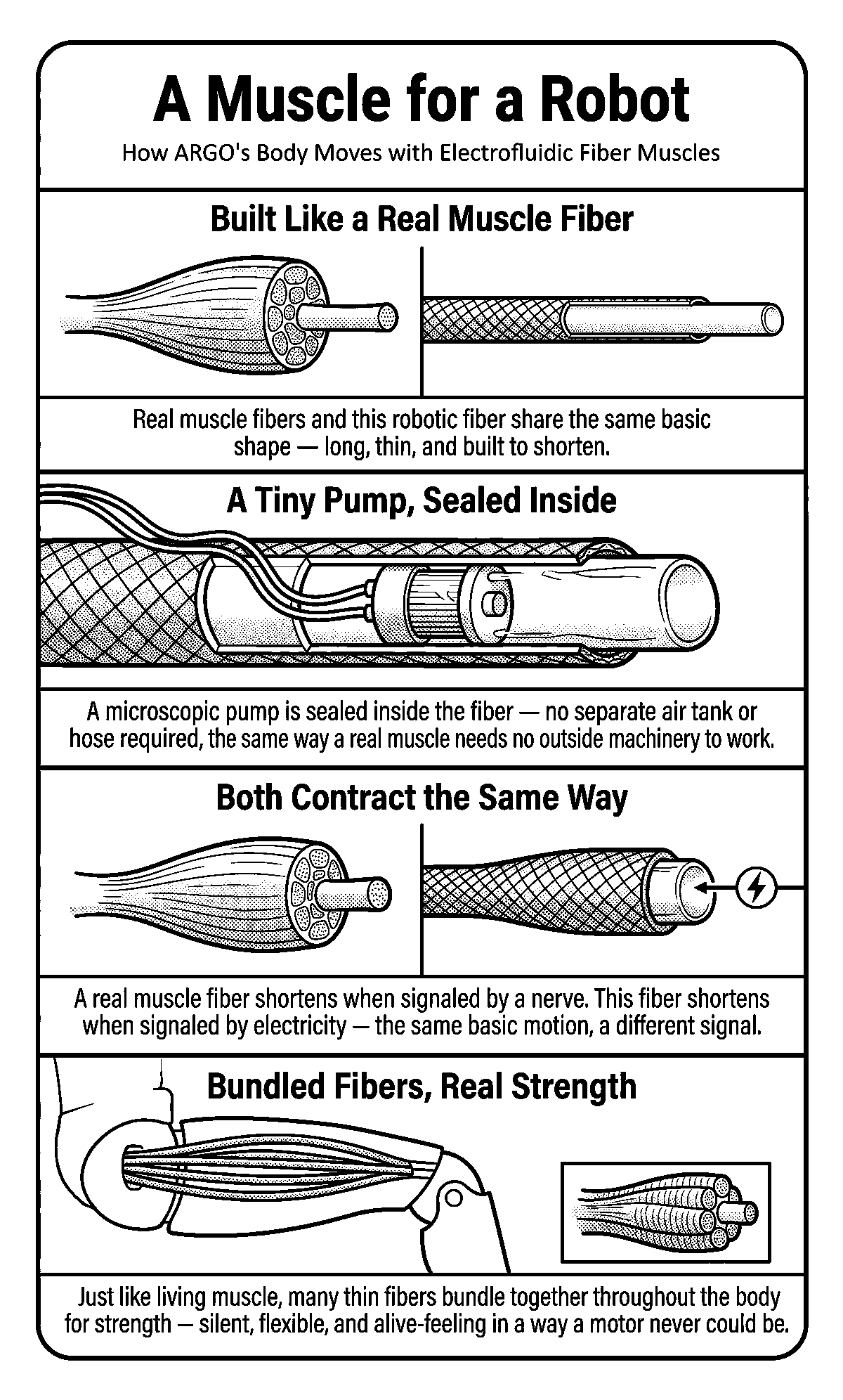
A Muscle for a Robot: A woven mesh sleeve, a microscopic pump, an electrical signal. The same basic trick a real muscle fiber uses to contract.
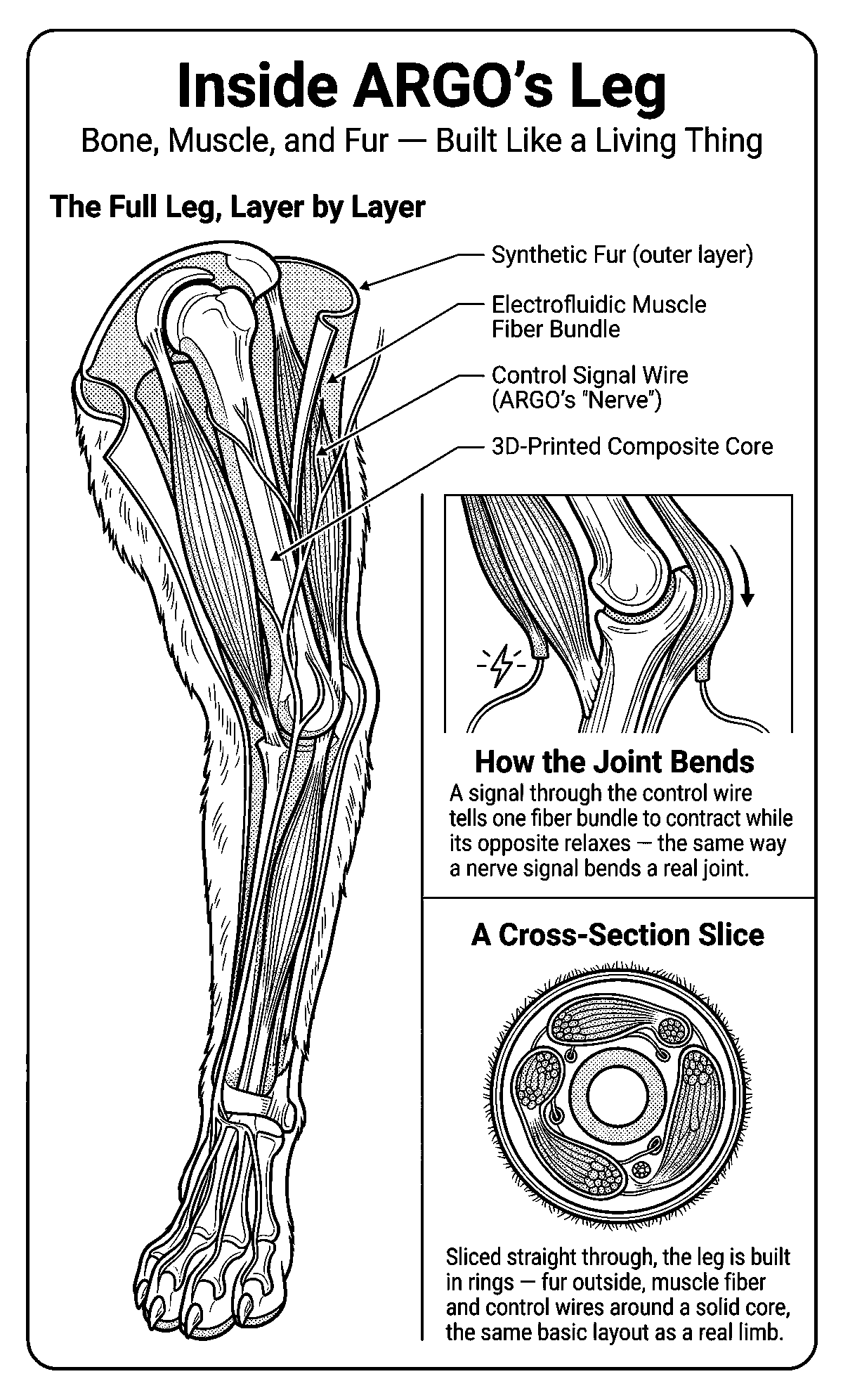
Inside ARGO's Leg: Bone, muscle, and fur, built in layers like a living limb: a 3D-printed composite core, muscle fiber bundles, control wires standing in for nerves, all wrapped beneath synthetic fur.
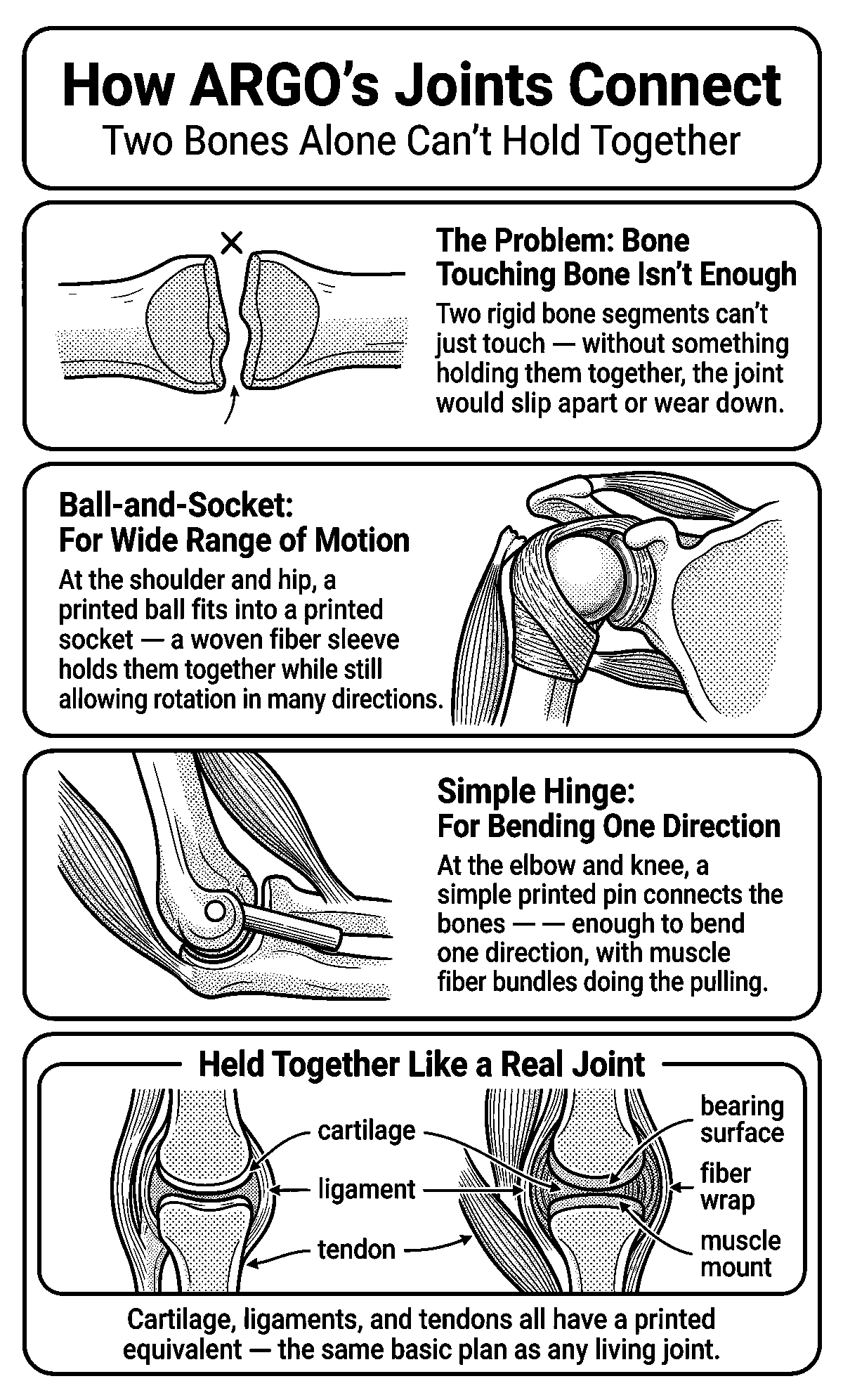
How ARGO's Joints Connect: Why two rigid bones can't just touch: ball-and-socket for the shoulders and hips, simple hinges for the elbows and knees, held together by woven fiber ligament wraps, the printed equivalent of cartilage, ligament, and tendon.